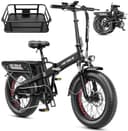
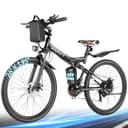
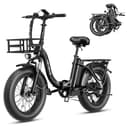
A folding e-bike solves one specific problem: you want to commute by electric bike, but you don’t have a garage, a ground-floor bike room, or a way to store a full-size frame. Fold it, carry it up the stairs, tuck it under a desk, or drop it in a trunk and finish the trip by train — that flexibility is the whole point, and to the right rider it’s worth real money.
The trade-offs are honest. Folders roll on smaller wheels, they’re heavy the moment you actually have to lift them, and a hinge is one more thing to keep tight. But if storage or a mixed bike-and-transit trip is the thing standing between you and leaving the car at home, a folder is often the only bike that fits your life.
All three picks are sold on Amazon with a live price we refresh daily. We haven’t ridden them — we don’t run a test lab — so we rank them on the specs the makers publish and on honest buyer fit: how it folds, how heavy it is to carry, listed range and power, and who each one suits. If you want the top pick examined on its own — specs, range, weight and the listing contradictions worth knowing — read our Heybike Mars 3.0 review. Prices move with sales, so check the live number, plan on a shop assembly, and buy a lock that matches the bike’s value on day one.
How to choose a folding e-bike
Start with the fold, because that’s the reason you’re here. Measure the space the bike has to live in — the closet, the trunk, the gap beside your desk — and check the folded dimensions against it before you look at anything else. A folder that doesn’t fit your space is just a heavy bike with an extra hinge.
Then take the weight seriously. A fat-tire folder is a genuine lift, and if you’re carrying it up two flights every day, a few pounds matter more than a few miles of range. If you’ll mostly roll it — onto a train, into a lobby — weight matters less, and you can chase range and power instead.
Match power to your terrain. Flat commutes are happy on a modest motor; if your route has real climbs, read our watts and torque guide and lean toward the stronger pick. Match range to your round trip and plan with margin, remembering that a listed range is a best case you should roughly halve. And confirm the bike’s class for where you plan to ride; the e-bike classes explainer covers the throttle and speed rules that decide trail access.
If this has narrowed to the two Heybikes, the choice between them is genuinely route-dependent rather than a matter of which is better: one is sold on listed range, the other on peak motor output. We lay the published figures side by side, empty cells included, on Heybike Mars 3.0 vs Ranger 2.0.