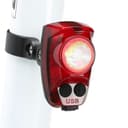
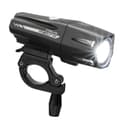
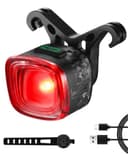
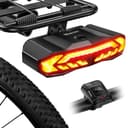
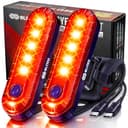
How we picked
Four criteria, in the order that decides whether a light does this job at all.
1. Does the listing publish a triple-digit lumen figure? This did most of the sorting and it eliminated most of the cheap lights on this site. A 15-lumen blinker is a perfectly good night light and a waste of a battery at midday. Every pick here publishes its own output, and where a listing publishes nothing we left the product off rather than guess. Note what we are not claiming: lumens are a measure of total light emitted, not of how visible a light is from 300 feet in a specific direction, and no maker in this category publishes the candela figure that would answer that properly. Treat the numbers as a floor to clear, not a score.
2. Is there a genuine daytime flash mode?Several lights offer a “day flash” that is simply the night flash at full power, and that is fine. What matters is the pattern: a short, hard pulse with uneven gaps reads as an alert, while a slow even fade reads as a reflection. If your light has a mode you find slightly annoying to stand behind, that is usually the right mode for daylight. Our flashing vs steady breakdown covers when a flash is the wrong choice — which is mostly on unlit paths, where you need to be located rather than noticed.
3. Runtime in the mode you will actually use. The catch of daytime running is that you are now using the brightest setting on every ride instead of saving it for emergencies, so the runtime that matters is the one in the high flash mode, not the 100-hour figure on the box for the dimmest eco setting. Plan on charging roughly weekly instead of monthly, which is the real argument for the USB-rechargeable lights over anything taking coin cells.
4. Does it also do the night job? A light that only works in daylight is a second thing to remember and a second thing to charge. We have weighted dual-purpose picks up deliberately: four of the five here are lights we already recommend after dark, which means buying for daytime costs you nothing extra in kit.
Front, rear, or both?
If you can only run one daytime light, run the rear one. That is the opposite of the advice for night riding and the reasoning is geometric. After dark your front light is doing two jobs — letting you see the road and being seen by oncoming traffic — so it is irreplaceable. In daylight you can see the road perfectly well, and the dangerous driver is the one behind you: the overtake that comes too close, the right hook at a junction, the car pulling out of a side road into the space you are about to occupy. A bright rear light buys you earlier recognition from exactly that driver.
A front daytime light earns its place in a specific situation worth knowing: the driver waiting to turn across your path at a junction, who is scanning for car-shaped gaps and genuinely does not register a bicycle. A triple-digit front flash changes you from a shape into a signal. If your commute has a lot of unprotected left turns across traffic, buy both and aim the front one slightly down and out so it hits the windscreen of a waiting car rather than the sky. The aiming method is in how to mount and aim your lights.
What a daytime light does not fix
Two honest limits, because the category oversells itself. First, a light cannot solve a sight-line problem. If you are in a driver’s blind spot alongside a van, or behind a hedge at a junction, no lumen count reaches them. Position on the road does more for your safety than any accessory, which is the subject of our riding in traffic guide.
Second, daytime running lights are not what the law asks for. Lighting statutes are written about darkness: California, for example, requires a white front lamp and a rear red device during darkness, with the rear device required at all hours only for an electric bicycle. Running lights in daylight is a voluntary safety choice on top of that, so do not treat a daytime light as compliance — check what your state actually demands after dark in our bike light law summary.
And one practical note that catches people out: a light bright enough to matter at noon is bright enough to dazzle at night if you leave it on the same setting. Set the mode down after sunset, especially on shared paths. We cover where that line sits in can bike lights be too bright.
What to buy alongside them
The cheapest visibility upgrade left after this is not another light. It is putting something reflective on a movingpart of the bike or body — ankles, pedals, wheel sidewalls — because motion is what a human eye picks out of a cluttered scene, and a reflective strip works when your battery has died. Our reflectors vs lights page covers which of those is legally required where. If you are starting from nothing, the lock and light set page gets both essentials in one go.