How we picked
1. Does it signal, or does it just claim to?“Smart” is a marketing word in this category. We only called something a turn signal if the listing publishes separate left and right indicators under rider control, and only called something a brake light if the listing publishes brake detection. One of the four here does both, one does braking only, and two do neither — and we say so in the table rather than blurring it.
2. Will it fit your actual bike? This is where most signaling lights fall over. A wide turn-signal bar needs a mounting surface wide enough to hold it, which in practice means a rear cargo rack. If you do not have a rack and do not want one, the signaling options collapse to brake-sensing lights, and you should know that before you order. Our rear racks page covers adding one.
3. Brightness, which is still the main event. Being seen is the job; signaling is the upgrade on top of the job. A clever light that is dim in daylight is worse at the primary task than a plain light that is bright, so a 200-lumen plain tail light stays in this comparison as the honest alternative.
4. One more thing to charge, counted honestly. A signaling light plus a remote is two batteries. We have weighted published runtime accordingly, and the 82-hour figure on the URBO TL is the single most practical spec on this page.
What each light actually does
| Light | Turn signals | Brake light | Mount | Published output / runtime |
|---|
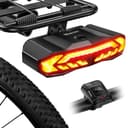
| WSDCAM Smart Tail Light | Yes — wireless remote | Yes | Rear cargo rack | Neither published |
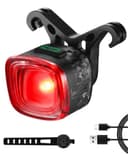
| Magicshine URBO TL | No | Yes — brake sensing | Quick release (seatpost) | Up to 82 h runtime; output not published |
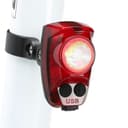
| Cygolite Hotshot Pro 200 | No | No | Hard mount (seatpost) | 200 lumens, 6 modes |
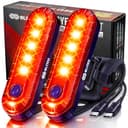
| Blitzu Cyborg 120T (2-pack) | No | No | Clip mount | 4 modes; output not published |
The empty cells are the finding. WSDCAM sells its light on the features and publishes neither a lumen figure nor a runtime, which is a genuine reason to be cautious about treating it as your onlyrear light — you cannot tell from the listing how visible it is in daylight. Magicshine publishes a runtime but no output. Only Cygolite publishes the number that answers “will a driver see this at noon?”, which is why our honest setup for a busy road is a 200-lumen plain light doing the seeing-you work with a signaling light added next to it, not instead of it.
Do drivers actually understand bike turn signals?
Partly, and the honest answer matters more than the sales pitch. Amber flashing on the left or right of a vehicle is one of the most universally learned signals on the road, so the meaning lands instantly. What does not land automatically is the expectation: a driver scanning a bike is not looking for indicators, because almost no bikes have them. So the signal gets read when it is noticed, and it is noticed less often than it would be on a car.
Two practical consequences. First, keep signaling with your arm — a hand signal is bigger, higher, more unexpected and therefore more attention-getting than a 2-inch amber LED, and in most states it is also what the law asks for. Second, the brake light is the feature with the better odds, because a brightening red light behind a slowing vehicle is exactly what a driver is already primed to interpret. If you buy one feature on this page, buy brake sensing.
Who signaling lights are genuinely for
- E-bike and cargo riders.You are heavier, faster, and your hands are busier; you also almost certainly have a rack already. This is the group the WSDCAM is built for — see our e-bike lights picks.
- Anyone riding loaded. With panniers full of groceries you do not want to take a hand off the bar at a junction. A remote on the bar is worth real money there.
- Riders on fast multi-lane roads. A brake light buys the car behind you reaction distance it would otherwise have to guess at.
- Riders with limited shoulder mobility or anyone for whom a held-out arm is uncomfortable or unsafe at speed. This is the clearest case of all, and it rarely gets mentioned.
Who they are not for: a short, slow, quiet-street commute where a plain bright rear light and good road position already do the job. Spend the money on a better plain tail light instead.
Fit checks before you order
The rack.The WSDCAM mounts to a rear cargo rack. If your bike has no rack, this is not a “probably fine” — there is nowhere for it to go. Check that your rack has a flat rear plate or crossbar wide enough for the unit, and remember that a trunk bag or pannier can sit in front of the light and block it. Our rack and pannier compatibility guide covers what fits what.
Seatpost shape. Brake-sensing lights like the URBO TL mount to a round seatpost. Aero or heavily shaped posts, and rear suspension layouts, can leave nothing to clamp to; a seatpost-mounted light is also blocked by a saddlebag.
The remote’s battery. A wireless remote is a second thing to keep alive. Treat a dead remote as a planned-for event, not a surprise, and keep the arm signal as the fallback it always was.
Legal basics.A signaling light is an addition, not a substitute: in most states you still need a white front light and a red rear reflector or light after dark, and a hand signal before a turn. Check your own state — our bike light laws page has the framework and California’s rules as a worked example.
What we would skip
Helmet-mounted turn signals. The idea is good and the execution puts the signal where a driver is not looking, on a surface that moves independently of the bike.
Anything that replaces your rear light with a signal-only unit. If a product does not publish an output figure, do not let it be your only rear light.
Laser lane projectors. They look dramatic and they are a projected line on the ground that drivers routinely do not see. A brighter light is a better spend.