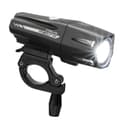
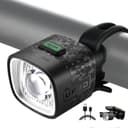
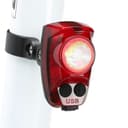
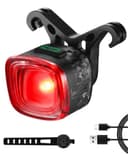
The four lights, side by side
| Light | End | Output (published) | Water rating | The one thing it sells |
|---|
| Cygolite Metro 1100 Pro | Front | 1100 lumens | IP67 | Seeing the road, wet or dry |
| Magicshine URBO FL | Front | Not published on this listing | IPX6 | 48 g and a cut-off beam |
| Cygolite Hotshot Pro 200 | Rear | 200 lumens, 6 modes | IP64 | Daylight visibility |
| Magicshine URBO TL | Rear | Not published; up to 82 h runtime | IPX6 | Brake sensing + auto on/off, ~1 oz |
Read the two “not published” cells as the finding they are, not as a gap in our research. Magicshine sells the URBO pair on weight, beam shape and automation, and its listings for these two lights publish no lumen figure at all. That is a legitimate way to sell a light — a cut-off beam with 200 well-aimed lumens lights a street better than 800 lumens sprayed at the sky — but it does mean you cannot compare the two brands on a single number, and anyone who tells you the URBO FL is “X lumens” is reading that off a different product or guessing. Our lumens versus lux page explains why the figure Magicshine is implicitly arguing about is lux, not lumens.
Where Cygolite actually wins: the water rating
The IP column is the most underrated line in that table. IP67 means the housing was tested against dust at the top level and against immersion in about a meter of water. IPX6 means it was tested against powerful water jets but not against immersion, and the Xmeans no dust test was carried out at all. For a commuter that distinction is not academic. A light clamped to a bar in February meets standing-water spray from a passing truck, a bike-rack puddle and an all-day-rain ride home — and the single most common way a commuter light dies is water in the charge port, not a dead LED.
IPX6 is genuinely fine for rain. IP67 is fine for rain plus the things that happen around rain. If you park outdoors year-round, that is worth more than any lumen difference, and it is why Cygolite is our default front-light brand on a site about commuting in the rain. Our waterproof lights roundup goes through the ratings properly.
Where Magicshine actually wins: the things a spec sheet hides
Weight, and what it does to the mount.48 grams is roughly a fifth of what a big see-the-road headlight weighs. A light that light can hang off a quick-release strap instead of a bolted bracket, which means it comes with you into the office in two seconds — and a light that comes with you is a light that does not get stolen off the bars.
A beam with manners.The URBO FL’s cut-off pattern throws light down at the road and clips the top off the beam, the way a car’s dipped headlight does. On a shared path or a two-way bike lane that is the difference between lighting your way and blinding the person coming at you, which is a real safety issue rather than just etiquette — we argue it out in can bike lights be too bright.
Automation, which fixes the actual failure mode.The reason commuters get caught unlit is almost never that their light was not bright enough. It is that the light was flat, or in a bag, or never switched on for a ride that started in daylight and ended at dusk. The URBO TL’s auto on/off and 82-hour published runtime attack exactly that, and brake sensing adds a signal drivers behind you understand instantly. If you have ever arrived home in the dark with an unlit rear, the smart light is the upgrade — not the brighter one.
Which one for which commute
- Lit city streets, short ride, bike parks indoors: Magicshine at both ends. You want light weight, no dazzle and nothing to remember.
- Any unlit section — trail, park, back road: Cygolite Metro 1100 Pro up front, no argument. See best lights for night riding.
- Heavy traffic, daytime riding:Cygolite Hotshot Pro 200 on the back. 200 lumens is the figure that reads as a light in daylight rather than a reflector — see daytime running lights.
- An e-bike, or a bike parked outside all winter: Cygolite, for the IP67 body and the hard mount that survives e-bike speeds on bad pavement. Our e-bike lights page has the full case.
- You keep forgetting to charge things: Magicshine URBO TL, for the auto on/off and the runtime. A charged dim light beats a flat bright one every single time.
What this comparison does not tell you
Three honest limits. First, we have not measured a beam. Cut-off optics are exactly the kind of claim that wants a light meter and a dark road, and we have neither; what we can tell you is what each maker publishes and what those figures imply. Second, lumens are not comparable across brandsin any case — there is no enforced measurement standard for bike lights the way there is for car headlamps, so an 1100-lumen claim from one maker and a 1200-lumen claim from another are not the same test. Third, neither brand publishes a runtime at full outputthat you should plan a commute around; Cygolite’s own listing notes that the brightest flash drains the battery quickly, which is true of every light in this class.
If you want the third brand in this conversation, the NiteRider head-to-head is on NiteRider Lumina vs Cygolite Metro. And if budget is the constraint rather than the brand, start with best budget bike lights and sets instead — a compliant cheap set you own beats a premium light you are still thinking about.