What you actually get
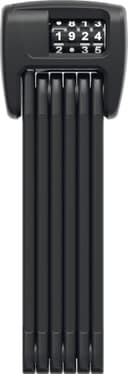
ABUS’s listing for the Bordo 6000C/90 describes 5 mm thick rods and a housing of specially hardened steel, with the rods connected by “special rivets.” Unfolded it reaches 90 cm, or about 35 inches; folded it collapses into a compact block that lives in the included frame bracket — ABUS’s Bordo brackets mount to the bottle-cage bolts, or strap on where a frame has none. ABUS lists the weight at 1,050 grams, a shade over 2.3 pounds, and the bars and body wear a soft coating so the lock can rattle against your paint without chewing it.
The “C” is the combination mechanism: a four-digit code you set yourself, so there is no key to lose and nothing to copy. On the current listing the dial is backlit — ABUS says the digits can be illuminated at the touch of a button so you can set the code in the dark, which is a small feature that turns out to matter at the end of a winter commute. ABUS also says the digits are not printed on, so they don’t fade with use. If you would rather have a key, the keyed 6000K is the same body with ABUS’s XPlus cylinder; the security of the bars is identical, and the choice is purely about how you like to open a lock.
How secure it is, honestly
Two ratings apply here, and they say the same thing in different words. On ABUS’s own scale the Bordo 6000 is a Level 10 of 15 — solidly mid-range, well above the cable-and-lightweight tiers, below the Granit U-locks and the Bordo Granit 6500 at the top of the range. Independently, Sold Secure lists the keyed Bordo 6000K/90 at Pedal Cycle Bronze. The combination 6000C isn’t listed separately, but it shares the same bars, rivets and housing, so treat Bronze as the family’s rating. Bronze is the grade for opportunist theft and basic hand tools; it is not the grade you want for a valuable bike left on a city street for hours. Our security ratings explainer walks through what each tier is tested against.
The engineering reason is the one every folding lock shares. A U-lock is one piece of hardened steel; a folding lock is a run of short bars held together by rivets, and every rivet is a joint that a thief can attack instead of the steel. Five-millimeter bars are also thinner than the 12 to 18 mm shackles on the U-locks we rank, which puts them within reach of long-handled bolt cutters if a thief gets the lock into a position where they can use them. None of that makes the Bordo a bad lock — it makes it a Bronze lock, which is a real step up from every cable and every unrated budget lock, and a real step down from a New York-class U-lock. Our page on how thieves break locks covers the attacks in detail; the short version is that reach and technique can close some of the gap, because a lock that lets you pull the frame tight to a rack denies the thief the leverage and the working space they need.
Where it earns its money: reach and carry
The Bordo’s case is not that it out-muscles a U-lock. It is that 90 cm of flexible reach gets around lampposts, thick sign poles and the awkward end of a rack that a mini U-lock simply won’t fit, and does it at a listed 2.3 pounds — roughly half the weight of the 18 mm New York Fahgettaboudit Mini. If you have ever circled a block looking for something skinny enough to lock to, you already understand the appeal. Locked properly — frame and rear wheel to something immovable, with the slack taken up — it also lets you keep the lock tight and off the ground, which is half of good locking practice on its own. Our guide to how to lock your bike covers the rest.
The other half of the case is the bracket. A folded Bordo is a flat block that rides on the down tube, out of the way and out of your bag. Locks fail most often by staying home, and a lock that is always on the bike is a lock that always gets used. That is why it leads the frame-mounted section of our how to carry a bike lock guide, and it is the single strongest argument for the Bordo over a U-lock of similar security that you would have to strap to a rack or carry in a pannier.
The honest cons
First, the price. ABUS charges a premium for the name and the build, and you can buy a hardened U-lock with a thicker shackle and a higher independent rating for the same money or less. If security per dollar is your only metric, the Bordo loses that comparison and the best U-locks page is where to go. Second, the rating: Bronze is enough for a commuter bike in a moderate-risk area and not enough for the situations our best e-bike locks page is written for. Third, the combination itself. A dial is convenient, but it is also the part of the lock most exposed to fiddling, and it is slower to open with cold fingers than turning a key. None of these is a reason not to buy it; all of them are reasons to buy it for the right job.
Who should buy it, and who should buy something else
Buy the Bordo 6000C if you commute on a bike of ordinary value, park it in daylight at work, a shop or a station in a low-to-moderate-risk area, and you want a lock you will genuinely carry every day. It suits riders whose racks and posts are unpredictable, riders who hate carrying a U-lock in a bag, and anyone who wants to stop managing keys. It is also a sensible second lock: paired with a U-lock on the frame, its reach makes it the ideal tool for capturing the front wheel, a strategy our two-lock guide explains.
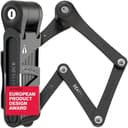
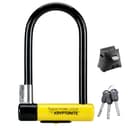
Buy something else if the bike is an e-bike or costs well into four figures, if it lives outside overnight, or if your city has a known lock-cutting problem. For those readers the right answer is a Gold-rated or better U-lock or chain, and the reach problem is better solved with a second lock than by downgrading the first. If you like the folding format but want to spend less, the FoldyLock Compact below gives up some link hardening for a lower price and lighter weight. If you want more security than any folding lock offers, the Kryptonite New York Standard is the U-lock we would pair with a commuter bike in a busier city. And if you are still weighing the format itself, folding lock vs U-lock lays out the trade in full.