Where to Put an AirTag on a Bike
A tag only helps if it is still on the bike an hour after the theft. That makes concealment, removal resistance and Bluetooth signal three competing requirements — and most popular hiding spots fail at least one.
How this is funded:we earn a commission if you buy through our links, at no extra cost to you. It never changes which product we recommend, and we’ll tell you when we’d skip one. Full disclosure.
Short answer: under the saddle in a small seat pack, or under the bottle cage in a bolt-down holder. Those are the two positions that balance the three things a hiding spot has to do at once, and the bolt-down cage mount in the table below is our pick for the version that resists removal. What you should not do is leave a bare tag taped to the frame or rattling in a water bottle — both are gone within a minute of the bike being taken.
The reason this question is harder than it looks is that a good spot has to satisfy three requirements that pull against each other:
- Concealment. A tag a thief notices is a tag a thief removes. A plain white disc on a frame is recognisable at a glance now.
- Removal resistance.Concealment buys you nothing if the hiding place is a strap or a clip. The question is not “can they see it” but “how long does it take them to get it off once they do”.
- Bluetooth signal.This is the one people get wrong. Find My has no GPS in the tag — it relies on nearby Apple devices hearing a short-range Bluetooth broadcast and reporting it. Metal around the tag weakens that broadcast, so the perfect hiding place inside a steel frame tube can be the one place the tag is useless.
Hide it from eyes, not from radio. That one sentence rules out half the clever ideas on the internet.
The parts you actually need
A bare tag has nowhere to live on a bicycle — it ships with no mount at all. So this is a two-part purchase: the tag, and something that holds it somewhere useful and makes it slow to remove. The cheap part, the holder, is the part that decides whether the expensive part does anything. Below are the pieces, with today’s live prices, followed by the spot-by-spot breakdown.
Quick picks
Ranked on published specs, real security and safety standards, and buyer fit.We have not tested these products — here is exactly what we do instead.
| # | Product | Best for | Price |
|---|---|---|---|
| 1 | 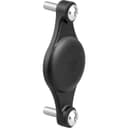 Topeak Cage Mount for AirTag The cheap part that decides whether an AirTag is any use on a bike: it holds the tag at the bottle cage and bolts it down with anti-theft hardware, so the tag can't simply be unclipped and thrown away. | Best bolt-down mount | $14.95 · View on Amazon Price as of October 21, 2026. #ad How we’re funded |
| 2 |  Apple AirTag (2nd Generation) The default bike tracker for anyone on an iPhone, because the thing that finds it isn't the tag — it's the enormous Find My network of other people's Apple devices quietly reporting its location as it passes them. | The tag itself | |
| 3 | 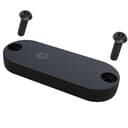 Orbit Velo Bike Tracker An AirTag-class Find My tracker that already is the mount — it secures to the bottle-cage holder and is listed at a three-year battery, so there's no tag-plus-holder shopping trip and nothing to recharge each season. | Best mount-and-tag in one | $35.49 · View on Amazon Price as of October 21, 2026. #ad How we’re funded |
| 4 | 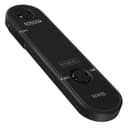 Knog Scout Bike Alarm & Finder The one device here that does both jobs — an 85 dB motion alarm that makes a thief stop and look around, plus Apple Find My so the same unit helps you get the bike back if they carry on anyway. | Best alarm + finder | $64.95 · View on Amazon Price as of October 21, 2026. #ad How we’re funded |
The spots that actually work
Inside a small seat pack, or strapped to the saddle rails. Our default recommendation on a commuter bike. It is invisible from standing height, there is no metal enclosing the tag, and a seat pack is a normal thing to see on a bike so it draws no attention. The weakness is that the whole pack can be unstrapped, so use a pack that is a nuisance to remove rather than a quick-release one, and consider taping the tag to the inside of the pack rather than letting it rattle loose.
Under a bottle cage, in a bolt-down holder.The strongest option on removal resistance: a purpose-made holder sits under the cage and bolts through the frame’s bottle bosses with anti-theft hardware, so getting it off needs a specific tool rather than a tug. The trade is that a bottle cage is one of the first places an experienced thief checks. Those two facts cancel out into a good choice: findable in principle, slow to remove in practice.
Under the rack deck, if you run a rear rack.Taped or zip-tied to the underside of the platform, facing down. Almost nobody looks there, the plastic or alloy deck does not block much signal, and a loaded pannier hides it further. Check it after a wet week — this is the spot where tape gives up.
Inside a handlebar end or a frame-bag pocket.Bar-end plugs that hold a tag exist and work, with the caveat that an aluminum bar is metal around the transmitter. A frame bag works well right up until the bag goes with the bike, which is fine — the tag goes too.
A tag that is its own mount. If you would rather not assemble a tag plus a holder, the Find My tracker in the table above is built as one unit, secures to the bottle-cage mount and is listed at a three-year battery. It is a simpler purchase and the position is the same compromise as any cage mount.
And the spots that do not
- Loose inside a water bottle. Thrown away with the bottle in the first minute.
- Taped visibly to the frame or the seatpost. A white disc on a bike is recognisable from several feet away now.
- In a saddle bag with a quick-release clip. One motion and the tag is in a bin. Choose the version that needs patience.
- Deep inside a steel seat tube or a sealed metal steerer. Beautifully hidden, and often unable to reach a passing phone. Hide it from eyes, not from radio.
- Under a reflector housing on a stock bike. Known spot, and the housing pops off.
- Anywhere you cannot reach to change the battery. A tag with a dead battery is a sticker.
What a tag can and cannot do
This is worth being blunt about, because the category is widely oversold. An AirTag-class tag has no GPS and no cellular radio of its own. It broadcasts over Bluetooth, and other people’s Apple devices — passers-by, parked cars, apartments — report that broadcast back to Apple’s Find My network. What you see is where the bike was when it last passed someone. In a dense city center that can be minutes old and good enough to act on. In a quiet suburb, an industrial estate or a van with the doors shut, it can be hours old or nothing at all.
A cellular tracker is a genuinely different product: it reports its own position over a mobile network and can fire a motion or tilt alert the moment the bike is disturbed, rather than waiting for a stranger’s phone to wander past. It costs more, it needs charging, and it usually needs a data plan. Whether that trade is worth it depends almost entirely on how much the bike is worth and how quiet your area is, and we compare the two approaches head-to-head in AirTag vs GPS tracker for a bike.
One more limit to plan around: Apple’s unwanted-tracking alerts exist to stop tags being used to follow people, and they can warn an iPhone-carrying thief that an unknown tag is traveling with them. That is the privacy feature doing its job, it is not a bug, and it is a real reason not to treat a tag as a secret weapon.
Pair it with the things that actually prevent theft
A tracker is the last layer, not the first. In order of how much they change the outcome:
- A lock that matches the bike’s value, used properly. Frame and rear wheel to something fixed — how to lock your bike and best U-locks.
- Not parking there. Indoors beats every lock and every tracker.
- The serial number recorded and the bike registered.This is what makes a recovered bike provably yours — how to prevent bike theft.
- An alarm, if you want something that intervenes.A motion-triggered siren makes a thief stop and look around, which is a different job from finding the bike afterwards. The combined alarm-and-finder unit above does both — and the wider category is in best bike anti-theft devices.
- The tracker. Cheap, passive, and the only one of these that helps after the bike is gone.
If the bike is an e-bike, add one more step: take the battery inside. It is the densest value on the bike and the easiest high-value part to remove — how to secure an e-bike battery covers what to do when it has to stay on.
General guidance, not professional advice. Chain & Charge is written by an enthusiast, not a bike mechanic, and we do not run a test lab. Laws, security ratings and specs change — verify your state’s current e-bike rules and a lock’s current security rating before you rely on them, and set any new gear up per the maker’s instructions.
Frequently asked questions
Where is the best place to hide an AirTag on a bike?
Under the saddle or under a bottle cage are the two best positions on a typical commuter bike, and which is better depends on your frame. Under the saddle means inside a small seat pack or strapped to the saddle rails behind the seatpost — concealed from every angle, nothing to see from standing height, and no metal around it to block the signal. Under a bottle cage means a purpose-made holder bolted on with anti-theft hardware, which is more durable but better known to thieves. In both cases the real requirement is the same: not visible from a glance, and not removable in five seconds.
Can thieves find an AirTag on a bike?
An experienced one often can, and you should plan for that rather than assume secrecy. There are three giveaways. The tag has a speaker and will chirp when you trigger it, so a thief who suspects a tag can hunt for the sound. Apple's unwanted-tracking alerts can notify an iPhone that an unknown tag is traveling with it, which is a privacy feature working exactly as designed and an unavoidable downside here. And the obvious spots — a bare bottle cage, a saddle bag left on the bike, a reflector housing — are well known. Concealment plus hardware that resists removal is the realistic goal.
Will an AirTag work inside a metal bike frame?
It may, but do not count on it. Find My works over Bluetooth, and Bluetooth is weakened by metal around the transmitter — so a tag pushed down a steel seat tube or sealed inside an aluminum steerer can have its range cut badly, and a tag that cannot be heard by a passing phone reports nothing at all. The practical rule is to hide it from eyes, not from radio: inside fabric, under a saddle, behind a cage, inside a plastic housing. A tag in a nylon seat pack is far more useful than a perfectly concealed tag in a metal tube.
Should I disable the AirTag speaker?
We would not, and on newer hardware it is not something you can simply switch off in software. The speaker is what lets you find the bike in a crowded yard or a hallway once you are close, and physically disabling it is how a tag crosses from anti-theft into something that can be used to track a person without their knowledge. If you are worried about a thief hearing it, the better answer is a tag that is hard to reach and hard to unbolt, or a cellular tracker that works on a completely different principle.
Is an AirTag enough to protect a bike?
No — it is a recovery tool, not a deterrent, and it does nothing to stop the theft. A tag tells you roughly where the bike was when it last passed someone else's Apple device, which on a dense city street can be minutes ago and in a quiet area can be hours. The layered answer is a lock that matches what the bike is worth, locked properly to something fixed, with a tag as the thing that gives you a chance afterwards. If you want a device that intervenes rather than reports, an alarm is the category to look at.
What should I do if the AirTag shows my stolen bike's location?
Report it to the police and give them the location, the serial number and your proof of ownership — do not go and collect the bike yourself. Find My locations are approximate and can be a building or two out, the person holding the bike may not be the person who took it, and confronting a stranger over property is how a property crime becomes something much worse. Keep a screenshot of each location update with its timestamp, because a trail of pings is more useful to an officer than one pin, and let them handle the recovery.
Sources
- Apple — Find My — Apple's description of the crowd-sourced Find My network: nearby devices — "over a billion iPhone, iPad, and Mac devices around the world" — securely relay a missing item's location to iCloud, "anonymous and encrypted to protect everyone's privacy" (accessed August 25, 2026)
- Knog — Scout Bike Alarm & Finder — Knog's published specs for the Scout: 85 dB motion-sensitive alarm, 2-to-6-month USB-C rechargeable battery, IP66 wash-proof rating, mounting to standard water-cage braze-ons with supplied anti-tamper screws, and Apple Find My support (iOS only) (accessed August 25, 2026)