How Long Do E-Bike Batteries Last?
The best published figure in the industry is 80 percent of capacity after 1,000 charge cycles. Read the footnote and you learn what it really measures — and why the answer for your commute is probably years, not miles.
How this is funded:we earn a commission if you buy through our links, at no extra cost to you. It never changes which product we recommend, and we’ll tell you when we’d skip one. Full disclosure.
Five to ten years for most commuters, and the useful number is cycles rather than miles.The best-documented figure in the industry is Bosch’s: its smart system batteries still hold 80% of original capacity after 1,000 charging cycles, which Bosch says corresponds to roughly 28,000 miles — and, at an average 53 miles a week, to more than ten years of use. That is a drive-system maker publishing about its own premium packs, not an independent test, and the footnote matters: those are laboratory measurements at 80% discharge and 77 °F, and they cover cyclicalaging only — not the aging that happens just from time passing.
Translate that to a commute and the picture gets reassuring. A 10-mile round trip on a bike with 40 miles of usable range is about a quarter of a cycle a day — roughly 60 cycles a year. At that rate, 1,000 cycles is more than a decade of commuting, and the battery is not the part that will decide when the bike is done.
So the risk is not really wear. It is heat, storage habits, and whether a replacement pack will still be purchasable in year six— which is the argument for buying a bike with a removable battery and a pack you can actually find again. The three picks below are the bikes in our registry that publish a removable pack, with one of them publishing the watt-hour figure as well. The cycle math, the five things that genuinely shorten a pack’s life, and the replacement question follow underneath.
Quick picks
Ranked on published specs, real security and safety standards, and buyer fit.We have not tested these products — here is exactly what we do instead.
| # | Product | Best for | Price |
|---|---|---|---|
| 1 | 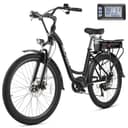 ANCHEER 48V City Electric Bike A 26in city e-bike on a 48V system with a listed 499Wh battery — a straightforward, non-folding commuter for riders who want a normal-looking bike rather than a fat-tire folder. Solid mid-budget value. | Best published battery spec | |
| 2 | 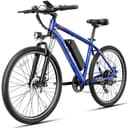 Jasion EB5 Electric Bike One of Amazon's best-selling entry e-bikes for a reason: a 26in commuter with a listed 1000W peak motor at a price that undercuts almost everything. The honest 'try an e-bike without a big spend' choice. | Best budget removable pack | |
| 3 | 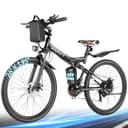 Vivi Folding Electric Bike The cheapest way into a folding e-bike, with a listed 749W peak motor and a removable battery. It's basic, but it folds, it charges off a wall outlet, and it replaces a lot of short car trips. | Lowest-cost removable pack |
What the Bosch figure actually says, footnote included
Bosch publishes the clearest service-life claim in the industry, and it is worth quoting precisely: with its smart system batteries, riders “still have 80% of the original battery capacity available after 1,000 charging cycles”, and 1,000 cycles “correspond to a mileage of approx. 28,000 miles (45,000 km)”. At an average 53 miles a week, Bosch says that means capacity is still at 80% after more than ten years.
Now the footnote, because without it the headline is misleading. Bosch states the figures are “based on laboratory measurements with 1,000 charging cycles at 80% discharge at 77 °F (25 °C) ambient temperature”, that depending on the battery “the maximum remaining capacity may also be lower”, and — the important one — that “the data refers only to cyclical and not to calendar aging”.
That last clause is the whole point of this page. A lithium pack ages two ways at once: by being used (cyclical) and by simply existing (calendar). The 1,000-cycle figure measures the first and explicitly excludes the second. For a commuter who rides 60 cycles a year, calendar aging is the one that will get to the battery first.
Why a commuter will almost never reach 1,000 cycles
A charge cycle is a full battery’s worth of energy, not one plug-in. Three top-ups from 70% to 100% add up to roughly one cycle, not three. So do the arithmetic for a real commute:
- 10-mile round trip, 40-mile usable range: about a quarter of a cycle a day, so roughly 1.25 cycles a week and about 60 a year.
- 20-mile round trip, same bike: about half a cycle a day, roughly 2.5 a week, about 125 a year.
- A long commute on a small battery— a full charge every day — is the only commuting pattern that gets near 250 cycles a year.
At 60 to 125 cycles a year, 1,000 cycles is eight to sixteen years of commuting. Nothing else on a budget e-bike lasts that long. Which means that for most commuters, the battery is not the part that decides the bike’s life— and the far more useful question is calendar aging, heat exposure and whether a replacement pack will still be purchasable in year six.
The five things that actually shorten a pack’s life
1. Heat. The single biggest factor, and the easiest to control. A pack baking in a hot garage, a car trunk in July or direct afternoon sun ages faster than one at room temperature, and the damage is permanent. Store it indoors.
2. Sitting at 100%, for weeks.A pack held at full charge ages faster than one at a middling state of charge. If the bike is going away for the winter, put it away part-charged — not full, not empty. Our storage guide covers the whole routine.
3. Running it flat, repeatedly. Deep discharges are harder on cells than shallow ones. This is also the practical argument for buying more range than you need: a bike with double your commute never goes below half, which is the gentlest way a pack can live.
4. Charging cold. Charging a very cold pack is the one genuinely risky habit in this list. Let it reach room temperature first.
5. The wrong charger. The CPSC is unambiguous: only use the charger provided with or recommended by the manufacturer, and only use a replacement pack tested and approved to work safely with your device. This is a fire-safety point as much as a longevity one, and we cover it properly in e-bike charging safety.
The replacement question, which is the real risk
Capacity fade is gradual and manageable. The thing that actually ends a budget e-bike is a pack you cannot buy. Direct-to-consumer brands change model lines fast, and a proprietary battery for a bike that is three generations old may simply not be on sale at any price — at which point a battery that has faded to 60% is the whole bike.
Two things to do about it, both before you buy. Search for a replacement pack for that exact model and see whether one is listed and in stock; if nothing comes up for a bike that has been out for two years, that is your answer. And prefer a removable pack, which is both easier to replace and easier to live with — three of our six registry e-bikes publish a removable battery, and the picks above are those three. The ANCHEER city e-bike is the one that publishes the actual energy figure, a 48V system with a listed 499 Wh battery, which is the spec you want for comparing bikes honestly.
For how to read a watt-hour figure and turn it into a realistic range, go to e-bike battery and range. For which bikes publish a removable pack, see best e-bikes with a removable battery.
What this means in practice
Buy more range than your commute needs, store the pack indoors and out of the heat, keep it off the charger once it is full, do not leave it sitting at 100% for months, let it warm up before charging in winter, and only ever use the charger that came with it. Do those six things and the battery is very unlikely to be the reason you replace the bike. Then before you buy, check that a replacement pack for your model exists — because that, not cycle count, is the figure that decides how long your particular e-bike lasts.
General guidance, not professional advice. Chain & Charge is written by an enthusiast, not a bike mechanic, and we do not run a test lab. Laws, security ratings and specs change — verify your state’s current e-bike rules and a lock’s current security rating before you rely on them, and set any new gear up per the maker’s instructions.
Frequently asked questions
How long do e-bike batteries last?
The best-documented figure in the industry comes from Bosch, which publishes that its smart system batteries still have 80% of original capacity after 1,000 charging cycles, and that 1,000 cycles correspond to roughly 28,000 miles. Bosch adds that at an average 53 miles a week, that means capacity is still at 80% after more than 10 years of use. The footnote matters: those are laboratory measurements at 80% discharge and 77 °F, and the figure covers cyclical aging only, not calendar aging. For a commuter, the practical read is five to ten years before a pack feels noticeably short.
When should I replace an e-bike battery?
When the range it delivers no longer covers the ride you need it for — not at a particular cycle count. A pack does not fail; it fades, and the number that matters is whether your round trip still fits inside a charge with a margin for cold weather and headwinds. Three signals say it is time: your usual commute now needs a mid-day charge, the range-remaining estimate collapses under load in a way it did not use to, or the pack stops taking a full charge. Replacement is the most expensive part of e-bike ownership, so it is worth knowing the cost before you buy the bike.
Does leaving an e-bike battery on the charger damage it?
It is bad practice for two separate reasons. On longevity, lithium packs age faster when they sit at a very high state of charge, so a battery left on the charger at 100% for days is aging faster than one left at a middling charge. On safety, the CPSC's guidance is explicit: follow the manufacturer's charging instructions and unplug when done, always be present while charging, and never charge while sleeping or away from home. Charge it when you are around, take it off when it is full, and do not store it at 100% for weeks.
How much does an e-bike battery cost to replace?
Enough that it should be part of the buying decision, and it varies far too much to quote a single figure honestly — it depends on the voltage, the capacity in watt-hours, whether the pack is a standard format or proprietary to the maker, and whether the maker still sells it. The structural risk is worse on budget direct-to-consumer bikes: a proprietary pack from a brand that has moved on can be unavailable at any price, which turns a battery fade into a dead bike. Before you buy, search for a replacement pack for that exact model and see whether one exists.
Do e-bike batteries lose capacity in winter?
Yes, temporarily and significantly, and it is not the same thing as aging. Lithium cells deliver less usable energy when cold, so a pack that returns 40 miles in August may return noticeably less on a freezing morning — and then return to normal when it warms up. That is reversible. What is not reversible is charging a pack while it is very cold, which some makers warn against outright. The practical habits are to bring a removable pack indoors, let it reach room temperature before charging, and plan winter range with a margin.
How many charge cycles is a year of commuting?
Fewer than most people assume, which is why the ten-year figures are plausible. A charge cycle is a full battery's worth of energy, not a plug-in event — topping up from 70% to 100% three times is roughly one cycle, not three. A 10-mile round trip on a bike with a 40-mile usable range uses about a quarter of a cycle a day, so a five-day commuting week is a bit over one cycle, or somewhere around 60 a year. At that rate 1,000 cycles is more commuting life than the rest of the bike is likely to have.
Sources
- Bosch eBike Systems — PowerTube / CompactTube batteries (US product page) — Bosch's published service-life claim: "With our smart system batteries, eBike riders still have 80% of the original battery capacity available after 1,000 charging cycles"; "1,000 charging cycles correspond to a mileage of approx. 28,000 miles (45,000 km)"; and "With an average distance traveled of approx. 53 miles (85 km) per week; this means the battery capacity is still at 80% even after more than 10 years of use." Footnote 3 states the limits: "Based on laboratory measurements with 1,000 charging cycles at 80% discharge at 77 °F (25 °C) ambient temperature. Affects all batteries in the smart system (exception: PowerMore 250). Depending on the battery, the maximum remaining capacity may also be lower. The data refers only to cyclical and not to calendar aging." (accessed October 17, 2026)
- U.S. CPSC — Micromobility Information Center — CPSC's consumer guidance for e-bikes and other micromobility products: "Follow the manufacturer's instructions for proper charging and unplug the device when done"; "Always be present when charging micromobility products. Never charge them while sleeping or when you are not at home"; "Only use the charger provided with or recommended by the manufacturer"; only use a replacement battery pack "tested and approved to work safely with your device" and confirmed by the device manufacturer; never use a device with a pack "modified or reworked by unqualified personnel or with repurposed or used cells"; "Never throw lithium batteries into the trash or general recycling. Instead, take them to your local battery recycler or hazardous waste collection center." CPSC notes it has "seen many lithium-ion battery home fires and deaths happen at night while batteries were charging and families were asleep" (accessed October 6, 2026)
- U.S. Energy Information Administration — Electric Power Monthly — Average U.S. residential electricity price in cents per kWh — the input for e-bike charging cost (accessed July 23, 2026)
Keep reading
E-Bike Battery and Range, Explained
Watt-hours, amp-hours, and why published range figures run optimistic.
Read the guideE-Bike Charging Safety
What the CPSC actually asks of you, and the charging habits that matter most.
Read the guideBest E-Bikes With a Removable Battery
The bikes whose packs come off to charge indoors — and why that is the spec to shop on.
See the picksHow to Store an E-Bike
Where the bike goes, where the battery goes, and the winter routine that protects both.
Read the guide