E-Bike Charging Safety
The one question everybody asks is whether you can charge overnight. The regulator's answer is no, in writing — and once you accept that, the rest of the routine is easy and takes nothing away from your commute.
How this is funded:we earn a commission if you buy through our links, at no extra cost to you. It never changes which product we recommend, and we’ll tell you when we’d skip one. Full disclosure.
No — do not leave an e-bike charging overnight, and the reason is not caution on our part. The U.S. Consumer Product Safety Commission puts it in plain words: “Always be present when charging micromobility products. Never charge them while sleeping or when you are not at home.” The same guidance notes that the agency has “seen many lithium-ion battery home fires and deaths happen at night while batteries were charging and families were asleep”. There is no sensible way to read around that.
The good news is that the rule costs a commuter almost nothing. You rarely need a full charge every day — a 10-mile round trip on a bike with 40 miles of usable range uses about a quarter of the battery — so the routine that satisfies the CPSC is simply: plug in when you get home, unplug before bed, charge twice a week rather than nightly, and take a removable pack off the bike so you can charge it where you actually are.
The three bikes below are the ones in our registry that publish a removable battery, which is the single feature that makes all of this easy: a pack that comes off charges on a kitchen counter or a garage floor in front of you, instead of in the hallway where the bike sleeps. The full CPSC guidance, what UL 2849 certification actually covers, and the warning signs that mean stop follow underneath.
Quick picks
Ranked on published specs, real security and safety standards, and buyer fit.We have not tested these products — here is exactly what we do instead.
| # | Product | Best for | Price |
|---|---|---|---|
| 1 | 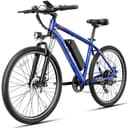 Jasion EB5 Electric Bike One of Amazon's best-selling entry e-bikes for a reason: a 26in commuter with a listed 1000W peak motor at a price that undercuts almost everything. The honest 'try an e-bike without a big spend' choice. | Best budget removable pack | |
| 2 | 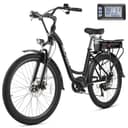 ANCHEER 48V City Electric Bike A 26in city e-bike on a 48V system with a listed 499Wh battery — a straightforward, non-folding commuter for riders who want a normal-looking bike rather than a fat-tire folder. Solid mid-budget value. | Best published battery spec | |
| 3 | 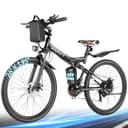 Vivi Folding Electric Bike The cheapest way into a folding e-bike, with a listed 749W peak motor and a removable battery. It's basic, but it folds, it charges off a wall outlet, and it replaces a lot of short car trips. | Lowest-cost removable pack |
What the CPSC actually asks of you
The U.S. Consumer Product Safety Commission publishes consumer guidance for e-bikes and other micromobility products, and it is short enough to list in full:
- “Follow the manufacturer’s instructions for proper charging and unplug the device when done.”
- “Always be present when charging micromobility products. Never charge them while sleeping or when you are not at home.”
- “Only use the charger provided with or recommended by the manufacturer.”
- Use a replacement pack only if it is tested and approved to work safely with your device and confirmed by the device manufacturer.
- Never use a device with a pack modified or reworked by unqualified personnel, or built with repurposed or used cells.
- “Never throw lithium batteries into the trash or general recycling”— take them to a battery recycler or hazardous waste collection center.
The agency adds the reason for the second one: it has “seen many lithium-ion battery home fires and deaths happen at night while batteries were charging and families were asleep”. That is the sentence that settles the overnight question, and it is why we do not treat “I charge overnight and it has been fine” as evidence of anything.
Why overnight charging is the specific problem
Not because the last hour of a charge is dangerous. Because of what is missing when you are asleep. A lithium pack failure gives warning — heat, a hissing or popping sound, a sharp chemical smell, smoke — and those warnings are only useful to someone awake and in the room. Charging while present turns a potential fire into a pack you unplugged and carried outside. Charging while asleep removes every one of those options, in the room you are asleep in.
The second reason is location. People charge overnight wherever the bike sleeps, which is often a hallway, a bedroom corner, or the one door out of an apartment — exactly the places a fire is most dangerous and most likely to block an exit. Charging when you are awake naturally puts the pack somewhere sensible, because you are standing next to it.
The routine that fits a commute
This is the part that makes the rule easy instead of annoying. A commuter almost never needs a full charge daily — a 10-mile round trip on a bike with 40 miles of usable range uses roughly a quarter of the battery. So:
Charge in the evening, while you are up. Plug in when you get home, unplug before bed. A partial charge is fine and is better for the pack anyway.
Charge twice a week, not every night.Range headroom is what makes this possible, which is one more reason to buy more range than your commute needs — see battery and range.
Take the pack off the bike. A removable battery is the single feature that makes safe charging practical: you charge it on a kitchen counter or a garage floor, where you are, instead of wherever the bike is parked. All three picks above publish a removable pack, and best e-bikes with a removable battery has the full list.
Let a cold pack warm up first. In winter, bring it in and give it an hour before plugging it in. Our storage guide covers the rest of the cold-weather routine.
Keep the charger it came with, and label it.Chargers for different bikes look identical and are not interchangeable. A strip of tape with the bike’s name on it costs nothing.
What to look for when you buy: UL 2849
UL 2849 is the certification worth knowing by name. UL Solutions describes it as a fire-safety certification that evaluates an e-bike’s electrical drive train, battery, and charger system combinations — the drive unit, the battery, the battery management system, the interconnecting wiring, the power inlet and the off-board charger — as a system rather than as separate parts. UL Solutions is recognized by OSHA as a Nationally Recognized Testing Laboratory to certify to it.
The system framing is the point. The dangerous mismatch is usually not a bad cell; it is a charger, a pack and a controller that were never evaluated together. A bike certified to UL 2849 has been looked at as a whole, and a growing number of US cities and building managers now ask for exactly that certification before they will let an e-bike into a building.
Two honest caveats. Budget direct-to-consumer bikes frequently do not publish a UL 2849 certification, and we do not claim certification for any bike whose listing does not state it— none of the three picks above publishes one, and we are telling you that rather than implying otherwise. If certification is a hard requirement for your building, check the specific model’s own documentation before ordering and treat its absence as a reason to buy a different bike.
The warning signs, and what to do
Stop using and stop charging a pack that is swollen or bulging, dented, punctured, leaking, unusually hot, smells of solvent, or makes hissing or popping noises. Also treat a pack as suspect after a crash, even if it looks undamaged — internal cell damage is invisible from the outside.
What to do: get it out of the living space to somewhere non-combustible, do not charge it again, do not open it, and take it to a battery recycler or hazardous waste collection center rather than putting it in the trash. And if a pack is actively failing, leave the building and call the fire service; a lithium fire is not something to fight with a kitchen extinguisher.
None of this should put you off an e-bike. Millions of them charge safely every day, and the failures cluster around the behaviors this page is about — mismatched chargers, uncertified or repaired packs, and charging unattended overnight. Avoid those three and the risk is genuinely small. If you are still weighing up whether to buy one at all, that argument is on are e-bikes worth it, and the battery’s long-term behavior is on how long e-bike batteries last.
General guidance, not professional advice. Chain & Charge is written by an enthusiast, not a bike mechanic, and we do not run a test lab. Laws, security ratings and specs change — verify your state’s current e-bike rules and a lock’s current security rating before you rely on them, and set any new gear up per the maker’s instructions.
Frequently asked questions
Can you leave an e-bike charging overnight?
No, and the CPSC says so directly: "Always be present when charging micromobility products. Never charge them while sleeping or when you are not at home." The agency also notes it has "seen many lithium-ion battery home fires and deaths happen at night while batteries were charging and families were asleep." That is unusually plain language from a regulator, and it is the reason we will not hedge the answer. Charge when you are awake and in the building, unplug when it is full, and treat an overnight charge as a habit to design out rather than a risk to accept.
Where should I charge an e-bike battery?
Somewhere you can see it, on a hard non-combustible surface, away from exits and away from anything that burns — not on a bed, a sofa, a carpet, or in a hallway that is also your only way out. A removable pack makes this far easier, because you can take it off the bike and charge it on a kitchen counter or a concrete garage floor instead of wherever the bike happens to live. Do not charge in a space that is very cold, and let a cold pack reach room temperature first; some makers warn against charging a freezing battery outright.
What is UL 2849 and should I look for it?
Yes, look for it. UL 2849 is a fire-safety certification that evaluates an e-bike's electrical drive train, battery and charger as a system rather than as separate parts — UL Solutions describes the scope as covering the drive unit, battery, battery management system, interconnecting wiring and power inlet, plus the off-board charger. The point is that a certified pack, a certified charger and a certified controller have been tested together. A pack that is individually fine but mismatched to its charger is exactly the failure this standard exists to catch.
Can I use a different charger for my e-bike?
No. The CPSC's guidance is to "only use the charger provided with or recommended by the manufacturer", and this is the single rule on this page with the least room for interpretation. A charger that physically fits may deliver the wrong voltage or the wrong termination behavior for your pack's battery management system, and the failure mode is a fire rather than a dead battery. The same applies to replacement packs: the CPSC says to use only a pack tested and approved to work safely with your device and confirmed by the device maker.
Should I charge my e-bike battery to 100 percent?
For a ride you need the full range for, yes — charge it fully and ride it. For everyday commuting and for storage, no: a lithium pack held at a very high state of charge ages faster than one at a middling charge, so there is a real longevity benefit to not topping up to 100% every single night when your commute only uses a quarter of the battery. Bosch's own published figures make the related point that cyclical aging is measured at 80% discharge. Full charge before a long ride, partial charge the rest of the time, and never store it full for months.
What do I do with a damaged or swollen e-bike battery?
Stop using it, stop charging it, and get it out of the living space — a pack that is swollen, dented, punctured, leaking, hot to the touch or smells of solvent is a failure in progress and not a maintenance job. Do not try to open it, do not keep charging it to see if it settles, and do not put it in the trash or general recycling: the CPSC is explicit that lithium batteries go to a battery recycler or a hazardous waste collection center. If a pack has been in a crash, treat it as suspect even if it looks fine from the outside.
Sources
- U.S. CPSC — Micromobility Information Center — CPSC's consumer guidance for e-bikes and other micromobility products: "Follow the manufacturer's instructions for proper charging and unplug the device when done"; "Always be present when charging micromobility products. Never charge them while sleeping or when you are not at home"; "Only use the charger provided with or recommended by the manufacturer"; only use a replacement battery pack "tested and approved to work safely with your device" and confirmed by the device manufacturer; never use a device with a pack "modified or reworked by unqualified personnel or with repurposed or used cells"; "Never throw lithium batteries into the trash or general recycling. Instead, take them to your local battery recycler or hazardous waste collection center." CPSC notes it has "seen many lithium-ion battery home fires and deaths happen at night while batteries were charging and families were asleep" (accessed October 6, 2026)
- UL Solutions — E-bike certification: evaluating and testing to UL 2849 — UL Solutions' description of the standard: UL 2849 is a fire-safety certification that evaluates an e-bike's "electrical drive train, battery, and charger system combinations" as a system rather than as separate parts. The electrical system in scope "consists minimally of the drive unit, battery, battery management system (BMS), interconnecting wiring, and power inlet", and includes off-board dedicated chargers used to charge a battery either removed from or still on the bike. It covers both pedal-assist (EPAC) and non-pedal-assist e-bikes. UL Solutions is recognized by OSHA as a Nationally Recognized Testing Laboratory to certify micromobility products to it (accessed October 17, 2026)
- Bosch eBike Systems — PowerTube / CompactTube batteries (US product page) — Bosch's published service-life claim: "With our smart system batteries, eBike riders still have 80% of the original battery capacity available after 1,000 charging cycles"; "1,000 charging cycles correspond to a mileage of approx. 28,000 miles (45,000 km)"; and "With an average distance traveled of approx. 53 miles (85 km) per week; this means the battery capacity is still at 80% even after more than 10 years of use." Footnote 3 states the limits: "Based on laboratory measurements with 1,000 charging cycles at 80% discharge at 77 °F (25 °C) ambient temperature. Affects all batteries in the smart system (exception: PowerMore 250). Depending on the battery, the maximum remaining capacity may also be lower. The data refers only to cyclical and not to calendar aging." (accessed October 17, 2026)
Keep reading
How Long Do E-Bike Batteries Last?
Charge cycles, calendar aging, and the replacement question that matters more than either.
Read the guideHow to Store an E-Bike
Where the bike goes, where the battery goes, and the winter routine that protects both.
Read the guideBest E-Bikes With a Removable Battery
The bikes whose packs come off to charge indoors — the feature that makes safe charging easy.
See the picksHow to Secure an E-Bike Battery
The other reason the pack comes off the bike: a battery left outside is a battery worth stealing.
Read the guide