What Quad Lock is actually known for
Worth stating properly, because you cannot judge a replacement without it. Quad Lock’s reputation rests on three published things. First, the patented dual-stage lock: the phone engages with a placement and a twist, and the second stage is what keeps it there on rough ground. Second, mount breadth— out-front, stem, handlebar, plus adaptors, all speaking the same interface, so one case works across bikes, cars and desks. Third, hardware quality: the Out Front V3 publishes stainless steel hardware, supports four bar diameters with the included spacers, and reverses for over-stem mounting.
And the cost of all that is the interface itself. Compatibility is stated as “all Quad Lock cases and Universal Adaptors”, so the phone has to wear Quad Lock’s hardware— a case, or an adhesive adaptor on the back of the case you have. If you like that, buy the original; it is in our bike phone mount roundup and the head-to-head with its closest competitor is in Quad Lock vs SP Connect.
How we picked the alternatives
Four criteria, in the order they matter to a commuter who mounts and unmounts a phone twice a day. What is not here: a vibration test and a drop test. We own no units, we have shaken none of these mounts on a pothole, and a retention figure we did not measure is a figure we would be inventing.
1. Does it need a proprietary case?The whole reason for this page. Two picks need nothing on the phone at all — the Bone strap mount and both cradles work with whatever case you already own. The SP Connect Stem Mount Pro does need the phone-side half of the SPC+ system, which the listing is explicit about: the box holds one Stem Mount Pro and nothing else. If you are leaving Quad Lock purely to stop buying cases, that pick is not your answer, and we say so in its write-up rather than burying it.
2. Does it publish a real fit range? The most common bad outcome in this category is a mount that will not close around a large phone in a thick case. Three of these four publish specific numbers: the Bone fits 4.7 to 7.2 in phones, the RockBros 4.7 to 7.1 in, and the Lamicall is the most precise of the lot at 4.7 to 6.8 in, 58 to 90 mm wide and up to 15 mm thick with the case on, clamping bars from 15 to 40 mm. Measure your phone with its case on before you order anything here.
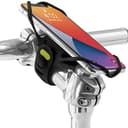
3. How much of the screen does it cover?Quad Lock’s twist-lock leaves the display completely clear, which is the feature people miss most when they switch. The Bone is the only pick here that matches it — silicone corners, no arms across the glass, and Bone states it does not block Face ID or Touch ID. Both cradles park arms over the screen corners. That is the real cost of going cheap, and it is worth knowing before you are annoyed by it at a junction.
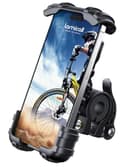
4. How fast does the phone come off? A mount that takes two hands and ten seconds is a mount you stop using. The Lamicall is built around exactly this: one-hand install and release with a safety latch you have to release deliberately. The Bone is nearly as quick once you know the strap order. The cradles are slower, and the SP Connect is instant once you are in the system.
Which alternative fits which complaint?
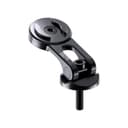
“I like the system, I just do not want anything clamped to my bars.” That is the SP Connect Stem Mount Pro. It replaces your stem cap, so the phone sits on a CNC-machined aluminum plate in the middle of the cockpit with the handlebar completely clear, in portrait or landscape. Two prerequisites, both from SP Connect’s own material: it is designed for 1 1/8 in steerer tubes, and the phone-side half of SPC+ is a separate purchase. Many e-bikes hide the stem cap under a cover or an integrated display mount, so check your cockpit before ordering.
“I want the screen clear and I am not buying another case.” The Bone Bike Tie Pro 4. One piece of silicone, 65 g, W70 x H140 x D40 mm, no screws, strapping to a stem or a bar and coming off leaving nothing bolted on. It is the closest thing here to the Quad Lock experience of an unobstructed display, and it is the pick to move between a commuter and a weekend bike. Be realistic about what you lose: retention is strap tension rather than a lock, and silicone perishes under UV over years, so treat it as a wear part.
“I take the phone on and off at every stop.”The Lamicall. One-handed in and out with a deliberate safety latch is the feature that decides whether a mount still gets used in month six, and the published fit numbers are the most specific in this group. It is plastic rather than metal at a similar price to the aluminum options, and the 6.8 in ceiling with a 15 mm thickness limit is the tightest here — a large phone in a thick case may not fit.
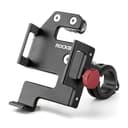
“I just want the cheapest thing that works.”The RockBros aluminum mount. An aluminum clamp at a budget price, published to fit 4.7 to 7.1 in phones, working with your existing case, and cheap enough to leave on a bike you lock in the street — which matters, because a $60 mount is a theft target in a way a $17 one is not. Clamp arms do cover part of the screen edge, and a thick case can push a large phone past the limit.
What no alternative fixes
Rain.None of these mounts — and not Quad Lock either — publishes a water rating. Bone states only that its silicone is stain resistant and washable. If your commute includes real weather, budget for a weather cover or plan to navigate with audio prompts and the phone in a pocket. Our wet-weather setup is in bike commuting in the rain.
Vibration.Long-term exposure to handlebar vibration is hard on phone cameras, and it is the reason Quad Lock sells a vibration dampener as a separate part. No mount on this page publishes a damping claim beyond the Lamicall’s silicone pads and the Bone’s all-silicone body. If you ride rough roads daily, a stem position is gentler than an out-front arm, and a bag pocket is gentler than both.
Theft. A phone mount left on a locked bike tells a thief there is a phone-shaped habit here, and mounts themselves get taken. Cheap mounts are the practical answer, along with taking the cradle with you. The same logic applies to lights, and the detail is in how to keep bike lights from being stolen.
One last point worth making plainly, because it decides this purchase more than any spec: if your phone is also your bike computer, buy retention. The cheapest mount here costs about one percent of the phone it holds, and a cradle that lets go at 20 mph is not a saving. If you ride fast, ride rough surfaces, or carry a phone you could not cheerfully replace, the honest recommendation on this page is to buy the original Quad Lock system you came here to avoid — or at minimum the SP Connect equivalent — and treat the case as part of the cost of carrying a $1,000 device on a handlebar. For everything else, including most city commutes, the four picks above do the job for a fraction of it. If you would rather not have the phone on the bars at all, a bar-mounted mirror and a planned route covers more than people expect: best bike mirrors and how to plan a bike commute route.