Chain & Charge

Best Bike Mirrors for Commuting

Six mirrors, one for every place you can put one. The glass matters far less than the mount — and the mount is decided by your handlebar, not by your budget.

By Stephen V.Last updated How we pick

Buy the Hafny HF-MR095 handlebar mirror if you ride a flat-bar commuter or an e-bike and want to stop reading this. It clamps to the bar, it holds its aim, the lens is HD glass rather than plastic, and it costs less than a decent tail light. If your bars are drops, you need the Hafny HF-M956-FR06 bar-end version instead, because almost no handlebar mirror fits a drop bar at all.

This is the cheapest meaningful safety upgrade in commuting, and the reason is not the mirror. It is what you stop doing. Turning your head to check for a car behind you costs you about a second of not watching the road ahead, and most riders drift toward the center of the lane while they do it. A mirror removes that trade: you keep your line, you keep your eyes forward, and you learn to make the lane-position decision before you need it rather than during it.

The category looks like a pile of interchangeable plastic. It is not, and the axis that matters is where the mirror mounts — because that is what decides whether it fits your bike at all, whether the view moves with your head or with the frame, and how much width you add in traffic. Five mounting positions exist. This page has one pick for each, plus a sixth for the e-bike cockpit problem. Price barely enters into it: every pick here is cheap, and the most expensive one is not the best one.

We own none of these mirrors and run no test lab. Every specification below is read from the maker’s own live listing on a dated visit, and where a listing publishes nothing — three of these six publish a bare title with no dimensions, weight or glass figure at all — the row says so instead of carrying a number we invented. Here is exactly what we do instead of testing. One figure you will not see anywhere on this page: a field of view in degrees. Not one mirror in this category publishes one, so any site quoting you a number is quoting itself.

How this is funded:we earn a commission if you buy through our links, at no extra cost to you. It never changes which product we recommend, and we’ll tell you when we’d skip one. Full disclosure.

Quick picks

Ranked on published specs, real security and safety standards, and buyer fit. Select a row to jump to the full write-up.We have not tested these products — here is exactly what we do instead.

#ProductBest forPrice
1
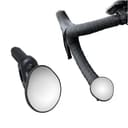
Hafny HF-MR095 Handlebar Bike Mirror

Hafny HF-MR095 Handlebar Bike Mirror

The cheapest thing on this site that changes how you ride in traffic: you stop turning your head to check for a car behind you, which means you stop drifting a foot into the lane every time you do it.

Best overall
$22.99 · View on Amazon

Price as of October 21, 2026. #ad How we’re funded

2
WITTKOP Handlebar Bike Mirror

WITTKOP Handlebar Bike Mirror

The handlebar mirror built for the bike that is too wide and too fast to turn your head on: it folds in against the bar when you are squeezing past a car, and it mounts above or below the bar so it can clear an e-bike's crowded cockpit.

Best for e-bikes
$25.19 · View on Amazon

$27.9910% off

Price as of October 21, 2026. #ad How we’re funded

3
Hafny HF-M956-FR06 Drop Bar Mirror

Hafny HF-M956-FR06 Drop Bar Mirror

The answer for drop handlebars, which most bike mirrors simply do not fit: it plugs into the open end of the bar where your bar tape stops, so nothing clamps onto a curved surface and nothing sits in your hand position.

Best for drop bars
$22.99 · View on Amazon

Price as of October 21, 2026. #ad How we’re funded

4
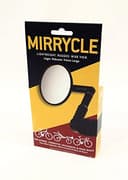
Mirrycle Mountain Bike Mirror

Mirrycle Mountain Bike Mirror

The bar-end mirror that has been the default recommendation on flat-bar bikes for decades, and the one most likely to still be on the bike in five years — it mounts inside the end of the bar rather than clamping to the outside of it.

Best bar-end mirror
$18.03 · View on Amazon

Price as of October 21, 2026. #ad How we’re funded

5
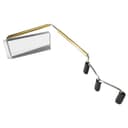
Take A Look Cycling Compact Mirror

Take A Look Cycling Compact Mirror

The eyeglass-mounted mirror that long-distance riders keep going back to: it clips to the arm of your glasses or sunglasses so the view sits a couple of inches from your eye, which is why it reads clearly at a size no handlebar mirror could manage.

Best if you wear glasses
$19.95 · View on Amazon

Price as of October 21, 2026. #ad How we’re funded

6
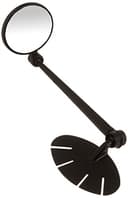
Third Eye Pro Helmet Bicycle Mirror

Third Eye Pro Helmet Bicycle Mirror

A mirror that moves with your head instead of with the bike, which means you aim it by looking rather than by reaching — and it transfers to any bike you ride, including a hire bike or a bike with no free bar space.

Best for multiple bikes
$17.36 · View on Amazon

Price as of October 21, 2026. #ad How we’re funded

The picks in full

#1Best overall

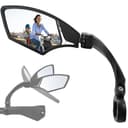
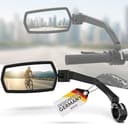
Hafny HF-MR095 Handlebar Bike Mirror

The cheapest thing on this site that changes how you ride in traffic: you stop turning your head to check for a car behind you, which means you stop drifting a foot into the lane every time you do it.

Strengths

  • HD glass rather than plastic, listed as shatterproof and anti-glare
  • 360-degree adjustable, so you can set it to your own riding position
  • Wide-angle field, listed for MTB, e-bike and commuter bars
  • Costs less than a set of lights and arguably does as much for your safety

Trade-offs

  • This listing is the left-side version — order the right-hand one if you need that side
  • Handlebar-end mounting needs a free bar end, which some grips and plugs occupy
  • A mirror adds width; mind doorways, bike racks and filtering gaps
  • Shatterproof per the listing is not the same as unbreakable in a fall
GlassHD glass, shatterproof, anti-glare (listed)
Adjustment360-degree
MountHandlebar
SideLeft (this listing)

Specs read from the product listing, on September 6, 2026. We have not physically tested this product.

#2Best for e-bikes

WITTKOP Handlebar Bike Mirror

The handlebar mirror built for the bike that is too wide and too fast to turn your head on: it folds in against the bar when you are squeezing past a car, and it mounts above or below the bar so it can clear an e-bike's crowded cockpit.

Strengths

  • Mounts above OR below the handlebar, so it clears levers, displays and phone mounts
  • Folds in against the bar for storage, bike racks and tight filtering gaps
  • Listing states a large HD field of vision and a break-proof body
  • 360-degree rotatable, so you can set it to your own riding position

Trade-offs

  • Priciest mirror here, in a category where the cheapest one still works
  • A handlebar clamp needs free bar space, which a grip-shift or a cockpit full of accessories may not have
  • Listing publishes no dimensions, weight or glass specification
  • Break-proof per the listing is not the same as unbreakable in a crash
MountHandlebar clamp, above or below the bar
Adjustment360-degree rotatable, foldable
LensLarge HD field of vision (listed)
BodyBreak-proof and durable (listed)

Specs read from the product listing, on October 10, 2026. We have not physically tested this product.

#3Best for drop bars

Hafny HF-M956-FR06 Drop Bar Mirror

The answer for drop handlebars, which most bike mirrors simply do not fit: it plugs into the open end of the bar where your bar tape stops, so nothing clamps onto a curved surface and nothing sits in your hand position.

Strengths

  • Bar-end mounting is the only arrangement that works cleanly on drop bars
  • HD automotive-grade glass rather than plastic, listed as shatter-proof
  • Super convex lens widens the field at the cost of apparent distance
  • Sits out of your hand positions instead of competing for bar space

Trade-offs

  • Needs an open bar end — if your bar plugs are taped in, that is a job first
  • A convex lens makes traffic look further away than it is; allow for it
  • Adds width exactly where a bar already defines your filtering gap
  • Listing publishes no weight or dimensions
MountBar end (drop bars)
GlassHD automotive-grade, shatter-proof (listed)
LensSuper convex
ModelHF-M956-FR06

Specs read from the product listing, on October 10, 2026. We have not physically tested this product.

#4Best bar-end mirror

Mirrycle Mountain Bike Mirror

The bar-end mirror that has been the default recommendation on flat-bar bikes for decades, and the one most likely to still be on the bike in five years — it mounts inside the end of the bar rather than clamping to the outside of it.

Strengths

  • Inside-the-bar-end mounting is the most vibration-stable arrangement here
  • Long-running design with replacement mirror heads sold separately
  • Positions the mirror outboard, where it sees past your own shoulder
  • Among the cheapest picks on this page

Trade-offs

  • The listing title publishes no dimensions, weight or glass specification at all
  • Needs you to remove a grip or bar plug to fit it
  • Fixed outboard position adds width you cannot fold away
  • Flat bars only — it is not a drop-bar part
MountInside the bar end (flat bars)
PositionOutboard of the grip
GlassNot published in the listing
DimensionsNot published in the listing

Specs read from the product listing, on October 10, 2026. We have not physically tested this product.

#5Best if you wear glasses

Take A Look Cycling Compact Mirror

The eyeglass-mounted mirror that long-distance riders keep going back to: it clips to the arm of your glasses or sunglasses so the view sits a couple of inches from your eye, which is why it reads clearly at a size no handlebar mirror could manage.

Strengths

  • Mounts to eyeglasses or a helmet, so it fits any bike including drop bars
  • Close to the eye, so a small mirror still gives a usable, readable image
  • Nothing on the bike to steal, foul or clamp around
  • Compact version is the smaller of the maker's two sizes

Trade-offs

  • Only works if you reliably wear glasses — useless on the days you do not
  • Moves with your head, so it needs the same adaptation as a helmet mirror
  • Adds weight to one side of a pair of glasses
  • The listing title publishes no dimensions, weight or glass specification
MountEyeglasses or helmet
Moves withYour head, not the bike
SizeCompact (smaller of the maker's two)
DimensionsNot published in the listing

Specs read from the product listing, on October 10, 2026. We have not physically tested this product.

#6Best for multiple bikes

Third Eye Pro Helmet Bicycle Mirror

A mirror that moves with your head instead of with the bike, which means you aim it by looking rather than by reaching — and it transfers to any bike you ride, including a hire bike or a bike with no free bar space.

Strengths

  • Mounts to the helmet, so it works on every bike you own and on borrowed ones
  • You aim it by turning your head slightly, which is faster than a fixed mirror
  • Adds no width to the bike at all
  • Cheap enough to try as an experiment

Trade-offs

  • The view moves every time your head moves, which takes real getting used to
  • Sits in your peripheral vision permanently — some riders never adapt to it
  • Lives on the helmet, so it is gone when you replace the helmet
  • The listing title publishes no dimensions, weight or glass specification
MountHelmet
Moves withYour head, not the bike
Adds width to bikeNone
DimensionsNot published in the listing

Specs read from the product listing, on October 10, 2026. We have not physically tested this product.

How we picked

Four criteria, in the order they decide the purchase. Note what is not on the list: a score, and a field-of-view figure. We have not ridden these units, and nobody in this category publishes the second one.

1. Does it physically fit your handlebar?This is first because it is the one that makes a mirror useless on arrival. A handlebar clamp needs a few free centimeters of straight bar, which a cockpit holding brake levers, a shifter, a bell, a light and a phone mount may genuinely not have. A bar-end mirror needs an open bar end, which grips and bar plugs occupy. And a drop bar — a curved bar with tape over it and no flat section at all — rules out nearly every clamp mirror on the market. Check your own bars before you check anything else.

2. Does the view move with the bike or with your head? This is the real fork in the category and almost nobody frames it. A bike-mounted mirror (handlebar or bar end) shows the same fixed slice of road all the time: you aim it once, and after a week you check it without thinking. A body-mountedmirror (helmet or eyeglasses) moves with your head, so you aim it by looking — a much larger effective field once you have adapted, and genuinely disorienting until you have. Some riders never adapt. We have picks on both sides and we are not going to pretend one is strictly better.

3. Glass or plastic, and convex or flat?Glass gives a noticeably sharper image than acrylic and survives UV better; a cheap plastic lens goes hazy in a couple of summers parked outside. Convex widens the field and makes everything look further away than it is — the trade every car wing mirror makes, and the reason you allow extra margin when a car looks comfortably far back. Where a listing states the lens material we print it; where it does not, we say so.

4. How much width does it add, and can you fold it? A mirror sticks out into exactly the gap you were planning to ride through. On a wide e-bike bar, in a bike room full of other bikes, or filtering between a van and a curb, that is a daily annoyance rather than a theoretical one. A folding mirror solves it; a fixed outboard bar-end mirror does not.

The six mirrors, side by side

Read the mount column first. Everything else is secondary, and the blanks are real: a bare listing title is the most common thing in this category.

MirrorMountView moves withLens (as listed)Folds
Hafny HF-MR095Handlebar clampThe bikeHD glass, anti-glareNo (360° adjustable)
WITTKOP handlebar mirrorHandlebar clamp, above or belowThe bike“Large HD field of vision”Yes
Hafny HF-M956-FR06Bar end (drop bars)The bikeHD automotive glass, super convexNo
Mirrycle MountainInside the bar end (flat bars)The bikeNot publishedNo
Take A Look CompactEyeglasses or helmetYour headNot publishedn/a
Third Eye ProHelmetYour headNot publishedn/a

Which mount is right for you

Flat bars with free space: handlebar clamp.The default, and the reason our top pick is one. You set it once, it holds, and checking it becomes as automatic as a car’s wing mirror. If your bars are crowded, check whether the clamp can go underthe bar — one pick here mounts either side, which is often the difference between fitting and not.

An e-bike: handlebar clamp, folding.E-bike cockpits are the most congested on the road — a display, a throttle, a horn button, often a phone mount — and e-bike bars are wide. A mirror that folds in against the bar is worth the small premium purely for the bike-rack and filtering-gap problem. It is the same reasoning that makes cockpit space a consideration on the phone-mount page, and the whole e-bike kit question is in the e-bike starter kit.

Drop bars: bar end, no exceptions worth mentioning. There is no flat section to clamp to and the tape is in the way. A bar-end mirror plugs into the open end of the bar, sits outside your hand positions, and is the only tidy answer. Budget ten minutes and a bit of swearing to get the bar plug out.

No usable bar space, or more than one bike: helmet or glasses. A body-mounted mirror transfers between bikes, works on a hire bike, and adds no width at all. The cost is the adaptation period, which is real: the view swings every time you turn your head, and for the first week you will find yourself hunting for it. Riders who stick with it generally prefer it permanently, because turning your head two degrees gives you a view no fixed mirror can.

You always wear sunglasses: the eyeglass mirror, specifically. Mounted two inches from your eye, a tiny mirror reads as clearly as a large one on the bars. This is the pick with the highest ceiling and the narrowest condition — it is worth nothing on the day you forget the glasses.

What a mirror does not do

It does not replace a shoulder check before you move. A convex mirror has a blind spot, your own body blocks part of the view on a bike-mounted mirror, and a car can close the gap in the two seconds between your last glance and your move. The honest framing is that a mirror tells you whether you need to look properly, and removes nine out of ten of those head turns. The tenth one still matters. That is also how we frame the rest of riding in traffic in bike commuting safety tips.

It also does nothing for being seen, which is the other half of the problem and the half with the stronger safety case. If you are choosing between a mirror and lights, buy the lights first — a front and rear set costs about the same as these mirrors and addresses the direction most collisions come from. Then buy the mirror; they are complementary, not alternatives, and the whole stack is in the commuting essentials checklist.

Fitting and aiming it

Three things, and they take five minutes:

  • Aim it sitting on the bike in your riding position, not standing beside it. The difference is large enough that a mirror aimed off the bike is usually showing you your own elbow.
  • Set it so your shoulder occupies the inner edge of the view. That gives you a reference point, so you can tell at a glance how far out in the lane a following car is rather than just that one exists.
  • Re-check the clamp after the first week. Every bar-mounted accessory creeps once under vibration, and a mirror that has rotated ten degrees is quietly showing you a hedge. Same discipline as mounting lights.

What we would skip

Plastic-lens mirrors with no stated material. Acrylic goes hazy, and hazy is worse than nothing because you keep trusting it. Glass costs a few dollars more.

Mirrors sold with a field-of-view figure in degrees. No maker in this category publishes one on their own listing. A number that appears only in a review was produced by that review.

Suction or adhesive pad mounts on a handlebar. Bars are round, vibrating and often wet. Those pads are car-windshield parts.

A second mirror on the drive side, at first.Riders in right-hand traffic get almost all the value from the left mirror, because that is the side traffic overtakes on. Add the right one later if you genuinely miss it — same logic as hanging a single pannier on the left.
Frequently asked questions

Are bike mirrors worth it?

For commuting in traffic, yes, and it is one of the cheapest upgrades available — most of these cost less than a set of lights. The value is not really the view; it is that you stop turning your head. A shoulder check costs you about a second of not watching the road ahead, and most riders drift toward the middle of the lane while they do it. A mirror lets you make the decision about lane position before you need to, holding your line and your forward attention. The honest limit is that it does not replace a proper look before you move.

What is the best type of bike mirror?

It depends on your handlebar first and your temperament second. A handlebar clamp is the easiest to live with on a flat-bar bike: aim it once and it becomes automatic. A bar-end mirror is the answer for drop bars, where almost no clamp mirror fits. Helmet and eyeglass mirrors move with your head, which gives a much larger effective field once you have adapted and is genuinely disorienting until you have — some riders love them permanently and some never get on with them. If you have no free bar space or ride several bikes, the body-mounted options are the only ones that work.

Do bike mirrors fit drop handlebars?

Clamp-on mirrors generally do not. A drop bar has no straight flat section to clamp to, and the section that is straightish is wrapped in bar tape and occupied by your hands. The working answer is a bar-end mirror, which plugs into the open end of the bar below the tape: it sits outside your hand positions and nothing clamps to a curved surface. Fitting one means getting the existing bar plug out, which can take some persuading. The alternative is an eyeglass or helmet mirror, which ignores the handlebar question entirely.

Are bar end mirrors any good?

They are very good at staying put, which is their main advantage. Mounting inside the end of the bar puts the mirror outboard of your grip, so it sees past your own shoulder, and it is the most vibration-stable arrangement in this category — a bar-end mirror rarely needs re-aiming. The costs are that it needs an open bar end, which means removing a grip or plug, and that it adds fixed width you cannot fold away, exactly where the bar already defines your filtering gap. On a flat bar with free bar ends it is an excellent choice.

Which side should a bike mirror go on?

The side traffic overtakes on, which in the US and anywhere else you ride on the right means the left. That is where the cars you cannot hear coming will be. One thing to watch when ordering: some mirrors are sold as side-specific, so a listing can be the right-hand version of the product you wanted — the Hafny handlebar mirror we lead with is the left-side listing. Start with one mirror on the traffic side and only add a second if you find yourself missing it.

Do mirrors work on an e-bike?

They work well and arguably matter more, because you are traveling faster and the bike is heavier, so your options narrow earlier when something is behind you. Two e-bike-specific issues: the cockpit is usually crowded with a display, a throttle and a horn, so check you have free bar space or buy a mirror that can clamp under the bar instead of over it; and e-bike bars are wide, so a folding mirror is worth the small premium for bike racks and tight gaps. A convex mirror also flatters distance, so allow extra margin at e-bike speeds.

Do helmet mirrors take long to get used to?

Expect about a week of feeling that the view is in the wrong place, because it is in a new place every time you move your head. The adaptation is the whole trade: once your brain treats head angle as the aiming control, you get a much larger effective field of view than a fixed mirror can give and you can look at a specific vehicle rather than at a fixed slice of road. Riders who push through generally prefer it permanently. Riders who do not adapt in two weeks usually never do, which is an argument for starting with a cheap one.

Sources

Keep reading