One Pannier or Two?
Most commuters need one. The handling penalty of a single loaded bag is real but far smaller than people expect — and which side you hang it on is not arbitrary.
How this is funded:we earn a commission if you buy through our links, at no extra cost to you. It never changes which product we recommend, and we’ll tell you when we’d skip one. Full disclosure.
Buy one.For a daily commute carrying a laptop, a lunch, a layer and a lock, a single 20–27 litre pannier is the right tool, and the Rhinowalk 27Lis the single bag we would point most commuters at. Buy the pair — the Ortlieb Back-Roller Classicis the benchmark — when your regular load is groceries, a change of clothes plus gym kit, or anything approaching touring.
And hang the single bag on the left, if you ride on the right-hand side of the road. That is not a tradition, it is two concrete reasons stacked, and we get to them below.
What a single loaded bag actually does
Less than you would guess, and the reason is geometry. A pannier hangs low and close to the rear axle, so the distance from its mass to the bike’s centre line is short — the lever arm is small. Compare that to a rack-top bag, which sits higher and therefore has more influence on handling despite being centred, or to a backpack, which puts the whole load up at shoulder height.
So the asymmetry is real and it shows up in four specific places, none of which is “riding along”:
- Standing still and holding the bike up. The most noticeable moment, and the least important. It feels alarming for about a week.
- Slow-speed manoeuvring. Walking the bike through a doorway or turning tightly in a bike room, where you are balancing rather than steering.
- Lifting the bike. Onto a train, up stairs, onto a car rack. Take the bag off first; this is the one case where you genuinely feel it.
- Standing out of the saddle on a steep climb. The bike rocks side to side under you and the weighted side swings further.
At commuting speed on a flat road, seated, you will not notice a 10 lb bag on one side after the first few rides. What you will notice every single day is the width and weight of an empty second pannier you did not need.
Which side, and why it is not arbitrary
Left, if you ride on the right. Three reasons, in order of how much they matter.
1. You load and unload from the kerb. The bag you unclip twice a day should be on the side away from moving traffic. Everything else here is preference; this one is safety.
2. The drivetrain is on the right. The derailleur, the chain and the cassette all live on the right-hand side of the bike. A bag that sags, swings or comes loose on that side has somewhere expensive and greasy to go. Keeping the single bag left keeps the drive side clear.
3. Kickstands and leaning. Most kickstands put the bike leaning left, and most people lean a bike left against a wall, so a loaded left bag resists tipping in the direction the bike is already going rather than adding to it.
If you ride on the left — the UK, Ireland, Australia, Japan — reason one reverses and becomes the kerb-side argument for the right. Reason two does not reverse, because the drivetrain is on the right everywhere. Most riders in left-hand-drive countries still end up favouring the kerb side; it is the reason with the actual consequence.
What to look for in a single bag
If you have decided on one, the criteria shift in three ways relative to buying a pair. Capacity matters more, because there is no second bag to absorb overflow — 20 L is tight for an office load and 27 L is comfortable. Carry handles matter more, because this bag is coming into the building with you rather than being left as a pair on the bike; a bag that converts to a shoulder bag saves you owning two bags. And the mount matters more, because all the lateral load goes through one set of hooks instead of being shared. The picks below are sorted on exactly that, with the best pair included for the case where one is not enough.
Quick picks
Ranked on published specs, real security and safety standards, and buyer fit.We have not tested these products — here is exactly what we do instead.
| # | Product | Best for | Price |
|---|---|---|---|
| 1 | 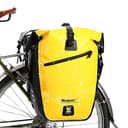 Rhinowalk Waterproof Pannier 27L A single 27L waterproof pannier that carries a laptop and converts to a shoulder bag for the walk into the office — the one-bag commuter's pick when you don't need a matched pair. | Best single bag | $49.99 · View on Amazon Price as of October 5, 2026. #ad How we’re funded |
| 2 | 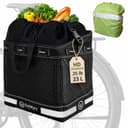 OutWurx Grocery Pannier (23L, with Rain Cover) A single 23L grocery pannier with a snap-secure inner tote, reflective accents and an included rain cover, on a 3-point lock-down mount rated for e-bike racks. A more secure, weatherable grocery bag than the open-top pairs. | Best single, secure mount | |
| 3 | 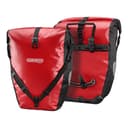 Ortlieb Back-Roller Classic Panniers (Pair) The waterproof pannier every other pannier is measured against: a fully welded, roll-top pair (40L total) that keeps a laptop dry in a downpour, on the QL2.1 hooks that click on and off in a second. | Best pair | $199.00 · View on Amazon Price as of October 5, 2026. #ad How we’re funded |
| 4 | 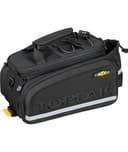 Topeak MTX 2.0 TrunkBag DXP The trunk bag that stops being a trunk bag when you need it to: the side panels drop down into full panniers, so one purchase covers the daily laptop-and-lunch load and the unplanned grocery run. | The third answer: centred | $122.95 · View on Amazon Price as of October 5, 2026. #ad How we’re funded |
How to load a single bag so it behaves
Three rules, and they matter more with one bag than with two because there is nothing on the other side cancelling your mistakes out.
Heavy items low and forward.Low keeps the centre of mass down; forward keeps it closer to the bike’s centre of gravity and away from the rear overhang where it acts as a pendulum. A laptop against the rack-side wall and a lock at the bottom front is the arrangement that disappears underneath you.
Fill the bag or compress it.A half-empty pannier is worse than a full one, because the contents move independently and the bag flaps. Roll the top down properly — three folds, not one — or put the soft stuff in to take up the space.
Check the lower anchor every few weeks. A single bag puts all the lateral load through one lower hook or bungee, and a loose one lets the bag swing into the spokes or the drivetrain. Our full method is in how to pack panniers, and rack and pannier compatibility covers which anchors fit which racks.
The e-bike case
On an electric bike the argument for a single bag is stronger, not weaker. The bike already weighs 50 to 75 lb, so a 10 lb bag is a much smaller fraction of the total mass than the same bag on a 22 lb road bike, and the asymmetry you feel scales with that fraction. The motor also removes the reason you would otherwise care about carrying an empty second bag.
What does change is the hardware. E-bike racks are built out of thicker tube, often carry the tail light or its wiring, and sometimes the battery, so a single bag with a positive lock-down mount is worth more than a pair with generic hooks. We go through the whole fitment question in best panniers for e-bikes.
When two bags are genuinely right
- Groceries. A real shop does not fit in one bag, and splitting the load is what makes a bike a credible car replacement for errands. See carrying groceries on a bike.
- Bulky and awkward loads. Two 20 L bags carry shapes that one 40 L bag cannot, because the useful dimension is width, not volume.
- Clothes plus gear.Keeping work clothes in one bag and everything else in the other stops the shirt sharing space with a damp lock and a pair of shoes — carrying work clothes covers that in detail.
- Long rides and touring.Outside this site’s remit, but the balance argument that barely applies at commuting loads becomes real at 40 L and 50 miles.
Frequently asked questions
Do you need two panniers?
No, for a normal commute. A laptop, a lunch, a layer, a lock and a charger is a 20 to 27 litre load, and a single bag of that size handles it with room to roll the top closed properly. A 40 litre pair means carrying the weight and the width of a mostly empty second bag every day, and a half-full pannier lets its contents shift. Buy the pair when your regular load genuinely exceeds one bag — a full grocery shop, a change of clothes plus gym kit, or any kind of touring.
Which side should a single pannier go on?
The left, in the US and anywhere else you ride on the right. Two reasons. First, you unclip and reload the bag from the kerb side rather than reaching into moving traffic, which is the only one of these reasons that is about safety. Second, the right side of the bike is where the derailleur and chain live, so a bag that sags or swings there is a bag that can contact the drivetrain. There is a third, smaller point: a bike leaned on a kickstand usually leans left, and a loaded left bag resists tipping further in that direction.
Can you ride with one pannier?
Yes, and it feels far less dramatic than the physics sounds. The bag sits low and close to the rear axle, so its weight has a small lever arm against the bike's centre line — you notice it most when standing still and lifting the bike, and almost not at all once you are rolling. Where asymmetry genuinely shows up is slow-speed manoeuvring, lifting the bike onto a train or up stairs, and standing out of the saddle on a steep climb. On a heavy e-bike it is even less noticeable, because the bag is a smaller fraction of the total mass.
How much weight can you put in one pannier?
The limit is almost never the bag, it is the rack and how the load sits on it. Rack ratings vary a lot and they are published per rack — the West Biking rack in our registry states 110 lb, and plenty of lighter racks state far less — and every stated figure assumes a secured load rather than a swinging one. Practically: keep a single bag well under the rack's rated capacity rather than loading one side to the limit, keep heavy items low and forward in the bag, and read the figure for your own rack instead of applying a general rule.
Is a trunk bag better than one pannier?
It is the better answer if symmetry bothers you or if your rack's sides are occupied. A trunk bag sits centred on the rack deck, so there is no asymmetry at all, and it is faster to grab and go. The trade-offs are that the load sits higher, which has more effect on handling than a low side bag does, capacity is usually smaller, and fitment is trickier — rail-system trunk bags attach only to that brand's own rack, where universal strap bags fit any deck. Several convertible bags do both jobs, with side panels that drop down into panniers.
Should I buy two panniers and only use one?
Often yes, and it is the quiet best answer for a lot of riders — most waterproof panniers are sold as a pair anyway, so you end up with a spare for the grocery run, a replacement when one wears out, and a second bag for the occasional big load. The exception is when the single-bag options are genuinely better products for your use: the only pannier in our registry that publishes a padded laptop sleeve is sold as a single bag, and the only one that specifies an e-bike-rated lock-down mount is too.
Sources
- Topeak — MTX TrunkBag DXP (MTX 2.0) — Topeak's published specs for the MTX TrunkBag DXP 2.0: 19.4 L capacity with an expandable top section, 1,185 g, 36 x 25 x 21.5-29 cm, 600 denier polyester over rigid EVA foam, MTX QuickTrack 2.0 mounting, side panels that expand to full panniers, and the note that MTX Dual Side Frames are required when using the panniers on MTX BeamRacks (accessed September 15, 2026)
Keep reading
Best Budget Panniers
The value end of the category, singles and pairs, with what each compromise actually costs you.
See the picksHow to Pack Panniers
Weight distribution, what goes where, and the roll-top technique that decides whether it stays dry.
Read the guidePanniers vs Trunk Bag
The centred alternative to a single side bag, and the fitment trap that catches buyers.
Compare themBest Panniers for Carrying a Laptop
If the daily load is a computer, the single-bag answer has one clear winner.
See the picks