What Size Panniers Do I Need?
For a daily office load, one 20-27 liter bag. For groceries, 30-40 liters across a pair. Almost nobody needs more than that, and carrying it costs you something every single day.
How this is funded:we earn a commission if you buy through our links, at no extra cost to you. It never changes which product we recommend, and we’ll tell you when we’d skip one. Full disclosure.
Short answer: one bag in the 20 to 27 liter rangecovers a normal office commute — a laptop, a charger, a lunch, a layer and a lock, with room left to close a roll-top properly. Move up to a 30 to 40 liter pair only if you genuinely shop by bike, and down to 10 to 15 litersif there is no computer in the load. Our pick for the most common case is the single 27 L bag in the table below.
The reason this question matters is that the mistake runs in one direction. Almost nobody buys panniers that are too small; a great many people buy a 40 L pair for an 18 L load because the premium bags are sold in pairs and more capacity feels like good planning. It is not free. You carry the second bag’s weight and width every day, the contents slide around inside the space you are not using, and the roll-top you cannot pack properly is a roll-top that no longer seals.
What capacity actually has to hold
Pannier capacity is quoted in liters, and liters are an unhelpful unit until you have translated them into the objects you carry. Three reference points fix the scale:
- A full supermarket paper sack is about 15–20 liters.That is the single most useful conversion in this category. “One bag of groceries per side” is a 30–40 L pair.
- A daily office load is about 12–18 liters. Laptop, charger, lunch, a rolled shirt, a packable jacket.
- A gym kit is about 10–12 liters on top of whatever else you carry, which is what pushes some commuters into a pair.
Then there is the part the liter figure does not tell you: shape. A 25 L bag that is tall and narrow takes a 15-inch laptop standing up against the rack-side wall. A 25 L bag that is short and deep does not, no matter what the number says. Several bags in this market publish a volume and no dimensions at all, and for a laptop that makes the volume figure close to meaningless — measure the computer and ask the seller before you buy.
And the number nobody prints: how much the roll-top eats
A roll-top seals because you fold it over itself at least three times. Most published capacities are measured with that closure extended, so the honest usable volume of a waterproof bag is meaningfully less than the figure on the listing — plan on around 80 percent of it. This is the single most common reason a bag that should have been big enough is not, and it is also why two bags with identical stated liters can feel completely different to live with.
Below are four bags, one for each size band that makes sense on a commute, with today’s live prices. The sizing argument, the band-by-band breakdown and the fit checks that matter on your own bike follow underneath.
Quick picks
Ranked on published specs, real security and safety standards, and buyer fit.We have not tested these products — here is exactly what we do instead.
| # | Product | Best for | Price |
|---|---|---|---|
| 1 | 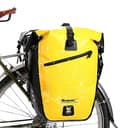 Rhinowalk Waterproof Pannier 27L A single 27L waterproof pannier that carries a laptop and converts to a shoulder bag for the walk into the office — the one-bag commuter's pick when you don't need a matched pair. | Best single 20-27 L bag | $49.99 · View on Amazon Price as of October 21, 2026. #ad How we’re funded |
| 2 | 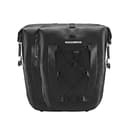 RockBros Waterproof Panniers (2-Pack, 30L) Most of the Ortlieb's waterproofing at a fraction of the price: a roll-top pair rated to 30L that shrugs off rain and doubles as a shoulder bag. The value pick for wet-weather commuting. | Best 30 L pair | $103.99 · View on Amazon Price as of October 21, 2026. #ad How we’re funded |
| 3 | 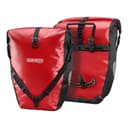 Ortlieb Back-Roller Classic Panniers (Pair) The waterproof pannier every other pannier is measured against: a fully welded, roll-top pair (40L total) that keeps a laptop dry in a downpour, on the QL2.1 hooks that click on and off in a second. | Best 40 L pair | $199.00 · View on Amazon Price as of October 21, 2026. #ad How we’re funded |
| 4 | 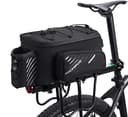 RockBros 15L Rear Rack Bag with Rain Cover The sensible middle of this category: about the capacity of a normal work load, an included rain cover instead of a waterproofing claim, and a price that does not ask you to commit to a rack ecosystem. | Best 10-15 L option | $39.89 · View on Amazon Price as of October 21, 2026. #ad How we’re funded |
How to actually measure your load
Do this once and you will never guess at a liter figure again. Put everything you carry on a normal day into a cardboard box or a kitchen bin bag, including the things you forget — the lock, the charger, the packable jacket, the spare tube. Then compare it against these rough volumes:
- 15-inch laptop in a sleeve: about 3–4 L
- Rolled shirt and trousers: about 4–6 L
- Work shoes: about 4–5 L
- Lunch box and a water bottle: about 2–3 L
- Packable rain jacket: about 1–2 L
- U-lock, if it is not on the frame: about 1–2 L
- A full supermarket paper sack: about 15–20 L
Add your own list up, then add about a quarter for the air that packing always wastes and the roll-top you need to be able to close. That number is your bag size. For most people it lands between 15 and 25 liters, which is why the single-bag answer wins so often.
What happens when you buy too big
Oversizing is the default mistake in this category, partly because the premium bags are sold as pairs and partly because more capacity feels like future-proofing. It costs you four things, every ride:
Weight and width you are not using.An empty 20 L pannier still weighs something and still sticks out into the space your heel wants.
Contents that move. A half-full bag lets everything slide to one end on the first corner, which is both noisy and, with a laptop in there, genuinely bad for the laptop.
A roll-top you cannot seal. If the bag is wrong-shaped for the load, you end up closing it badly, and a badly closed roll-top is not a waterproof bag.
Temptation.A 40 L pair invites you to carry 40 L of things, and a loaded rack changes how a bike handles far more than most riders realize. Our packing guide covers keeping weight low and balanced when you genuinely do fill them.
The four size bands, and who each is for
10–15 liters — the no-laptop commute.A lock, a lunch, a layer and a phone. This is trunk-bag territory more than pannier territory: a 15 L bag on the rack deck keeps the load central, straps to any rack, and lifts off as a shoulder bag. Our trunk bag roundup and panniers vs trunk bag compare the two shapes properly.
20–27 liters — the standard office load. One bag, one decision, a laptop and clothes. This is the band we recommend to most commuters and the one the single-bag market has grown into. The laptop pannier page is the deeper version of this choice.
30 liters across a pair — the flexible middle.About 15 L a side, which is enough for work on one side and a shop on the other. Good for riders whose load genuinely varies day to day, and the band where the value roll-top pairs live.
40 liters across a pair — the grocery and cargo band. Two full paper sacks, or a week’s shopping, or work kit plus gym kit. This is the right answer for a genuinely car-free household and overkill for everyone else. The grocery pannier page and carrying groceries by bike are the two pages for that life.
Expandable bags: the honest version
Some bags solve the sizing problem by changing size. The clearest example we cover is a rack-top bag whose side panels drop down into full panniers — listed at 19.4 L closed, roughly double that with the panniers deployed — so one purchase handles the daily laptop load and the unplanned grocery run. Another is a hard-shell bag listed from 17 up to 45 L that straps to any rack deck.
Two honest caveats. First, expandable bags carry their expansion hardware all the time, so the small mode is never as small or as light as a bag that is simply small. Second, the rail-mounted ones are brand-specific: a QuickTrack bag needs a QuickTrack rack, and that is a rack purchase as well as a bag purchase. Our Ibera vs Topeak comparison is about exactly that commitment.
Check the bag against the bike, not just the load
- Heel clearance. A tall narrow bag mounted far forward is the classic heel-strike. Longer bags need to sit further back, which some racks do not allow.
- Hook spacing and rail diameter.Capacity is useless if the bag will not clip on — the compatibility guide covers every variant.
- The rack’s load rating, not the bag’s volume. 40 liters of groceries is far heavier than 40 liters of clothes.
- Whether it carries off the bike. A bag with a shoulder strap is a bag you will take inside. A bag without one gets left on the rack, and no pannier mount is a security device.
- Published dimensions, where they exist. Several bags publish a liter figure and no dimensions at all, which is useless for a laptop. Measure the laptop and ask the seller if the listing is silent.
If you are still torn between one bag and two after all of that, the honest answer is that one bag of the right size beats two bags of the wrong one almost every time — and the case for a pair is argued fairly in one pannier or two. If you are not sure a pannier is the right container at all, start with are panniers worth it or basket vs pannier.
Frequently asked questions
What size panniers do I need for commuting?
One bag in the 20 to 27 liter range covers the standard office commute: a 13 to 15 inch laptop, a charger, a lunch, a layer and a lock, with enough room left to close a roll-top properly. That last part matters more than people expect — a roll-top only seals if you can get three folds into it, so a bag packed to its absolute limit is a bag that is no longer waterproof. Go to a 30 to 40 liter pair only if you genuinely do a grocery shop on the way home, and go down to 10 to 15 liters if your daily load is a lock, a lunch and a layer with no computer.
Is a 40L pannier set too big for commuting?
For most office commutes, yes. A 40 liter pair is a touring capacity, and on a daily ride it costs you three things: the weight and width of a mostly empty second bag, heel clearance you did not need to give up, and contents that shift around inside a half-full bag. The exception is real: if you do the week's shopping by bike, or you carry sports kit plus work clothes, or you ride with a child's things as well, 40 liters across a pair is exactly right. Buy for your heaviest regular load, not your heaviest imaginable one.
How many liters is a laptop and a change of clothes?
Around 12 to 18 liters in practice, which is why a single 20 to 27 liter bag feels roomy rather than tight. A 15-inch laptop in a sleeve is roughly 3 to 4 liters, a rolled shirt and trousers about 4 to 6, shoes 4 to 5 if you carry them, and then lunch, a lock, a charger and a packable jacket take the rest. The usual mistake is adding capacity for shoes you could leave at the office. Our guide to carrying work clothes covers what to cycle and what to store at the other end.
Do I need one pannier or two?
One, for almost every commuter. A single loaded bag does produce a small handling asymmetry, but it is far smaller than people expect and completely invisible after a week — while a second bag is extra weight, extra width and a second thing to unclip every time you park. Two bags earn their place when the load genuinely exceeds about 25 liters, when you want weight split low and even for a long ride, or when you want wet kit kept away from clean clothes. We work the handling question through properly on our one-pannier-or-two page.
Does pannier capacity include the roll-top?
Usually, and that is the catch with published liter figures. Many roll-top bags quote a maximum volume measured with the closure extended, which is the volume you can only use by rolling the top down once instead of three times — in other words, the volume at which the bag stops being waterproof. Treat the headline number as an upper bound and plan on using about 80 percent of it for a bag you want to stay dry. This is also why two bags with the same stated liters can feel very different to pack.
What size pannier rack do I need?
The rack is sized to the bike, not to the bag. What you match is the wheel size and the mounting — a rack listed for 26 to 29 inch frames with disc-brake clearance covers most commuter and hybrid bikes — and then whether the rack's side rails suit your panniers' hooks. Capacity enters the picture through the rack's load rating rather than its size: a 40 liter pair fully loaded with groceries can approach a rack's stated limit, which is one more reason the smaller bag is often the better buy. Our rack load guide covers how to read those ratings.
Sources
- Topeak — MTX TrunkBag DXP (MTX 2.0) — Topeak's published specs for the MTX TrunkBag DXP 2.0: 19.4 L capacity with an expandable top section, 1,185 g, 36 x 25 x 21.5-29 cm, 600 denier polyester over rigid EVA foam, MTX QuickTrack 2.0 mounting, side panels that expand to full panniers, and the note that MTX Dual Side Frames are required when using the panniers on MTX BeamRacks (accessed September 15, 2026)