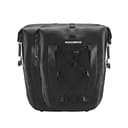
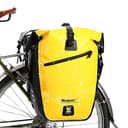
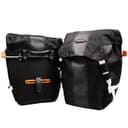
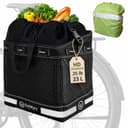
Where budget panniers are genuinely good — and where they aren’t
The single most important spec at this price is the closure, because it decides how much rain the bag keeps out. A roll-top bag — you fold the open top down several times and clip it — has no zipper and no seam across the top for water to wick through, so a well-made budget roll-top stays dry in a genuine downpour. That is the closure to prioritize if anything valuable rides inside. A “water-resistant” bag, by contrast, shrugs off a shower but is not built to be soaked, and a bag that relies on an included rain cover is only as dry as your habit of actually fitting the cover. None of those is a flaw; each is a spec to match to your climate. Commute daily through wet months and you want a roll-top; see the odd shower and a rain cover is plenty.
The honest limit of the budget tier is the seam. Premium roll-tops are fully welded, so the body is effectively one waterproof piece; cheaper bags are stitched and taped, which is excellent until a long, hard soaking eventually finds a needle hole. In practice that rarely matters for a commute measured in minutes rather than hours, and a dry bag or a plain plastic liner wrapped around your laptop closes the gap for pennies.
One bag or a pair, and matching capacity to your load
Decide next between a single pannier and a matched pair. A single is faster to fit and lift, hangs on one side, and is the natural pick for a laptop, a lunch and a change of clothes; the trade is roughly half the capacity, so a big grocery run will overwhelm it. A pair doubles your volume and, loaded evenly, actually rides better because the weight is balanced across both sides of the wheel. If you are torn between a pannier and a smaller rack-top bag, our panniers vs trunk bag comparison lays out the trade-off, and once your bags arrive, how to pack panniers covers loading them so the bike stays stable.
Match the volume to your real load rather than the biggest number on the listing. A laptop commute needs far less than a weekly shop, and an oversized bag carried half-full just flaps and catches the wind. Think about your heaviest normal day, not the rare maximum you might carry once a year, and buy for that. A pannier sized to your everyday load rides better and sits more neatly on the rack than an oversized bag you almost never fill.
The rack does half the work
A pannier is only as good as what it hangs on: every bag here needs a rear rack with standard side rails, and fitting a solid rack is the first purchase, not an afterthought. Budget bags use simple hook hardware that fits most tubular rails, so you are rarely locked into one rack brand — but a wobbly or ill-fitting rack will make even a good pannier sway and rattle. If you have not sorted that yet, start with our best rear racks and match the rack to your frame first. Many budget panniers add reflective trim, too, which is a real bonus after dark: federal bicycle-safety guidance stresses being visible to drivers, so a bag that catches headlights is doing safety work as well as carrying your lunch — see the source below.
Still deciding whether to spend anything at all? Are panniers worth it is the honest version of that argument, including the three situations where we would tell you to stick with the backpack you already own.