Check these five things before you buy
- Does the bike already have a rack, or mounts for one? Look for threaded eyelets at the rear dropouts and near the top of the seatstays. Frame-mounted racks bolt to those and carry heavier loads far more securely than anything clamped to a seatpost. No eyelets means you need an adjustable universal rack or a seatpost-mounted one, and the latter carries much less.
- Disc brakes.The caliper sits exactly where a rack’s lower stay wants to go. Racks sold as disc-brake compatible route around it; ordinary racks either won’t bolt up or will foul the caliper, which is not a thing to improvise with. Every e-bike we’d expect a reader to own has disc brakes, so treat this as mandatory.
- The hub motor and its hardware.A rear hub motor brings a fatter axle, a torque arm and a motor cable into the same dropout the rack wants to bolt to. Before you tighten anything, confirm the rack’s lower stays sit clear of the cable and don’t interfere with the torque arm — and remember you’ll have to remove the rack, or work around it, to take the rear wheel out for a flat.
- Tire width and wheel size. Fat tires need a rack whose stays sit wide enough not to rub, and a height-adjustable rack is the easy way to get clearance right across 26- to 29-inch wheels. This is the measurement most often skipped and most often responsible for a return.
- Heel clearance.The rack’s rearward position decides whether your heel strikes a pannier on every stroke. Longer rack platforms push the bags back and solve it; short ones on a compact frame don’t. It is worth checking against the bags you plan to use — rack and pannier compatibility goes through the measurements.
Capacity: the number that isn’t the rack’s
Rack load ratings look reassuringly large, and on an e-bike they are rarely the binding constraint. The number that actually limits you is the bike’s total payload capacity— the maximum combined weight of rider plus cargo the manufacturer states for the frame, wheels and, on an e-bike, the motor and battery mounting. Find that figure in your bike’s manual and subtract yourself; whatever remains is your real cargo allowance, regardless of what the rack could theoretically hold.
E-bikes are heavy to start with, which eats into that budget before you load anything. They also carry loads faster and brake harder than a regular bike, so a rack’s attachment quality matters more than its headline rating: a frame-mounted rack transfers load into the frame properly, while a seatpost-mounted one concentrates everything on a clamp. Our guide to how much weight a rack can hold works through the whole chain, and how to mount a rack covers doing it properly once you’ve chosen.
Loading a heavy bike well
Handling changes more on an e-bike than on a regular bike when you load the back, because there is already a lot of mass behind the bottom bracket — often including the battery. Two habits fix most of it: keep heavy items low and forwardon the rack rather than piled on top, and balance the weight side to side so the bike doesn’t pull under braking. Panniers do both naturally, which is one reason we’d fit those before a big trunk bag; the packing detail is in how to pack panniers.
One e-bike-specific check: if your bike carries its battery on the rear rack or behind the seat tube, work out what is left for cargo and how a loaded pannier interacts with removing the battery for charging. A rack setup that means unloading both bags every time you charge is a setup you will stop using by week three.
Which of the three?
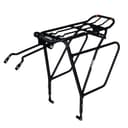
The Ibera Touring Carrier Plus+ is the default. It is frame-mounted for real load, explicitly made for disc-brake frames, and height-adjustable across 26- to 29-inch wheels, which is exactly the flexibility a fat-tired e-bike asks for. It needs eyelets, so check for those first.
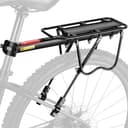
The West Biking universal rackis the answer when the frame fights you — it adjusts to a wide range of frames and states the highest load capacity of the three at 110 lb, which is more than most riders will ever put on it. The trade is finish and fiddly setup: universal fit means you dial it in yourself.
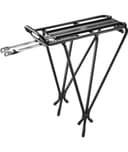
The Topeak Explorer earns its place if you want the MTX QuickTrack rail, which lets a trunk bag click on and off with no straps. On a commuter e-bike that does a lot of short errands, tool-free bag swapping is a genuine daily convenience. It carries standard pannier rails on the sides too. If none of those specifics apply to you, the wider field is in best rear racks, and if you’re still deciding how you want to carry things at all, start at carrying groceries on a bike.