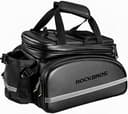
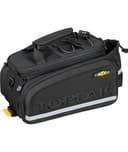
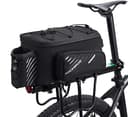
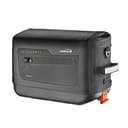
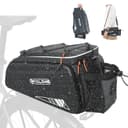
How we picked
Four criteria, in the order they actually decide the purchase.
1. Will it attach to your rack?Everything else is academic until this is settled. Every entry above states which world it belongs to — a named rail system or a universal strap fit — and where a bag names a specific rack generation, we quote that generation rather than rounding it to “fits most racks”.
2. Does the capacity figure exist, and is it honest?Some listings publish liters and some publish nothing at all. Where a number exists we print it; where it does not — and on one premium pick here it does not — that absence is listed in the cons, because a bag with no published capacity is a bag you cannot check your laptop against.
3. Waterproof, water resistant, or a rain cover?These are three different products and sellers use them interchangeably. We print the word the listing uses. A rain cover is not a flaw — it is often the more honest solution at a budget price — but it is a thing you have to remember to fit, and that belongs in the cons.
4. Does it come off, and can you carry it? The entire appeal of a trunk bag over panniers is the one-motion removal. A bag you have to unthread from four velcro straps every evening is a bag that stays on the bike, and a bag with no shoulder strap is one you carry awkwardly under an arm.
Rail systems vs universal fit: the decision that comes first
Rail systems— Topeak’s MTX QuickTrack and Ibera’s PakRak are the two you will meet most often — put a dedicated track along the top of the rack. The bag slides on, clicks, and locks. No straps, no wobble, off in a second. The catch is total: that bag fits that system and nothing else. If you already own a rack from one of those families, a rail bag is the best experience in this category by a clear margin. If you do not, you are buying a rack as well as a bag.
Universal bagsstrap or velcro to an ordinary rack deck. They are slower to remove, they can shift if you strap them lazily, and they are what the large majority of commuters should buy — because the large majority of commuters have a plain rack. That is why the top pick here is a universal bag and not the technically superior rail bag below it.
Two things to check on your own bike before ordering anything. First, the usable length of the rack deck, because a long bag on a short deck overhangs and fouls your heels or the seatpost. Second, whether a rear light currently lives on the rack — a trunk bag will cover it, and a tail light swallowed by a bag is doing nothing at all. Moving it is a two-minute job and how to mount bike lights covers where it should go instead.
What the capacity number actually means
Liters are a volume, not a shape, and a trunk bag’s shape is the constraint. Ten liters spread across a wide, shallow rack-top bag holds a very different set of objects than ten liters in a deep pannier. In practice:
- Around 10 L is a lock, a lunch, a packable layer and a U-lock. It is not a laptop bag.
- Around 15 Lis the realistic daily commute figure — that plus a change of clothes, and for many people a thin laptop laid flat.
- Expandable bags that quote a range are quoting the top figure with every zip open and, on the Topeak, with the pannier sides deployed. Plan around the bottom number and treat the top as headroom.
None of the listings here publishes a laptop-sleeve dimension, so do not assume one. Measure your machine and compare it against the bag’s stated size before you order — and if a laptop is the whole reason you are shopping, read how to carry a laptop on a bike first, because padding against potholes matters at least as much as waterproofing.
The weight-up-high problem
This is the real trade-off nobody mentions, and it is the honest argument against this whole category. A trunk bag puts its load on top of the rack, several inches higher than a pannier hanging at the sides. The higher the weight, the more it affects how the bike steers — you feel it as a slow, top-heavy wobble at low speed, which is exactly when you are filtering through traffic or pulling away from a light.
For a normal commute load this is a non-issue. For a big shop it is not, and it is why the expandable bags on this page matter: dropping the load into pannier position, or moving the heavy items into side bags, gets the weight back down where it belongs. The packing logic is the same one in how to pack panniers — heavy things low, light things high — and it applies doubly to a rack deck.
It also interacts with your rack’s rating. A rack rated for a given load was rated with that load on the deck, but a tall stack changes the leverage on the stays. How much weight a bike rack can hold explains how to read the number, and it is worth two minutes before you fill a 45-liter bag.
Trunk bag or panniers?
The honest answer is that they solve different problems, and a lot of commuters eventually own both. A trunk bag wins on convenience: one bag, one motion, a shoulder strap, no rattling empty panniers on the days you carry nothing. Panniers win on capacity and on keeping weight low, and a waterproof roll-top pannier is still the most reliable way to get a laptop across town in a downpour.
If you are genuinely undecided, we work it through properly in panniers vs trunk bag, and the pannier side of the comparison is ranked in the best waterproof panniers. The middle path is the expandable bag: a trunk bag most days, panniers on the days you need them, which is exactly what the Topeak DXP’s drop-down sides and the RockBros’s 17-to-45-liter range are for.
You need a rack first
Worth stating plainly, because it catches people out: a trunk bag needs a rear rack, and a fair number of bikes sold today do not have one and do not have the eyelets to bolt one on easily. If that is you, sort the rack before the bag — the best rear racks is the place to start, and how to mount a rear rack covers the fitting.
If your commuter is an e-bike, check rear racks for e-bikes instead: a hub motor, a disc caliper and fat tires rule out a lot of racks before load ratings come into it. And if buying into a rail system appeals, note that the rack decision and the bag decision become the same decision — picking a Topeak MTX or Ibera PakRak rack is what makes those bags available to you later.
What we would skip
A trunk bag with no shoulder strap. The whole point is that it comes with you. Carrying a rigid box under one arm across a parking lot gets old in a week.
Anything claiming waterproofing with no rain cover and no published rating. At this price point, an included rain cover is usually the more honest product than an unverifiable waterproof claim.
A 45-liter bag for a 10-liter commute. An oversized bag on a rack deck flaps, catches wind and encourages you to fill it. Buy for the load you carry four days a week, and solve the fifth day with a different approach to groceries rather than a permanently huge bag.