How we picked
Four criteria, weighted for the way a student actually uses a lock.
1. A published security rating, not a marketing word.Sold Secure Gold, Kryptonite’s own 1–10 scale and ABUS’s 1–15 scale are the three systems worth reading, and they are not interchangeable. Gold is the band where a lock has resisted a defined attack test; Silver is a step below it. Everything here is a hardened lock with a published rating, which already rules out the single worst campus purchase — a cable lock as the only lock. Our ratings explainer decodes all three scales.
2. Carryability, weighted heavily.On a campus this is not a comfort feature, it is the main security feature, because it determines whether the lock is with you. A frame bracket, a holster or a wearable design all beat “it fits in a backpack”, which in practice means “it is in my room”. Three of the five picks here ship with a carry solution.
3. Reach, for racks that were installed in 1974. Campus bike parking is a museum of rack designs, and a mini U-lock that cannot reach around a fat steel loop is useless at that rack. Length is a real spec, not a nice-to-have.
4. Price against the bike. We have ranked by fit rather than by maximum security on purpose. If the bike cost $250, a $60 Gold lock plus good technique is a better answer than a $150 lock and no cable for the front wheel. Our how much to spend page argues this out properly.
The specs, side by side
| Lock | Type | Metal (published) | Rating | How you carry it |
|---|
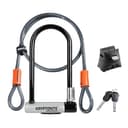
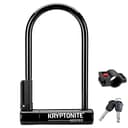
| Kryptonite KryptoLok | U-lock + cable | 12.7mm shackle | Sold Secure Gold | Frame bracket included |
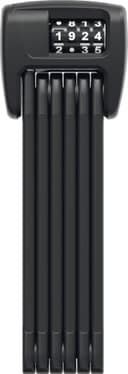
| ABUS Bordo 6000 | Folding, 90 cm | 5mm hardened bars | ABUS Level 10/15 | Frame holster included |
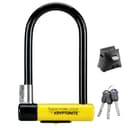
| Kryptonite NY Standard | Full-size U-lock | 16mm shackle | Kryptonite high band | Bracket included |
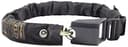
| Hiplok Gold | Wearable chain | 10mm hardened chain | Sold Secure Gold | Worn around the waist |
| Kryptonite Keeper | U-lock | 12mm shackle | Sold Secure Silver | Bracket included |
The rating column is the one to read twice. Four of these five are in the upper bands of their maker’s scale; the Keeper is deliberately a step down, and it is in this list as the honest floor — a real hardened U-lock at close to cable-lock money, which is a far better $25 than a cable.
Why cable locks lose bikes on campuses specifically
Because a campus rack is the one place where a thief can walk down a line of bikes and pick. A cable lock takes seconds with hand tools, it is silent, and it looks like every other cable on the rack while it is being cut. If half the bikes at your rack are on cables and yours is on a Gold-rated U-lock, you are not the bike that gets taken — and that, not absolute strength, is what keeps a student bike for four years. We go through this properly in are cable locks safe and how thieves actually break locks.
The nuance worth knowing: a cable is a perfectly good second lock. The KryptoLok ships with one for exactly that job, looping a front wheel back to the U-lock. It is convenience security, not primary security, and that distinction is the whole point.
Campus locking technique that costs nothing
- Frame and rear wheel inside the shackle, to the rack. The rear wheel is the expensive one. Fill the U with bike so there is no room for a jack or a crowbar. Full method in how to lock your bike.
- Front wheel on the cable, every time.Quick-release wheels are the most-stolen part on a campus because they take no tools at all — wheels and saddle covers the cheap fixes.
- Lock to something that is actually fixed. Signposts without a top, chain-link fences and small trees are not racks. The sign-post trick and the other no-rack options are in locking without a rack.
- Record the serial number before you need it.It is stamped under the bottom bracket. Register it with campus security and with a national registry the week you arrive. This is the single highest-value five minutes in bike ownership and the reason some stolen bikes come back — what to do if your bike is stolen.
- Do not leave it out overnight. Overnight parking is where opportunistic theft becomes patient theft, and patient theft defeats a 12.7mm shackle. If overnight outdoor parking is unavoidable, that is the scenario for the New York Standard plus a second lock.
- Make the bike boring. Scuffed bar tape and a strip of electrical tape over the logos genuinely helps on a rack where every bike is a choice.
Two locks, or one?
On a campus, one good lock plus a cable is the right answer for most students, and a second hardened lock is the right answer for two groups: anyone who parks outdoors overnight, and anyone riding a bike worth more than about a month’s rent. The logic is that two different lock types force a thief to carry two different tools, which is a much bigger ask than one tool used twice. We work through when that upgrade pays in do you need two bike locks.
If you ride an e-bike to class, treat it as its own category rather than a student bike — it is heavier, far more valuable and a known target. The locks that match it are in best locks for e-bikes, and the battery should come inside with you.
What we would skip
A cable as the only lock. The cheapest way to donate a bike.
A combination lock with a four-dial barrel. Convenient, and defeated by patience rather than tools.
A mini U-lock, unless you know your racks. It is the most secure shape per pound and it will not reach around some campus racks. Check before you commit.
Spending more than the bike is worth while leaving the wheels loose. Technique is free and it beats an upgrade.