Chain & Charge

Best Bike Pump for Commuting

Two different problems hide behind one word. A pump at home stops flats happening; a pump on the bike gets you home when one does. Almost nobody needs the same tool for both.

By Stephen V.Last updated How we pick

Buy the floor pump first.Not the clever pocket one — the unglamorous one that stands in a hallway with a gauge on it. The single most common “my bike is slow and keeps getting flats” problem on a commute is not punctures at all. It is a tire that has been quietly losing air since the shop set it up, ridden soft for months, and then pinched flat on a pothole. Schwalbe, which makes the tires on a lot of commuter bikes, publishes the number: you should check and correct pressure at least once a month, and a loss of about 1 bar a month is normal even on a healthy tube.

That one fact splits this page in half, and it is why “best bike pump” is a bad question. There are two jobs here. Prevention happens at home on a stand-up pump with a dial on it, takes two minutes a week, and is the cheapest reliability upgrade in commuting. Rescue happens at the side of a road in the dark with cold hands, and needs something small enough that it is actually on the bike when it happens. A pump that is brilliant at one is usually mediocre at the other, and the mini pump that lives in a drawer at home is worth nothing at all.

So: five picks, one per failure. A floor pump for the weekly habit. A frame pump that unfolds into a small floor pump, for people who want one pump to do both jobs properly. A plain budget mini for the rider who currently has no pump at all. An electric pump for anyone whose hands or shoulders are the actual reason a flat becomes a cab fare. And a CO2 inflator, which is the fastest option here and the one we would never let you buy on its own.

We own none of these pumps and run no test lab. Every figure below is read from the seller’s own live listing on a dated visit, and in this category that discipline bites in a specific way: a “160 psi” number on a pump is a body rating, not a promise that your arms can get there, and none of these listings publishes a strokes-to-pressure figure, a per-stroke air volume for the gauge models, or an inflation time. Where a listing publishes nothing, the row below says so. Here is exactly what we do instead of testing.

How this is funded:we earn a commission if you buy through our links, at no extra cost to you. It never changes which product we recommend, and we’ll tell you when we’d skip one. Full disclosure.

Quick picks

Ranked on published specs, real security and safety standards, and buyer fit. Select a row to jump to the full write-up.We have not tested these products — here is exactly what we do instead.

#ProductBest forPrice
1
Topeak JoeBlow Sport III Floor Pump

Topeak JoeBlow Sport III Floor Pump

The accessory that prevents more commuting problems than any other, because most of what new riders blame on a slow, squirmy, puncture-prone bike is just tires nobody has topped up since the shop did.

Best overall
$66.07 · View on Amazon

$69.956% off

Price as of October 24, 2026. #ad How we’re funded

2
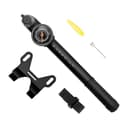
Topeak Mini Morph G Mini Pump

Topeak Mini Morph G Mini Pump

The pump that actually gets a roadside tire back to a rideable pressure, because it unfolds into a tiny floor pump: a fold-out foot pad, a T-handle you pull with both hands and an in-line gauge, so you stop at a number instead of at the point where your thumbs give up.

Best to carry
$37.88 · View on Amazon

$49.9524% off

Price as of October 24, 2026. #ad How we’re funded

3
BV Mini Bike Pump Portable Frame Pump

BV Mini Bike Pump Portable Frame Pump

The honest floor of the category: a plain hand pump with a reversible head that fits both valve types, for the rider whose current plan for a flat is a phone and a ride-share. It is the cheapest thing on this page that is not a toy.

Best budget
$17.99 · View on Amazon

Price as of October 24, 2026. #ad How we’re funded

4
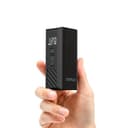
CYCPLUS A3Mini Electric Bike Pump

CYCPLUS A3Mini Electric Bike Pump

The pump for anyone whose hands, wrists or shoulders are the reason a flat turns into a cab fare: it inflates on its own, shows the pressure on a display, and shuts itself off. That is a real accessibility answer, not a gadget.

Best with no effort
$59.99 · View on Amazon

Price as of October 24, 2026. #ad How we’re funded

5
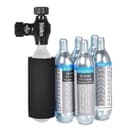
BriskMore CO2 Inflator Kit (5 x 16g)

BriskMore CO2 Inflator Kit (5 x 16g)

The fastest way back on the bike and the worst way to own a pump: one cartridge fills a tire in seconds, and when the cartridges are gone they are gone. Carry it as well as a pump, never instead of one.

Fastest roadside fix
$23.99 · View on Amazon

Price as of October 24, 2026. #ad How we’re funded

The picks in full

#1Best overall

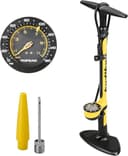
Topeak JoeBlow Sport III Floor Pump

The accessory that prevents more commuting problems than any other, because most of what new riders blame on a slow, squirmy, puncture-prone bike is just tires nobody has topped up since the shop did.

Strengths

  • 3-inch analog gauge — you inflate to a number instead of guessing by thumb
  • TwinHead DX5 fits Presta, Schrader and Dunlop valves without an adapter
  • Steel barrel and a long hose, so the pump reaches an awkwardly parked bike
  • One pump serves every bike in the household

Trade-offs

  • It lives at home — it does nothing for you at the roadside
  • 160 PSI is far more headroom than any commuter tire will ever use
  • Steel barrel makes it heavy to shift around a small apartment
  • Costs several times a basic frame pump
Max pressure160 PSI
Gauge3" analog
HeadTwinHead DX5 — Presta, Schrader, Dunlop
BarrelSteel

Specs read from the product listing, on September 6, 2026. We have not physically tested this product.

#2Best to carry

Topeak Mini Morph G Mini Pump

The pump that actually gets a roadside tire back to a rideable pressure, because it unfolds into a tiny floor pump: a fold-out foot pad, a T-handle you pull with both hands and an in-line gauge, so you stop at a number instead of at the point where your thumbs give up.

Strengths

  • Fold-out foot pad and T-handle give you body weight instead of thumb strength
  • In-line gauge reads to 140 psi (listing) — you inflate to a number, not a guess
  • Head fits Presta, Schrader and Dunlop with no adapter (listing)
  • Frame bracket included (listing), so it rides on the bike rather than in a drawer

Trade-offs

  • Bigger and heavier than a pocket mini pump — it wants a frame mount or a pannier
  • The flexible hose is the part that eventually fails on every Morph-style pump
  • Listing publishes no weight for this variant; the no-gauge Mini Morph spec table gives 50 cm3 air volume and a 160 psi body rating
  • Costs roughly double a plain mini pump, for leverage you only need when you are stranded
GaugeIn-line, reads to 140 psi (listing)
HeadPresta, Schrader, Dunlop (listing)
LeverageFold-out foot pad + T-handle (listing)
MountFrame bracket included (listing)
Body rating160 psi / 11 bar, 50 cm3 air volume (bike-components, no-gauge variant)

Specs read from the product listing, on October 24, 2026. We have not physically tested this product.

#3Best budget

BV Mini Bike Pump Portable Frame Pump

The honest floor of the category: a plain hand pump with a reversible head that fits both valve types, for the rider whose current plan for a flat is a phone and a ride-share. It is the cheapest thing on this page that is not a toy.

Strengths

  • Fits Presta and Schrader with a smart reversible head (listing) — no adapter to lose
  • Cheapest real pump here by a wide margin
  • Small and light enough that you will not take it off the bike
  • Rated to 120 psi (listing) — far beyond anything a commuter tire needs

Trade-offs

  • No gauge at all, so you are back to the thumb test Schwalbe calls unreliable
  • Short barrel and no foot pad means a lot of strokes and sore hands on a 700c tire
  • Listing publishes no weight, no length and no per-stroke air volume
  • The rated pressure is a body rating, not a promise you can reach it by hand
Max pressure120 psi (listing)
HeadReversible, Presta + Schrader (listing)
GaugeNone
TypeFrame-mount hand pump

Specs read from the product listing, on October 24, 2026. We have not physically tested this product.

#4Best with no effort

CYCPLUS A3Mini Electric Bike Pump

The pump for anyone whose hands, wrists or shoulders are the reason a flat turns into a cab fare: it inflates on its own, shows the pressure on a display, and shuts itself off. That is a real accessibility answer, not a gadget.

Strengths

  • Inflates with no physical effort and stops itself at the set pressure (listing)
  • Display shows live pressure — the only pump here that is also a gauge you can read at a glance
  • Native Presta and Schrader (listing), unlike car inflators that need a Presta adapter
  • 212 g and pocket-size (listing), so it rides in a jacket rather than on the frame

Trade-offs

  • A 2000 mAh battery is one more thing to charge, and a flat battery is a dead pump
  • Electric mini pumps are slow and run hot on a big-volume tire; this is a top-up tool, not a tire-seating compressor
  • Costs several times a hand pump that never needs charging
  • Listing publishes no inflation time, no duty cycle and no tires-per-charge figure
Max pressure120 psi (listing)
Battery2000 mAh (listing)
Weight212 g (listing)
ValvesPresta + Schrader (listing)
FeaturesBrushless motor, display, auto-off (listing)

Specs read from the product listing, on October 24, 2026. We have not physically tested this product.

#5Fastest roadside fix

BriskMore CO2 Inflator Kit (5 x 16g)

The fastest way back on the bike and the worst way to own a pump: one cartridge fills a tire in seconds, and when the cartridges are gone they are gone. Carry it as well as a pump, never instead of one.

Strengths

  • Fills a commuter tire in seconds with no effort at all
  • Fits Presta and Schrader (listing) and weighs almost nothing in a saddlebag
  • Insulated sleeve included (listing) — a discharging cartridge gets cold enough to hurt
  • Five 16 g cartridges in the box (listing), so it arrives ready rather than needing a second order

Trade-offs

  • Single-use: a fumbled cartridge is a wasted fill, and there is no second attempt
  • No gauge, so you cannot set a pressure — you get whatever the cartridge gives that tire
  • CO2 migrates out of a butyl tube faster than air, so expect to re-inflate within days
  • Refills are an ongoing cost, and airlines restrict cartridges in baggage
TypeCO2 inflator, 16 g threaded cartridges
In the boxInflator head + 5 x 16 g cartridges + sleeve (listing)
ValvesPresta + Schrader (listing)
GaugeNone — not adjustable

Specs read from the product listing, on October 24, 2026. We have not physically tested this product.

How we picked

Five criteria, in the order they decide the purchase. Note what is not on the list: a maximum pressure ranking, a “best value” score and a strokes-to-80-psi figure. The first is close to meaningless on a commuter bike, and nobody publishes the third.

1. Which job is this — prevention or rescue? This comes first because it sends you to opposite ends of the page, and buying the wrong end is the most common mistake here. Prevention is a weekly habit, and habits die when the tool is awkward: a floor pump that stands up, takes two seconds to attach and shows a dial survives as a routine. Rescue is a once-a-year emergency, and the only pump that helps is the one strapped to the bike. If you buy one pump for both, you are choosing which job to do badly.

2. Does it have a gauge?The single most useful feature and the one riders skip to save money. Schwalbe is blunt about the alternative: the thumb test is “not very reliable” because a tire feels firm from roughly 2 bar up regardless of what is actually in it, so a tire you squeezed and called fine can be 20 psi under where it should be. A gauge turns pressure from a feeling into a number you can hit. Three of the five picks here have one; the two that do not are honest about it.

3. Does the head fit your valve without an adapter?Commuter bikes come with both valve types — the narrow Presta with a little screw-down tip, common on 700c road and hybrid wheels, and the fat Schrader that looks like a car valve and is near-universal on e-bikes, cheaper hybrids and anything with wide tires. A pump that needs a brass adapter to reach one of them is a pump that will fail you the day the adapter is in your other jacket. Every pick on this page handles both without an adapter, per its own listing. Car-style tire inflators from the auto aisle usually do not, which is one of two reasons we picked a bicycle-specific electric pump over a cheaper car inflator.

4. How hard do you actually have to work?The spec sheets hide this completely. A full-size floor pump uses your body weight through a long barrel. A fold-out-foot-pad frame pump uses your body weight through a short one. A pocket mini pump uses your thumbs and wrists, which is why the last 20 psi on a skinny tire with a pocket pump is genuinely unpleasant and why so many roadside repairs end at “soft enough to limp home.” If limited grip strength, arthritis or a shoulder injury is part of your life, this criterion outranks every other one on the page and the electric pump is the answer.

5. What does it cost you after the purchase?Three of these pumps cost nothing to keep. The electric pump costs a charge you have to remember. The CO2 inflator costs money every single time you use it, and leaves you with nothing when the cartridges run out. That is not a reason to avoid it — it is a reason not to let it be your only plan.

The five, side by side

Read the first two columns and stop. The blanks are real: a seller who has not published a weight has not published one, and we are not going to estimate it.

PumpJobGaugeValvesEffortRated max
Topeak JoeBlow Sport IIIPrevention, at home3" analog dialPresta, Schrader, DunlopBody weight, long barrel160 psi
Topeak Mini Morph GBoth — rescue firstIn-line, reads to 140 psiPresta, Schrader, DunlopBody weight, foot pad + T-handle160 psi (body, no-gauge spec table)
BV Mini Bike PumpRescue, on a budgetNonePresta, SchraderThumbs and wrists120 psi
CYCPLUS A3MiniRescue, no physical effortDigital displayPresta, SchraderNone — it runs itself120 psi
BriskMore CO2 InflatorRescue, fastestNonePresta, SchraderNone — one twistNot published — not adjustable

Rated maximums are the figures the listings publish. None of them is a target: a 700c commuter tire usually wants something in the 50–80 psi range and a wide e-bike tire a good deal less, and the right number is printed on your own tire sidewall. Nothing on this page needs to go near 120 psi.

What pressure should a commuter tire actually run?

The answer is on the side of your tire, not on a chart. Every bicycle tire has a pressure range molded into its sidewall, and that range — not a number from a forum, and not the pump’s rated maximum — is the one to work inside. A narrow 700x28 hybrid tire and a 20x4.0 fat e-bike tire can differ by a factor of three.

Where to sit inside the range is a real trade-off, and it is worth understanding because it changes what pump you need. Toward the top of the range you get lower rolling resistance and much better protection against pinch flats, and you lose comfort and grip on a wet painted line. Toward the bottom you get a softer ride and more traction, and you pay in rolling resistance and risk. What you must not do is sit belowthe range: Schwalbe’s own guidance is that permanently low pressure causes premature wear, with sidewall cracking the typical result, and unnecessarily increased abrasion. The pothole that ends in a pinch flat and the tire that dies at eighteen months are the same mistake.

Two practical consequences for pump choice. First, higher pressures leak faster — Schwalbe states plainly that pressure loss is significantly faster at high pressures and slower at low ones — so a skinny-tired commuter needs the weekly habit more than a fat-tired e-bike does. Second, a tire pumped to a number you can see is a tire you can actually manage. That is the whole argument for the gauge, and it is why the two picks here without one are explicitly the emergency tools rather than the main pump.

CO2 is a shortcut, not a pump

A 16 g cartridge fills a commuter tire in about the time it takes to read this sentence, which is exactly why riders who are late for work love them. Three things to know before it becomes your plan.

It is single-use and unforgiving. There is no partial fill and no second attempt with the same cartridge: if the head is not seated squarely when you twist, the gas goes into the street and you are a cartridge down. Doing that once in the cold, in the dark, with a bus to catch, is the experience that teaches people to carry a hand pump as well.

It does not stay in the tire. Carbon dioxide migrates through a butyl inner tube considerably faster than air does, so a tire you fill with CO2 on Tuesday will be noticeably soft within a few days. That is fine as an understanding — it is a get-home gas, and you top the tire up with air at home that evening. It is a problem if you assumed the job was finished.

And there is no gauge, so you get whatever one cartridge gives that particular tire volume. On a narrow 700c tire a single 16 g cartridge gets you to a usable pressure; on a wide e-bike tire it will not, and no amount of technique changes that. The BriskMore kit ships with five cartridges and an insulated sleeve, and the sleeve is not a luxury: a cartridge discharging at full rate gets cold enough to injure a bare hand.

The e-bike case is different

Three things change on an e-bike, and all three push you toward a different pump. The tires are usually Schrader and much higher in volume, which means far more strokes from a pocket pump and a CO2 cartridge that cannot fill them. The bike is heavy, so a soft tire is more likely to pinch flat and the consequences of riding it under-inflated are worse. And getting the rear wheel out to fix anything on a hub-motor bike is a job with a torque arm and a motor cable in it, which makes not getting the flat worth considerably more than it is on an acoustic bike.

For an e-bike commuter the honest shopping list is the floor pump at home, checked weekly, plus either the Mini Morph G or the electric pump on the bike — and the electric pump looks much better here than it does on a light hybrid, because the volume it has to move is the thing that makes hand-pumping miserable. The rest of the e-bike-specific kit is in the e-bike starter kit, and the maintenance jobs worth doing yourself are in the e-bike maintenance guide.

What else goes in the saddlebag

A pump on its own fixes exactly one failure: a slow leak you can top up. For an actual puncture you also need a spare tube in your wheel size, two tire levers, and a multi-tool with the hex key that fits your axle or a wrench if your wheels are bolted on. That is the whole kit, it fits in a jersey pocket or a corner of a pannier, and the tool half of it is covered on the commuter accessories page.

The one thing we would add that nobody puts on these lists: know your wheel size before you need a tube. It is written on the tire sidewall, it takes ten seconds to read at home, and reading it for the first time by phone light at the roadside is how people end up buying the wrong tube from the only shop still open.

Frequently asked questions

Do I really need both a floor pump and a mini pump?

Not on day one, but they do different jobs and the floor pump is the one that pays off daily. The floor pump is prevention: a gauge and a two-minute weekly top-up, which removes most of the slow-leak flats and the sluggish handling people blame on the bike. The mini pump is insurance against the puncture that happens anyway. If you can only buy one now, buy the floor pump and accept that your first roadside flat will be a walk or a ride-share. If your commute has no fallback - no transit option, no one to call - buy the carryable pump first instead and borrow a gauge until you can add the floor pump.

How often should I pump up my bike tires?

Schwalbe, which makes a lot of the tires fitted to commuter bikes, publishes it plainly: check and correct the air pressure at least once a month, and a loss of around 1 bar per month is normal even on an airtight tube. Loss is faster at higher pressures and slower at low ones, so a skinny-tired hybrid drifts out of range faster than a fat-tired e-bike. In practice, weekly is a better habit than monthly for a bike you ride every day, because weekly is a routine you can attach to something and monthly is a thing you forget.

Is a bike pump with a gauge worth it?

Yes, and it is the one feature we would not give up. Schwalbe calls the thumb test 'not very reliable' because a tire feels firm from roughly 2 bar upward no matter what is actually in it - so the tire you squeezed and called fine can easily be well under its own sidewall range. A gauge converts pressure from a feeling into a number, which is the only way to use the range printed on your tire. The gauge also makes the weekly habit shorter, because you stop when the dial says so instead of guessing and over-pumping.

What is the difference between Presta and Schrader valves?

Schrader is the fat one that looks exactly like a car tire valve, with a spring-loaded pin in the middle. It is what you will find on most e-bikes, most cheaper hybrids and almost anything with wide tires. Presta is the narrow one with a small knurled nut on the tip that you unscrew before inflating and screw back down afterward, common on 700c road and hybrid wheels. The practical point when buying a pump: get one whose head fits both without a brass adapter, because the adapter is the part that goes missing. Every pump on this page handles both per its own listing.

Are electric bike pumps any good?

For one specific reader, they are the best answer on this page: anyone whose hands, wrists or shoulders are the reason a roadside flat turns into a cab fare. A pocket electric pump inflates to a pressure you set, shows the number on a display and stops itself, with no physical effort at all. The honest limits are real too. It is one more battery to keep charged, and a flat battery is a dead pump. Small electric pumps are slow and run warm on high-volume tires, so treat one as a top-up and get-home tool rather than something that will seat a stubborn tire. And it costs several times what a hand pump that never needs charging costs.

Can I use a car tire inflator on a bike?

Sometimes, and it is usually the wrong tool. Two problems. Most car inflators have a Schrader-only chuck, so a Presta-valved commuter bike needs a brass adapter you have to remember to carry. And car inflators are built around car pressures and car volumes, which means long run times and a lot of heat on a bicycle tire that only needs a fraction of the air. If you want the no-effort option, a bicycle-specific electric pump with native Presta and Schrader heads is worth the extra money. If you already own a car inflator and a Presta adapter, it will get you home - just do not make it your only plan.

How much pressure should a commuter bike tire have?

Read your own tire sidewall - every bicycle tire has its pressure range molded into it, and that range is the only figure that applies to your wheel. A narrow 700x28 hybrid tire and a 20x4.0 fat e-bike tire differ enormously. Inside the range, higher means lower rolling resistance and better pinch-flat protection but a harsher ride and less grip on wet paint; lower means comfort and traction at the cost of efficiency and risk. What matters most is not going below the range at all: Schwalbe's guidance is that permanently low pressure causes premature wear with sidewall cracking the typical result. Ignore the pump's rated maximum entirely - 120 or 160 psi is what the pump body can take, not a target for your tire.

Will a CO2 inflator alone get me through a commute?

Not reliably, and we would not recommend buying one as your only inflation plan. Each cartridge is single-use, there is no partial fill and no second attempt if the head is not seated squarely, and once the cartridges are gone the tool does nothing. CO2 also migrates out of a butyl tube faster than air, so a tire filled on the roadside will be noticeably soft again within a few days and needs topping up with air at home. Carry CO2 as the fast option alongside a hand pump, not instead of one - and on a wide e-bike tire, assume a single 16 g cartridge will not get you to a usable pressure at all.

Sources

  • Schwalbe — Technology FAQ: tire pressure — The tire maker's own published guidance: "You should check and correct the air pressure at least once a month"; a loss of about 1 bar per month is considered normal even for airtight tubes; "The pressure loss is significantly faster at high pressures and significantly slower at low pressures"; latex tubes should be checked and adjusted before every ride; and the thumb test is "not very reliable" because tires feel firm from roughly 2 bar regardless of actual pressure, so Schwalbe recommends a pressure gauge instead (and calls the thumb test "completely inadequate" on Marathon Plus tires). On permanently low pressure: premature wear, with sidewall cracking the typical result, and unnecessarily increased abrasion (accessed October 24, 2026)
  • bike-components — Topeak Mini Morph mini floor pump (spec table) — The retailer's published specification table for the Mini Morph body: max pressure listed as "11" / "160" (bar / psi), air volume "50 cm³", width 5 cm, height 26 cm, depth 2.8 cm, "Presta, Schrader, and Dunlop valve", gauge "none", aluminum cylinder with a plastic base and rubber handle, and "1 x Topeak Central Mount Bracket" in the box. This listing is the NO-GAUGE Mini Morph — bike-components does not list a Mini Morph G, so the gauge variant's own figures on our page come from its Amazon listing instead and the two are never mixed. No weight is published in this table (accessed October 24, 2026)

Keep reading