Chain & Charge

Commuter Bike Accessories Worth Buying

You have the bike, the lock, the lights and the bags. This is the short list of what genuinely earns a place after that — and the longer list of what does not.

By Stephen V.Last updated How we pick

The accessory wall is where a commuting budget goes to die. Once you own the five things that actually matter — bike, lock, lights, a way to carry your load, a helmet — almost everything else on offer is solving a problem you do not have, and a few things are solving problems you will absolutely have by week three.

This page is the short list of the second group. Six accessories that change a daily ride, ranked by how often they earn their money, plus an honest section at the end on the things we would not buy and why. If you have not covered the five essentials yet, start with the commuting essentials checklist — nothing on this page belongs ahead of any item on that one.

We own none of these products and run no test lab; picks come from published specs and honest fit, and where a listing publishes no figure we say so instead of guessing — here is exactly what we do instead. Accessory prices move constantly, so check the live number before you buy.

How this is funded:we earn a commission if you buy through our links, at no extra cost to you. It never changes which product we recommend, and we’ll tell you when we’d skip one. Full disclosure.

Quick picks

Ranked on published specs, real security and safety standards, and buyer fit. Select a row to jump to the full write-up.We have not tested these products — here is exactly what we do instead.

#ProductBest forPrice
1
Topeak JoeBlow Sport III Floor Pump

Topeak JoeBlow Sport III Floor Pump

The accessory that prevents more commuting problems than any other, because most of what new riders blame on a slow, squirmy, puncture-prone bike is just tires nobody has topped up since the shop did.

Preventing most flats
$55.89 · View on Amazon

$69.9520% off

Price as of September 6, 2026. #ad How we’re funded

2
Crankbrothers Multi Tool M17

Crankbrothers Multi Tool M17

The one tool worth carrying, because it includes a chain tool — and a snapped chain is the only common roadside failure that a hex key alone cannot get you home from.

Getting home
$27.99 · View on Amazon

Price as of September 6, 2026. #ad How we’re funded

3
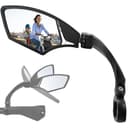
Hafny HF-MR095 Handlebar Bike Mirror

Hafny HF-MR095 Handlebar Bike Mirror

The cheapest thing on this site that changes how you ride in traffic: you stop turning your head to check for a car behind you, which means you stop drifting a foot into the lane every time you do it.

Seeing behind you
$22.99 · View on Amazon

Price as of September 6, 2026. #ad How we’re funded

4
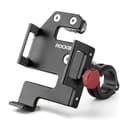
RockBros Aluminum Bike Phone Mount

RockBros Aluminum Bike Phone Mount

A phone in your pocket is a phone you stop to read; a phone on the bars is a route you can follow at a glance — and for a commuter still learning a new way to work, that is the difference between a calm ride and a stressful one.

Following a new route
$15.99 · View on Amazon

Price as of September 6, 2026. #ad How we’re funded

5
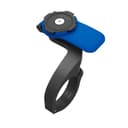
Quad Lock Out Front Handlebar Bike Phone Mount (V3)

Quad Lock Out Front Handlebar Bike Phone Mount (V3)

The step up for anyone who rides every day: the phone clicks into a twist-lock instead of being squeezed by arms, sits out front where you can see it without looking down, and comes off in one motion at the rack.

The daily-rider upgrade
$39.99 · View on Amazon

Price as of September 6, 2026. #ad How we’re funded

6
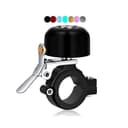
Greallthy Classic Brass Bike Bell

Greallthy Classic Brass Bike Bell

Required by law in some places and basic courtesy everywhere else — a brass ping is the sound pedestrians recognize as a bike, which is the whole job, and a shout is not a substitute.

Shared paths
$13.95 · View on Amazon

Price as of September 6, 2026. #ad How we’re funded

The picks in full

#1Preventing most flats

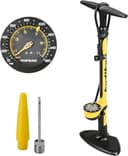
Topeak JoeBlow Sport III Floor Pump

The accessory that prevents more commuting problems than any other, because most of what new riders blame on a slow, squirmy, puncture-prone bike is just tires nobody has topped up since the shop did.

Strengths

  • 3-inch analog gauge — you inflate to a number instead of guessing by thumb
  • TwinHead DX5 fits Presta, Schrader and Dunlop valves without an adapter
  • Steel barrel and a long hose, so the pump reaches an awkwardly parked bike
  • One pump serves every bike in the household

Trade-offs

  • It lives at home — it does nothing for you at the roadside
  • 160 PSI is far more headroom than any commuter tire will ever use
  • Steel barrel makes it heavy to shift around a small apartment
  • Costs several times a basic frame pump
Max pressure160 PSI
Gauge3" analog
HeadTwinHead DX5 — Presta, Schrader, Dunlop
BarrelSteel

Specs read from the product listing, on September 6, 2026. We have not physically tested this product.

#2Getting home

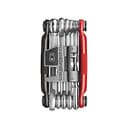
Crankbrothers Multi Tool M17

The one tool worth carrying, because it includes a chain tool — and a snapped chain is the only common roadside failure that a hex key alone cannot get you home from.

Strengths

  • Chain tool rated for 8- to 12-speed chains (Crankbrothers)
  • Hex 2, 2.5, 3, 4, 5, 6 and 8mm plus Torx T-25 covers nearly every bolt on a commuter (Crankbrothers)
  • Spoke wrenches #0-3 and 8mm/10mm open wrenches included (Crankbrothers)
  • 168g and 89 x 43 x 19mm (Crankbrothers) — it disappears in a bag

Trade-offs

  • A multi-tool has short handles; it is for getting home, not for a proper service
  • No tire levers and no patch kit — you still need those separately
  • Costs more than a basic folding hex set that covers most of the same bolts
  • Steel construction means it is heavier than an aluminum-bodied mini tool
Chain tool8-12 speed (Crankbrothers)
Hex2, 2.5, 3, 4, 5, 6, 8mm (Crankbrothers)
OtherTorx T-25, Phillips #2, flat #2, spoke #0-3 (Crankbrothers)
Weight168 g (Crankbrothers)
MaterialHigh tensile steel (Crankbrothers)

Specs read from the product listing, on September 6, 2026. We have not physically tested this product.

#3Seeing behind you

Hafny HF-MR095 Handlebar Bike Mirror

The cheapest thing on this site that changes how you ride in traffic: you stop turning your head to check for a car behind you, which means you stop drifting a foot into the lane every time you do it.

Strengths

  • HD glass rather than plastic, listed as shatterproof and anti-glare
  • 360-degree adjustable, so you can set it to your own riding position
  • Wide-angle field, listed for MTB, e-bike and commuter bars
  • Costs less than a set of lights and arguably does as much for your safety

Trade-offs

  • This listing is the left-side version — order the right-hand one if you need that side
  • Handlebar-end mounting needs a free bar end, which some grips and plugs occupy
  • A mirror adds width; mind doorways, bike racks and filtering gaps
  • Shatterproof per the listing is not the same as unbreakable in a fall
GlassHD glass, shatterproof, anti-glare (listed)
Adjustment360-degree
MountHandlebar
SideLeft (this listing)

Specs read from the product listing, on September 6, 2026. We have not physically tested this product.

#4Following a new route

RockBros Aluminum Bike Phone Mount

A phone in your pocket is a phone you stop to read; a phone on the bars is a route you can follow at a glance — and for a commuter still learning a new way to work, that is the difference between a calm ride and a stressful one.

Strengths

  • Aluminum clamp rather than plastic, at a budget price
  • Fits 4.7 to 7.1-inch phones (listed), which covers almost every current handset
  • Works with your existing case — no proprietary case to buy
  • Cheap enough to leave on a bike you lock outside

Trade-offs

  • Clamp arms cover part of the screen edge
  • No published weatherproofing — a phone on the bars is a phone in the rain
  • A thick case can push a large phone past the 7.1-inch limit
  • Slower to remove at a stop than a case-based quick-release system
MaterialAluminum handlebar clamp
Fits4.7-7.1" phones
MountHandlebar
CaseWorks with a standard case

Specs read from the product listing, on September 6, 2026. We have not physically tested this product.

#5The daily-rider upgrade

Quad Lock Out Front Handlebar Bike Phone Mount (V3)

The step up for anyone who rides every day: the phone clicks into a twist-lock instead of being squeezed by arms, sits out front where you can see it without looking down, and comes off in one motion at the rack.

Strengths

  • Twist-lock mounting — nothing covers the screen
  • Out-front position puts the phone in your natural sightline
  • Listed for iPhone, Galaxy and Pixel, plus universal adapters
  • One-motion release, which is what actually gets used twice a day

Trade-offs

  • Needs a Quad Lock case or a universal adapter — the mount alone will not hold a bare phone
  • By far the most expensive way here to hold a phone
  • Out front is exactly where the phone lands if the bike goes down
  • This listing publishes no weather cover; that is a separate product
MountOut-front handlebar
SystemTwist-lock (case or universal adapter)
Listed foriPhone, Galaxy, Pixel, universal adapters
VersionV3

Specs read from the product listing, on September 6, 2026. We have not physically tested this product.

#6Shared paths

Greallthy Classic Brass Bike Bell

Required by law in some places and basic courtesy everywhere else — a brass ping is the sound pedestrians recognize as a bike, which is the whole job, and a shout is not a substitute.

Strengths

  • Brass body — the classic ping people actually recognize
  • Universal handlebar fit per the listing
  • Black finish disappears on most commuter bars
  • One of the cheapest safety-adjacent parts you can buy

Trade-offs

  • An anonymous brand with no track record behind it
  • The listing publishes no decibel figure
  • A polite ping does not carry over traffic — this is a path tool, not a car tool
  • 'Universal' fit can sit awkwardly on oversized or aero bars
MaterialBrass
MountUniversal handlebar
ColorBlack
Published detailListing gives no decibel rating

Specs read from the product listing, on September 6, 2026. We have not physically tested this product.

How we picked

1. It has to solve a problem a commute actually produces. Not a problem racing produces, not a problem a listing invents. Every pick here maps to something that happens on an ordinary week of riding to work: a soft tire, a roadside failure, a car you cannot see, a junction you do not know, a pedestrian who has not heard you.

2. Cheapest thing that does the job wins. Two of the six cost less than a takeaway lunch. Where a premium version genuinely earns the difference for a daily rider we include both and say what the extra money buys, which is why there are two phone mounts here rather than one.

3. Published figures only. Where a listing publishes no decibel rating, no waterproofing and no weight, we print that as unpublished. A lot of accessory listings are anonymous sellers with generous adjectives, and the honest response is to say which numbers exist.

4. We say what to skip. A roundup that recommends everything is not a roundup. The last section is the things we would not buy for a commute, with the reasoning.

The pump is the highest-value thing here

This is not an exciting recommendation and it is the correct one. Tires lose pressure continuously whether or not you ride, and an underinflated tire is slow, squirmy, harder to control and far more likely to pinch-flat. New commuters routinely conclude that their bike is bad when what is actually happening is that nobody has put air in it since the shop did.

The Topeak JoeBlow Sport IIIis the pick because of the gauge: a 3-inch analog dial means you inflate to a number instead of guessing by thumb, which is what makes it a repeatable weekly habit rather than an occasional panic. The TwinHead DX5 takes Presta, Schrader and Dunlop valves without an adapter, which removes the other reason people stop bothering. Its 160 PSI ceiling is far more headroom than any commuter tire will use — you are paying for a range you will not touch, and it is still the right buy.

The honest limit: it lives at home. It does nothing for you at the roadside, which is what the next pick is for.

The multi-tool, and the one failure a hex key cannot fix

Most roadside problems on a commuter are a loose bolt or a saddle that has slipped, and any folding hex set handles those. The Crankbrothers M17 is worth the premium over a basic set for one specific reason: it includes a chain tool, and a snapped chain is the only common failure that leaves you genuinely walking if you cannot fix it.

Crankbrothers publishes the full tool list — a chain tool rated for 8- to 12-speed chains, hex wrenches from 2 to 8mm, Torx T-25, Phillips and flat screwdrivers, spoke wrenches #0 to #3, and 8mm and 10mm open wrenches — in high tensile steel at 168g. That covers close to every fastener on a normal commuter.

What it does not include, and what you still need separately: tire levers and a patch kit or spare tube. A multi-tool is for getting home, not for a proper service — the handles are short and the leverage is poor by design.

The mirror is the cheapest safety upgrade on this site

This one is underrated to the point of being a genuine edge. Without a mirror, checking for traffic behind you means turning your head, and turning your head on a bike means drifting — usually a foot or so into the lane, which is exactly the wrong direction at exactly the wrong moment. A mirror removes the drift and lets you check far more often, which changes how you position yourself in traffic.

The Hafny HF-MR095 uses HD glass rather than plastic, listed as shatterproof and anti-glare, on a 360-degree adjustable handlebar mount. Two things to check before ordering: this listing is the left-side version, so order the right-hand one if that is the side you want; and bar-end mounting needs a free bar end, which some grips and bar plugs occupy. It also adds width to your bars, which matters at doorways and crowded bike racks.

A mirror complements road positioning rather than replacing it. The habits that do most of the work are in bike commuting safety in traffic.

Phone mounts: the cheap one and the one for daily riders

A phone in your pocket is a phone you stop to read. On a route you know by heart that costs nothing; on a new one it turns a commute into a series of anxious pauses at junctions. If you are still working out a better way to work — which is exactly what how to plan a bike commute route is about — a mount is worth more than its price.

The RockBros aluminum mountis the value answer: an aluminum clamp rather than plastic, fitting 4.7 to 7.1-inch phones, working with the case you already own. Its compromises are real — the clamp arms sit over the screen edge, there is no published weatherproofing, and it is slower to remove at a stop than a proper quick-release.

The Quad Lock Out Front is the upgrade, and the case for it is entirely about the twice-a-day motion: it twist-locks instead of clamping, so nothing covers the screen, and it releases in one movement at the rack. It sits out front in your natural sightline. The costs are equally real: it needs a Quad Lock case or the universal adapter on top of the mount price, it is by far the most expensive option here, and out front is exactly where the phone lands if the bike goes down.

The bell, which is sometimes the law

Three dollars of courtesy, and in some jurisdictions a legal requirement. On a shared path a bell is the sound people recognize as a bike, which a shout is not — a shout makes pedestrians jump, and a jumping pedestrian is unpredictable. The Greallthy brass bell is a classic ping on a universal handlebar mount in black.

Two honest notes. It is an anonymous brand and the listing publishes no decibel figure, so we cannot tell you how loud it is. And a polite ping does not carry over traffic noise — this is a shared-path tool, not a way to alert a driver. Whether one is legally required where you ride is worth two minutes of checking; our bike light laws page covers the equipment rules that most often catch people out.

What we would skip

A cycling computer. For a commute it does nothing your phone is not already doing, and it adds a device to charge. If you want the route on the bars, buy the phone mount above and save the difference.

Clipless pedals and cycling shoes. Genuinely useful for long or fast riding, genuinely a nuisance for a commute where you walk at both ends. Flat pedals and normal shoes are the practical answer.

A second “better” bike.Not until the first one has proven the habit and told you what it lacks. Almost everything a commuter wants from a second bike can be bolted to the first one for a fraction of the price — a rack, fenders, wider tires.

A cheap seatpost-clamp rack for a heavy load. They exist and they are tempting, and they are the wrong tool for real cargo. What a rack can actually hold, and why the mounting method matters more than the number, is in how much weight a bike rack can hold.

Anything sold as a substitute for a lock. Alarms deter and trackers help you recover, and neither one stops a bike being taken. We are explicit about that in the best bike anti-theft devices and it is worth repeating here, because the accessory aisle is where that confusion usually starts.

A note on carrying, which is not an accessory

One category deliberately absent from this list: bags and baskets. They are not accessories, they are one of the five essentials, and they deserve more than a line here. If you are still riding with a backpack, that is the upgrade to make before anything on this page — the panniers and cargo hub covers racks, panniers and baskets, and panniers vs backpack is the honest comparison if you are not convinced.
Frequently asked questions

What accessories do I actually need for a commuter bike?

After the five essentials — bike, lock, lights, a way to carry your load and a helmet — the short list is a floor pump with a gauge, a multi-tool that includes a chain tool, and a bell if your route includes shared paths. A mirror and a phone mount are the two optional additions that most change a daily ride. Everything else can wait until your own route asks for it.

Is a bike mirror worth it for commuting?

It is one of the cheapest meaningful safety upgrades available. Without one, checking behind you means turning your head, which usually means drifting into the lane at the exact moment you are trying to be predictable. With one, you check far more often and stay in a straight line. Check which side the listing is for, and whether your grips leave the bar end free.

Do I need a floor pump if I already have a mini pump?

They do different jobs. A mini pump is an emergency tool for getting a repaired tire hard enough to ride home on; it is slow and hard work for routine inflation. A floor pump with a gauge is what makes weekly topping-up a two-minute habit, and that habit prevents more problems on a commuter bike than any other maintenance you can do.

Which bike accessories are a waste of money for commuting?

For a commute specifically: a cycling computer, when your phone already knows the route and time; clipless pedals and cycling shoes, when you walk at both ends of the trip; and a second bike, before the first has proven the habit. Also anything sold as replacing a lock — alarms deter and trackers help recovery, but neither prevents a theft.

Do I legally need a bell on my bike?

It depends where you ride — some states and many cities require an audible warning device, and others do not. It is worth two minutes of checking your local rules, alongside the lighting requirements, which are the equipment rules that most often catch riders out. Either way, on a shared path a bell is the sound pedestrians recognize as a bike, which a shout is not.

Sources

  • Crankbrothers — M17 multi-toolCrankbrothers' published tool list for the M17: a chain tool rated 8- to 12-speed, hex wrenches 2 / 2.5 / 3 / 4 / 5 / 6 / 8mm, Torx T-25, Phillips #2 and flat #2 screwdrivers, spoke wrenches #0-3, 8mm and 10mm open wrenches, high tensile steel construction, 168g, 89 x 43 x 19mm, lifetime warranty (accessed September 6, 2026)
  • U.S. NHTSA — Bicycle safetyFederal guidance on bicyclist safety, including being visible to drivers (accessed July 23, 2026)

Keep reading