How we picked
Four criteria, in the order an e-bike actually changes the decision.
1. Does it survive the weight? A rack rated for a light hybrid and a rack that has to sit on a 60-plus-pound bike carrying a load are different problems, and a hub motor puts hardware exactly where a rack strut wants to go. Fitment is checked before capacity.
2. Does it match the theft risk, not the bike’s price?The usual 10–20%-of-value rule for lock spend under-reads e-bikes. Their draw is not just value, it is that they are wanted by people who would not bother with a normal bike. That pushes the answer toward the hardened end regardless of what the bike cost.
3. Does it work at 20 mph rather than 12?A be-seen light that is adequate at commuting pace is not adequate at Class 3 speeds on an unlit road, because your stopping distance grew and your light’s throw did not.
4. Is it a recovery layer or a prevention layer? Both matter, but they are not interchangeable and we never present them as such. A tracker does not stop a theft; it changes what happens afterward.
The lock is the decision, and it is not close
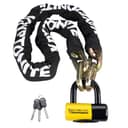
If you take one thing from this page: an e-bike left locked outdoors wants a hardened chain or a Diamond-grade U-lock, not a mid-tier commuter lock. The Kryptonite New York Fahgettaboudit 1415is the pick here because it is 14mm hardened links at Kryptonite’s own top 10/10 rating, with enough length — 100 cm — to actually get around a fat down tube and a solid rack, which a short U-lock frequently cannot on an e-bike frame. It is heavy, and we are not going to pretend otherwise; on an e-bike, that weight rides on the bike rather than on you, which is one of the few genuine conveniences of a motor.
The alternatives worth knowing about are laid out in the best locks for e-bikes, and if you want the honest version of what “grinder-proof” means before you spend at that tier, read are angle-grinder-proof locks worth it first. The short version: no lock is uncuttable, and the job is to make your bike a worse target than the one next to it.
Lights: the speed changes the requirement
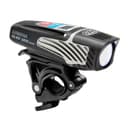
A Class 3 e-bike assists to 28 mph, and even a Class 1 will hold a speed on the flat that most people never sustain unassisted. The consequence is simple: at a higher speed you cover the lit patch in front of you faster, so you need the light to reach further to give you the same reaction time. That is why the NiteRider Lumina OLED Boost 1200is the front pick here rather than the mid-tier light we would put on a slower bike — 1,200 lumens of maximum output and an IP64 rating, with an on-light display so you know what you have left rather than guessing.
The honest caveat, and it applies to every light on the market: the headline lumen figure is the maximum-mode figure, and no light runs its quoted run time at its quoted output. Work out what you actually need by street type in how many lumens do you need, and understand the difference the beam pattern makes in be seen vs see the road.
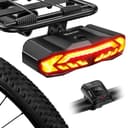
At the back, the WSDCAM smart tail lightearns its place for a specific e-bike reason: it adds wireless turn signals and a brake light on a vehicle that is moving at traffic speeds but has no indicators. Being predictable to a driver matters more the faster you go. It mounts to a rear cargo rack, so it assumes you fitted the rack — which, on this page, you did.
The rack, and why fitment beats capacity
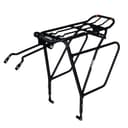
The Ibera PakRak Touring Carrier Plus+ is here because it is frame-mounted and disc-brake compatible, adjustable across 26- to 29-inch frames, and built for heavier top and side loads. On an e-bike, every one of those matters: e-bikes almost universally run disc brakes, frame sizing varies wildly between folders and full-size commuters, and the hardware around a rear hub motor is exactly what an ill-fitting rack fouls.
Check three things on your own bike before ordering any rack: whether the dropouts have eyelets or you will need a seatstay clamp, whether the disc caliper leaves room for the strut, and whether a rear hub motor’s torque arm and cabling occupy the mounting point. The full version of that check, with the e-bike-specific traps, is in rear racks for e-bikes, and how much weight a rack can hold covers what the rating actually means once it is on.
The bags that go on it have the same fitment problem one step further along: e-bike rack tubing is thicker than a road rack’s, and the rack often carries the tail light, its wiring or the battery, so hook geometry decides the purchase before capacity does. Best panniers for e-bikes ranks on exactly that. And once the bike is parked for the night, how to store an e-bike covers the battery-indoors habit this whole kit assumes.
The tracker: a recovery layer, not a lock
An AirTagdoes not stop anyone taking the bike. It changes what happens next, by putting the bike on the Find My network — the enormous crowd of other people’s Apple devices that quietly report a tag’s location as it passes them. On an e-bike, where the loss is large and the resale trail is often local, that is worth the small cost.
Two honest limits. It is iPhone and iPad only; there is no equivalent Android experience. And it ships with nowhere to live on a bike — you need a mount that bolts it somewhere non-obvious, which is a separate purchase. Both, plus the cellular alternatives that give you a live trail instead of a last-seen pin, are covered in the best bike anti-theft devices. If the worst happens, what to do if your bike is stolen is the page to have read in advance rather than at the time.
The phone mount, and the one thing e-bikes make worse
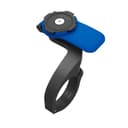
E-bike commutes tend to be longer, which means more of them are on routes you do not know by heart, which means more stopping to check a phone. The Quad Lock Out Frontis the pick for a daily rider because it twist-locks rather than clamping over the screen and releases in one motion at the rack — the thing that decides whether a mount gets used twice a day or abandoned. It needs a Quad Lock case or the universal adapter, which is a real cost on top, and there is a cheaper clamp-style mount on our accessories page if that is a step too far.
One e-bike-specific wrinkle: the bar is already crowded. A display, a throttle and often an integrated light leave less room than a regular commuter has, and an integrated or shrouded stem can rule out a stem-cap mount entirely. Our best bike phone mounts roundup lists the published bar-diameter and fit range for each pick, which is the spec to check before you order one for an e-bike.
What has not changed
Two things are identical to any other commuter kit and it is worth saying so plainly rather than padding the list. You still need a certified helmet, and every helmet sold for road use in the US clears the same federal standard, so an e-bike does not require a more expensive one. And you still need a way to carry things — the rack above is only half of that; the bags that go on it are in the panniers and cargo hub, with the fully waterproof options in best waterproof panniers.
One thing worth knowing before you ride rather than after: e-bike rules vary by class and by state, and the class of the bike you bought decides where you are allowed to ride it and whether anything is required of you. E-bike classes explained covers the three-class system, and do you need a license for an e-bike covers the question everyone asks second.