Chain & Charge

Best Bike Pump Under $50

Under fifty dollars you have to choose one job: a number you can trust, a pump that rides with you, or a twenty-second fix. Here is the order to buy them in.

By Stephen V.Last updated How we pick

The thing to understand before you spend anything: under $50, a bike pump can do one of three jobs properly, and the three are mutually exclusive. A big floor pump with a dial gauge makes the weekly top-up at home effortless and does not fit in a pannier. A frame pump rides with you and takes a hundred strokes. A CO2 inflator fixes a flat in twenty seconds and then it is empty. The $50 ceiling is exactly where you lose the option of a pump that does two of those at once — the full-size floor pumps and the electric pumps sit above it — so this page is about choosing a job, not about finding a bargain.

Which job matters more than most buyers realize, and the reason is pressure rather than punctures. Schwalbe’s own published guidance is to check and correct tire pressure at least once a month, treats a loss of about 1 bar a month as normal even on an airtight tube, and says the thumb test is “not very reliable” because a tire feels firm from roughly 2 bar regardless of what the gauge actually says. That is the maker of the tires telling you that the pump without a gauge cannot do the most valuable job a pump has. A soft tire is also what pinches against the rim on a pothole, so a large share of the flats riders blame on bad luck are a pressure problem — which is why we rank the gauge above the convenience.

Three picks clear the $50 line, so three picks are what you get. We are not going to pad the list with pumps that are nearly under it, and we are not going to rank these on a per-stroke air-volume figure, because two of the three listings publish none and we have inflated nothing ourselves. Every spec below is read from a published listing or retailer spec table on a dated visit. Here is exactly what we do instead of testing.

How this is funded:we earn a commission if you buy through our links, at no extra cost to you. It never changes which product we recommend, and we’ll tell you when we’d skip one. Full disclosure.

Quick picks

Ranked on published specs, real security and safety standards, and buyer fit. Select a row to jump to the full write-up.We have not tested these products — here is exactly what we do instead.

#ProductBest forPrice
1
Topeak Mini Morph G Mini Pump

Topeak Mini Morph G Mini Pump

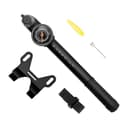
The pump that actually gets a roadside tire back to a rideable pressure, because it unfolds into a tiny floor pump: a fold-out foot pad, a T-handle you pull with both hands and an in-line gauge, so you stop at a number instead of at the point where your thumbs give up.

Best overall under $50
$39.10 · View on Amazon

$49.9522% off

Price as of November 23, 2026. #ad How we’re funded

2
BriskMore CO2 Inflator Kit (5 x 16g)

BriskMore CO2 Inflator Kit (5 x 16g)

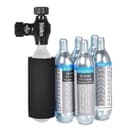
The fastest way back on the bike and the worst way to own a pump: one cartridge fills a tire in seconds, and when the cartridges are gone they are gone. Carry it as well as a pump, never instead of one.

Fastest roadside fix
$23.99 · View on Amazon

Price as of November 23, 2026. #ad How we’re funded

3
BV Mini Bike Pump Portable Frame Pump

BV Mini Bike Pump Portable Frame Pump

The honest floor of the category: a plain hand pump with a reversible head that fits both valve types, for the rider whose current plan for a flat is a phone and a ride-share. It is the cheapest thing on this page that is not a toy.

Best budget
$13.49 · View on Amazon

$17.9925% off

Price as of November 23, 2026. #ad How we’re funded

The picks in full

#1Best overall under $50

Topeak Mini Morph G Mini Pump

The pump that actually gets a roadside tire back to a rideable pressure, because it unfolds into a tiny floor pump: a fold-out foot pad, a T-handle you pull with both hands and an in-line gauge, so you stop at a number instead of at the point where your thumbs give up.

Strengths

  • Fold-out foot pad and T-handle give you body weight instead of thumb strength
  • In-line gauge reads to 140 psi (listing) — you inflate to a number, not a guess
  • Head fits Presta, Schrader and Dunlop with no adapter (listing)
  • Frame bracket included (listing), so it rides on the bike rather than in a drawer

Trade-offs

  • Bigger and heavier than a pocket mini pump — it wants a frame mount or a pannier
  • The flexible hose is the part that eventually fails on every Morph-style pump
  • Listing publishes no weight for this variant; the no-gauge Mini Morph spec table gives 50 cm3 air volume and a 160 psi body rating
  • Costs roughly double a plain mini pump, for leverage you only need when you are stranded
GaugeIn-line, reads to 140 psi (listing)
HeadPresta, Schrader, Dunlop (listing)
LeverageFold-out foot pad + T-handle (listing)
MountFrame bracket included (listing)
Body rating160 psi / 11 bar, 50 cm3 air volume (bike-components, no-gauge variant)

Specs read from the product listing, on October 24, 2026. We have not physically tested this product.

#2Fastest roadside fix

BriskMore CO2 Inflator Kit (5 x 16g)

The fastest way back on the bike and the worst way to own a pump: one cartridge fills a tire in seconds, and when the cartridges are gone they are gone. Carry it as well as a pump, never instead of one.

Strengths

  • Fills a commuter tire in seconds with no effort at all
  • Fits Presta and Schrader (listing) and weighs almost nothing in a saddlebag
  • Insulated sleeve included (listing) — a discharging cartridge gets cold enough to hurt
  • Five 16 g cartridges in the box (listing), so it arrives ready rather than needing a second order

Trade-offs

  • Single-use: a fumbled cartridge is a wasted fill, and there is no second attempt
  • No gauge, so you cannot set a pressure — you get whatever the cartridge gives that tire
  • CO2 migrates out of a butyl tube faster than air, so expect to re-inflate within days
  • Refills are an ongoing cost, and airlines restrict cartridges in baggage
TypeCO2 inflator, 16 g threaded cartridges
In the boxInflator head + 5 x 16 g cartridges + sleeve (listing)
ValvesPresta + Schrader (listing)
GaugeNone — not adjustable

Specs read from the product listing, on October 24, 2026. We have not physically tested this product.

#3Best budget

BV Mini Bike Pump Portable Frame Pump

The honest floor of the category: a plain hand pump with a reversible head that fits both valve types, for the rider whose current plan for a flat is a phone and a ride-share. It is the cheapest thing on this page that is not a toy.

Strengths

  • Fits Presta and Schrader with a smart reversible head (listing) — no adapter to lose
  • Cheapest real pump here by a wide margin
  • Small and light enough that you will not take it off the bike
  • Rated to 120 psi (listing) — far beyond anything a commuter tire needs

Trade-offs

  • No gauge at all, so you are back to the thumb test Schwalbe calls unreliable
  • Short barrel and no foot pad means a lot of strokes and sore hands on a 700c tire
  • Listing publishes no weight, no length and no per-stroke air volume
  • The rated pressure is a body rating, not a promise you can reach it by hand
Max pressure120 psi (listing)
HeadReversible, Presta + Schrader (listing)
GaugeNone
TypeFrame-mount hand pump

Specs read from the product listing, on October 24, 2026. We have not physically tested this product.

How we picked

Five criteria, in the order they decide whether a cheap pump is useful or frustrating.

1. Is there a gauge? The first filter, and the one that sorted this page. Without a gauge you cannot set a pressure, and setting a pressure is the job that prevents flats rather than fixing them. Schwalbe is unambiguous that judging pressure by thumb does not work, and it goes further on its heavily-armoured tires, where the construction makes the casing feel firm well below the correct pressure. One of these three picks has an in-line gauge. That is why it is first.

2. Can you reach a commuter pressure without hurting yourself? A rated maximum on a pump body is not a promise that your hands can get there. The difference between a plain mini pump and a mini floor pump is leverage: a fold-out foot pad plus a two-handed T-handle lets you use body weight, which is what turns 70 psi from a fight into a chore. On a 700c commuter tire, that distinction is the whole experience of using the pump.

3. Does the head fit your valve without an adapter? Boring and important. Commuter bikes come with both Presta (narrow, with a locking nut) and Schrader (the fat car-style valve), and a bike you bought second-hand may have one of each if the wheels were replaced. Every pick here handles both; two publish a reversible or multi-valve head, and the top pick adds Dunlop. A lost adapter is the most common reason a pump fails you at the roadside.

4. Does it live on the bike? A pump in a drawer has a zero percent success rate. A frame bracket in the box is the difference between a pump you own and a pump you have with you. Two of these three ride on the bike or in a saddlebag without being noticed.

5. Is it reusable? The question that decides where the CO2 kit sits. A cartridge inflator is wonderful once and then it is an empty tube in your bag. We have ranked it as the fast fix it genuinely is, not as a pump, and the card says plainly that you should carry it as well as a pump rather than instead of one.

What to buy first, in order

If you own no pump at all, here is the order that costs the least and solves the most.

First, something with a gauge. Weekly or monthly pressure checks are the cheapest flat prevention in cycling, and they only happen if setting a pressure is easy. Under $50 that means the mini floor pump above, which doubles as your roadside pump; above $50 it means a proper floor pump with a dial, which is more pleasant at home and useless on the road. If you expect to buy both eventually, buy the portable one first, because it covers both situations badly-but-adequately rather than one situation perfectly.

Second, the consumables that make a pump useful.A pump without a spare tube is half a repair. You want two tubes in your size with the right valve — one goes in the wheel, one stays in the bag — two tire levers, and a patch kit for the day you use both tubes. The whole roadside kit is listed in commuter bike accessories worth buying.

Third, and optional, the CO2 kit. This is a convenience purchase and an honest one: when you are already late, twenty seconds beats four minutes of pumping. Two things to know. CO2 migrates out of a butyl tube faster than air does, so a CO2 fill is a get-home measure and you should re-inflate properly within a day or two. And a discharging cartridge gets cold enough to burn skin, which is why the insulated sleeve in the box is not a gimmick.

What $50 cannot buy

Three honest gaps, so you can decide whether to save up instead.

A full-size floor pump.A tall barrel, a steel base you stand on and a big dial gauge at eye level is a nicer experience than anything on this page and sits above the line. If your bike lives in a garage and never needs a roadside fix, that is the better purchase and it is worth waiting for — the full picks are on the bike pump roundup.

An electric pump. A pocket compressor that inflates to a set pressure at the press of a button is genuinely excellent for anyone with weak hands, anyone running fat e-bike tires, or anyone who simply will not do the chore manually. Those also sit above $50. If hand strength is the reason you are shopping, do not buy down into this band; it will not solve your problem.

A high-volume pump for fat tires. An e-bike or fat-tire commuter needs a lot of air at low pressure, which is the opposite of what a narrow mini pump is designed for. It will get you home, slowly. If your tires are 4 inches wide, read the e-bike maintenance routine and budget for a floor pump or a compressor instead.

One last thing worth more than any pump on this page: know your tire’s pressure range before you inflate anything. It is printed on the sidewall, next to the size, and it is the only number that applies to your bike. Tires are the other half of this problem — our commuter tire pickscover the puncture-protection side, and Schwalbe’s own guidance is that permanently low pressure causes premature wear with sidewall cracking as the usual result. The pump is the cheap half of that fix.

Frequently asked questions

What is the best bike pump under $50?

The Topeak Mini Morph G, because it is the only pump in this budget that does the two jobs that matter. It unfolds into a tiny floor pump with a fold-out foot pad and a T-handle, so you inflate with body weight instead of thumb strength, and it has an in-line gauge its listing reads to 140 psi, so you stop at a number rather than a guess. The head takes Presta, Schrader and Dunlop with no adapter and the frame bracket is in the box. If you need to spend less, the BV Mini is the cheapest pump here that is not a toy - it just has no gauge, which is a real limitation.

Do I need a gauge on a bike pump?

Yes, and it is the most undervalued feature in the category. Schwalbe's own published guidance says to check and correct pressure at least monthly, treats about 1 bar of loss per month as normal even on a healthy tube, and states that the thumb test is not very reliable because a tire feels firm from roughly 2 bar regardless of the real pressure. A soft tire is what pinches against the rim on a pothole, so running the right pressure prevents a whole category of flats. Without a gauge you cannot do that job at all, which is why we rank the gauge above portability and above price.

Is a mini pump or a floor pump better for commuting?

Different jobs, and under $50 you have to pick one. A floor pump makes the weekly top-up at home effortless, reads clearly at eye level and never comes with you. A mini pump rides on the bike and gets you home, at the cost of a lot of strokes. The useful middle option is a mini floor pump - a portable pump with a fold-out foot pad and a T-handle - which does both jobs adequately rather than one perfectly, and that is why it is our top pick here. If your bike never leaves a short route and lives in a garage, buy the floor pump and save up above $50.

Are CO2 inflators worth it for commuting?

As a supplement, yes; as your only pump, no. One 16 g cartridge fills a commuter tire in seconds with no effort, which is exactly what you want when you are already late for work. Three caveats make it a second purchase rather than a first. It is single-use, so a fumbled fitting wastes a cartridge with no second attempt. There is no gauge, so you get whatever pressure that cartridge gives that tire. And CO2 seeps out of a butyl tube faster than air, so treat a CO2 fill as a get-home fix and re-inflate properly within a day or two.

What pressure should a commuter tire be?

Read the sidewall of your own tire - the range is moulded into it next to the size, and it is the only figure that applies to your bike. Within that range, lower pressure gives you more comfort and grip and more protection against pinch flats, while higher pressure rolls slightly faster and resists rim strikes on potholes. A heavier rider or a loaded rack needs more pressure than a light rider on an empty bike. The important habit is not finding a perfect number, it is checking the number at all: Schwalbe recommends at least monthly, and more often if you are running near the top of the range.

Will a mini pump inflate an e-bike or fat tire?

It will get you home, slowly, and it is not the right tool. A fat tire needs a large volume of air at a low pressure, which is the opposite of what a narrow mini pump barrel is built for - you will be there a while, and the gauge range on a mini pump is calibrated for pressures far higher than you need. If your bike runs wide tires, the better buys are a full-size floor pump for home or a pocket electric compressor for the road, both of which sit above $50. Our e-bike maintenance guide covers the rest of the heavier-bike routine.

Sources

  • Schwalbe — Technology FAQ: tire pressure — The tire maker's own published guidance: "You should check and correct the air pressure at least once a month"; a loss of about 1 bar per month is considered normal even for airtight tubes; "The pressure loss is significantly faster at high pressures and significantly slower at low pressures"; latex tubes should be checked and adjusted before every ride; and the thumb test is "not very reliable" because tires feel firm from roughly 2 bar regardless of actual pressure, so Schwalbe recommends a pressure gauge instead (and calls the thumb test "completely inadequate" on Marathon Plus tires). On permanently low pressure: premature wear, with sidewall cracking the typical result, and unnecessarily increased abrasion (accessed October 24, 2026)
  • bike-components — Topeak Mini Morph mini floor pump (spec table) — The retailer's published specification table for the Mini Morph body: max pressure listed as "11" / "160" (bar / psi), air volume "50 cm³", width 5 cm, height 26 cm, depth 2.8 cm, "Presta, Schrader, and Dunlop valve", gauge "none", aluminum cylinder with a plastic base and rubber handle, and "1 x Topeak Central Mount Bracket" in the box. This listing is the NO-GAUGE Mini Morph — bike-components does not list a Mini Morph G, so the gauge variant's own figures on our page come from its Amazon listing instead and the two are never mixed. No weight is published in this table (accessed October 24, 2026)

Keep reading