Chain & Charge

Best Bike Tires for Commuting

Nobody wakes up wanting new tires. You want the mornings back that a flat took from you — and that is a different purchase from the one the bike shop wall is selling.

By Stephen V.Last updated How we pick

Before anything else: go read your own tire.Every bicycle tire has its size molded into the sidewall — something like 700x38C alongside an ISO number like 40-622, or 26 x 1.75 / 47-559. That string is the only figure on this page that applies to your bike, and it takes ten seconds to find. A tire is the one component that is completely useless in the wrong size, and every Amazon listing we link below is one width on one rim diameter, not a model-wide page. We flag the exact size of each listing in its spec table for exactly that reason.

With that done, here is the thing nobody tells you: “best commuter tire” is not one question. It is three, and they pull against each other. Puncture protection is a thick belt between the tread and the tube, and it costs you weight and liveliness. Wet and cold grip is a soft, siped rubber compound, and it costs you tread life. And fitment— a 20-inch folder, a fat-tire e-bike, a 26-inch hybrid — quietly overrules both, because a tire that does not exist in your size is not an option however good it is. Work out which of those three brought you here and the page below gets very short.

The good news for the biggest group of readers: the protection claims in this category are unusually checkable. Schwalbe publishes an actual protection table— a 1-to-7 scale with millimeter thicknesses attached, so “5 mm SmartGuard, level 7” is a figure you can verify rather than a marketing word. Continental publishes what its SafetyPro breaker is made of (nylon textile) and why (weight). We have used those published figures throughout and attributed every one. Where a listing publishes nothing, the row says so.

We own none of these tires and run no test lab — no rolling-resistance rig, no puncture-force jig, no mileage logs. Everything below is read from the maker’s own documentation or the seller’s live listing on a dated visit, and the ranking is editorial argument, not a score. Here is exactly what we do instead of testing.

How this is funded:we earn a commission if you buy through our links, at no extra cost to you. It never changes which product we recommend, and we’ll tell you when we’d skip one. Full disclosure.

Quick picks

Ranked on published specs, real security and safety standards, and buyer fit. Select a row to jump to the full write-up.We have not tested these products — here is exactly what we do instead.

#ProductBest forPrice
1
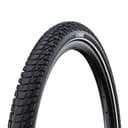
Schwalbe Marathon Plus 700x35C

Schwalbe Marathon Plus 700x35C

The tire you buy to stop thinking about flats. Schwalbe puts a 5 mm SmartGuard rubber insert under the tread and rates it protection level 7 of 7 — the only level the company lets its tires call unflattable. You pay for that in weight, in price, and in a tire that fights you on installation.

Best overall
$61.68 · View on Amazon

$69.0011% off

Price as of October 31, 2026. #ad How we’re funded

2
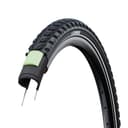
Continental Contact Urban 700x40

Continental Contact Urban 700x40

The compromise pick, and for most commutes the right one: a nylon SafetyPro breaker instead of a thick rubber slab, so you get real puncture protection without the dead, slow feel of a Marathon Plus. Continental's own words for it are maximum puncture protection with minimal added weight.

Best balance
$58.80 · View on Amazon

Price as of October 31, 2026. #ad How we’re funded

3
Schwalbe Marathon Plus Tour E50 700x38

Schwalbe Marathon Plus Tour E50 700x38

The same SmartGuard idea in the wider 700x38 size most commuter and e-bike wheels actually take, with the E-50 marking that means the tire was certified for fast e-bikes rather than merely sold near them. The pick if your bike has a motor and a curb weight to match.

Best for e-bikes
$61.55 · View on Amazon

Price as of October 31, 2026. #ad How we’re funded

4
Schwalbe Marathon 365 All-Season Tire

Schwalbe Marathon 365 All-Season Tire

The one tire for a rider who refuses to own two sets. A siped all-weather tread on the ADDIX 4Season compound with GreenGuard underneath — less puncture protection than a Marathon Plus, markedly better grip on wet paint, cold tarmac and wet leaves.

Best all-season
$51.15 · View on Amazon

Price as of October 31, 2026. #ad How we’re funded

5
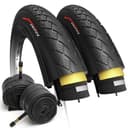
Fincci 700x38c Tire Pair with Tubes

Fincci 700x38c Tire Pair with Tubes

The honest budget route into puncture protection: two folding tires AND two Schrader inner tubes in one box, with a published 1 mm anti-puncture layer. It is a fraction of the protection a Marathon Plus gives you, for roughly a third of the money, and it ships the tubes you were going to have to buy anyway.

Best budget
$58.99 · View on Amazon

Price as of October 31, 2026. #ad How we’re funded

6
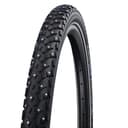
Schwalbe Marathon Winter Plus 26x1.75

Schwalbe Marathon Winter Plus 26x1.75

The only pick here that does something no other tire on the page can do: grip ice. It is a studded winter tire with SmartGuard protection underneath, and it is the answer to black ice on a morning commute — a problem no compound and no tread pattern solves.

Best for ice
$74.43 · View on Amazon

Price as of October 31, 2026. #ad How we’re funded

7
Schwalbe Marathon 20 x 1.75 (47-406)

Schwalbe Marathon 20 x 1.75 (47-406)

The reason this pick exists is fitment, not performance: folding commuters and small-wheel e-bikes take 20 in tires, and almost no puncture-protected tire is sold in that size. This is the one that is, from the brand that owns the category.

Best for folding bikes
$48.23 · View on Amazon

$50.845% off

Price as of October 31, 2026. #ad How we’re funded

The picks in full

#1Best overall

Schwalbe Marathon Plus 700x35C

The tire you buy to stop thinking about flats. Schwalbe puts a 5 mm SmartGuard rubber insert under the tread and rates it protection level 7 of 7 — the only level the company lets its tires call unflattable. You pay for that in weight, in price, and in a tire that fights you on installation.

Strengths

  • Schwalbe's top protection level (7 of 7) via a published 5 mm SmartGuard insert
  • Reflex sidewall — a reflective strip on the tire itself, visible side-on at night
  • Wire bead, 67 TPI Endurance casing (listing): built for mileage, not racing
  • The maker publishes the protection figure, so the central claim is checkable

Trade-offs

  • Heavy and stiff — a noticeably slower, more wooden ride than a lighter city tire
  • Famously hard to mount by hand; budget for strong thumbs or good levers
  • Schwalbe states plainly that you can never completely rule out a puncture
  • This listing is ONE size, 700x35C. Read your sidewall before you buy
Size (this listing)700x35C
ProtectionSmartGuard, 5 mm insert — level 7 of 7 (Schwalbe)
Casing67 TPI, wire bead, Endurance (listing)
SidewallReflex reflective strip (listing)
Pressure checkSchwalbe: thumb test not sufficient on Marathon Plus — use a gauge

Specs read from the product listing, on October 31, 2026. We have not physically tested this product.

#2Best balance

Continental Contact Urban 700x40

The compromise pick, and for most commutes the right one: a nylon SafetyPro breaker instead of a thick rubber slab, so you get real puncture protection without the dead, slow feel of a Marathon Plus. Continental's own words for it are maximum puncture protection with minimal added weight.

Strengths

  • SafetyPro Breaker — Continental publishes it as nylon textile, chosen for low weight
  • E50 rated (listing) and ECE-R75 marked, so it is legal on fast e-bikes in Europe
  • Reflective sidewall (listing) for side-on visibility in traffic
  • 40 mm width is the sweet spot for potholes, tram lines and gravel shortcuts

Trade-offs

  • A woven breaker is a different kind of protection than a 5 mm rubber insert — good against glass and thorns, less of a fortress against a nail
  • Continental's Safety-Level 6 is its OWN in-house scale and is not comparable to Schwalbe's level 7
  • Wire bead, so it will not fold into a pannier as a spare
  • This listing is 700x40 only
Size (this listing)700x40
ProtectionSafetyPro Breaker, nylon textile (Continental)
Maker's levelSafety-Level 6 on Continental's own scale
E-bike ratingE50 / ECE-R75 (listing + Continental)
SidewallReflective (listing)

Specs read from the product listing, on October 31, 2026. We have not physically tested this product.

#3Best for e-bikes

Schwalbe Marathon Plus Tour E50 700x38

The same SmartGuard idea in the wider 700x38 size most commuter and e-bike wheels actually take, with the E-50 marking that means the tire was certified for fast e-bikes rather than merely sold near them. The pick if your bike has a motor and a curb weight to match.

Strengths

  • E-50 marked (listing) — certified for e-bikes to 50 km/h, not just e-bike friendly
  • SmartGuard protection in a 38 mm width, which rides far better than a 35 on bad pavement
  • Addix Green compound on the Performance line casing (listing)
  • HS619 tread — the touring pattern, not a knobby that buzzes on tarmac

Trade-offs

  • Heavy, like every Marathon Plus; on an e-bike you notice it less, which is the point
  • E-50 is a European moped-class certification — nothing in the US requires it
  • Priced at the top of the category, and you will want two
  • One size only on this listing: 700x38. A 27.5 or 20 in wheel needs a different tire
Size (this listing)700x38
E-bike ratingE-50 (listing) — certified to 50 km/h
ProtectionSmartGuard (Schwalbe level 7 of 7, 5 mm insert)
Tread / compoundHS619, Addix Green (listing)
LinePerformance (listing)

Specs read from the product listing, on October 31, 2026. We have not physically tested this product.

#4Best all-season

Schwalbe Marathon 365 All-Season Tire

The one tire for a rider who refuses to own two sets. A siped all-weather tread on the ADDIX 4Season compound with GreenGuard underneath — less puncture protection than a Marathon Plus, markedly better grip on wet paint, cold tarmac and wet leaves.

Strengths

  • Siped tread plus ADDIX 4Season compound (listing) — built for cold, wet grip
  • GreenGuard protection: Schwalbe publishes a 3 mm insert made with recycled material
  • Listing states e-bike and city-bike suitability and a 20 to 28 inch size range
  • One tire covers autumn rain, winter damp and summer commuting

Trade-offs

  • GreenGuard is protection level 5 on Schwalbe's scale, not the Plus's level 7 — this is a grip tire first
  • Siped all-season rubber wears faster than a hard-compound touring tire
  • No substitute for studs on actual ice
  • The 20-28 inch range is the MODEL's range; this ASIN is one size inside it, so check the size shown at checkout
Model size range20 to 28 inch (listing) — this ASIN is one size within it
ProtectionGreenGuard, 3 mm recycled insert — level 5 (Schwalbe)
CompoundADDIX 4Season (listing)
TreadSiped, for all weather conditions (listing)
UseE-bikes and city bikes (listing)

Specs read from the product listing, on October 31, 2026. We have not physically tested this product.

#5Best budget

Fincci 700x38c Tire Pair with Tubes

The honest budget route into puncture protection: two folding tires AND two Schrader inner tubes in one box, with a published 1 mm anti-puncture layer. It is a fraction of the protection a Marathon Plus gives you, for roughly a third of the money, and it ships the tubes you were going to have to buy anyway.

Strengths

  • Two tires plus two 48 mm Schrader-valve tubes in one purchase (listing)
  • Publishes an actual protection figure — a 1 mm anti-puncture layer — not just the words
  • Folding bead, so one can live in a pannier as a spare
  • The cheapest way on this page to stop riding on bald stock rubber

Trade-offs

  • 1 mm of protection is not in the same class as a 3 mm or 5 mm insert, and we will not pretend otherwise
  • Schrader valves only — if your rims are drilled for Presta, these tubes will not fit
  • No brand record for casing longevity to lean on; expect to replace sooner
  • One size: 700x38c / 40-622
Size (this listing)700x38c / 40-622
In the box2 tires + 2 inner tubes (listing)
Protection1 mm anti-puncture layer (listing)
Valve (tubes)48 mm Schrader (listing)
BeadFoldable (listing)

Specs read from the product listing, on October 31, 2026. We have not physically tested this product.

#6Best for ice

Schwalbe Marathon Winter Plus 26x1.75

The only pick here that does something no other tire on the page can do: grip ice. It is a studded winter tire with SmartGuard protection underneath, and it is the answer to black ice on a morning commute — a problem no compound and no tread pattern solves.

Strengths

  • Studded — the only thing that works on ice, which rubber compounds do not
  • Carries SmartGuard protection as well (listing), so it is not a grip-only winter tire
  • Wire bead, 67 TPI (listing): a heavy-duty winter casing
  • Turns the two worst commuting weeks of the year from unrideable into normal

Trade-offs

  • Studs buzz loudly and roll slowly on dry tarmac — this is a seasonal tire, not a year-rounder
  • The most expensive tire on this page, and you need two
  • This listing is 26x1.75 ONLY. A 700c hybrid cannot use it
  • Studs wear down if you ride them on bare pavement all season
Size (this listing)26 in x 1.75
TypeStudded winter tire (listing)
ProtectionSmartGuard (listing)
Casing67 TPI wire-bead clincher (listing)
SeasonWinter only — not a year-round tire

Specs read from the product listing, on October 31, 2026. We have not physically tested this product.

#7Best for folding bikes

Schwalbe Marathon 20 x 1.75 (47-406)

The reason this pick exists is fitment, not performance: folding commuters and small-wheel e-bikes take 20 in tires, and almost no puncture-protected tire is sold in that size. This is the one that is, from the brand that owns the category.

Strengths

  • A 20 x 1.75 / 47-406 size, which is genuinely hard to find with real protection
  • Schwalbe Marathon casing — the touring tire that made the brand's name
  • Small wheels pick up more punctures per mile, so protection pays off faster here
  • Fits the fold-and-carry commuters this site covers

Trade-offs

  • LISTING AMBIGUITY, stated plainly: the title names the tire Marathon but advertises SmartGuard, which is the Marathon PLUS belt. We cannot resolve which belt ships, so treat the protection level as unconfirmed
  • Heavy for a 20 in tire, and small wheels feel added weight more
  • One size only — a 20 x 1.95 or a 406 fat tire needs something else
  • No reflective sidewall published on this listing
Size (this listing)20 x 1.75 / 47-406
ProtectionListing says SmartGuard on a tire named Marathon — unresolved, see cons
TypeClincher, flat-less touring tire (listing)
FitFolding and 20 in small-wheel bikes

Specs read from the product listing, on October 31, 2026. We have not physically tested this product.

How we picked

Six criteria, in the order they decide the purchase. Notice what is not on the list: a rolling-resistance ranking, a durability score and a “best value” rating. Nobody in this category publishes watts of rolling resistance for commuter tires, we have not measured any, and a mileage figure we did not ride is a number we would be inventing.

1. Does it exist in your size?First, because it overrules everything. A 700c hybrid, a 26-inch e-bike and a 20-inch folder are three different markets, and the deepest puncture belt in the world is irrelevant if the tire is not made for your rim. Two of the seven picks below are here purely because they fill a size hole — the 20-inch Marathon and the 26-inch studded winter tire — and we would not have included either on ride quality alone.

2. Does the maker publish a protection figure, not just a word? This is the criterion that did most of the sorting. “Puncture resistant” on a listing is a claim with nothing behind it. Schwalbe’s published table gives a level and a thickness: SmartGuard is a 5 mminsert of “highly elastic special rubber” at level 7, GreenGuard is a 3 mm recycled-rubber insert at level 5, and the e-bike-oriented smartdualguard is a 4 mminsert plus two nylon layers. Continental describes its SafetyPro breaker as nylon textile with “maximum puncture protection with minimal added weight”. The budget pick publishes “1 mm”. All four of those are honest statements of very different things, which is the point.

3. What does the protection cost you?There is no free lunch here and the category pretends otherwise. A 5 mm rubber slab under the tread makes a tire heavy, makes it roll with a dead, damped feel, and makes it a genuine wrestling match to seat on the rim. That is a real cost and the top pick on this page pays it in full. A woven textile breaker is the engineering answer to the same problem from the other direction: lighter and livelier, and a different protection profile — excellent against glass and thorns, less of a fortress against a long nail.

4. Grip in the weather you actually ride in.Mostly ignored in this category and mostly the wrong thing to ignore, because the failure modes are not symmetrical: a puncture costs you twenty minutes, and the painted line you slid on costs you a collarbone — which is also the argument behind spending on a helmet’s MIPS liner. A soft all-season compound with siping (those fine cuts across the tread blocks) is the answer for cold, wet tarmac and wet leaves. Studs are the answer for ice, and they are the onlyanswer for ice — no compound and no tread pattern grips a frozen puddle.

5. Is it visible from the side? The most underrated feature in the category. A reflective sidewall strip puts a bright moving circle on the part of your bike a driver pulling out of a side street actually sees first, and it works when your lights are pointed the wrong way for that geometry. Two picks here publish one. Our rear light roundup covers the other half of that problem.

6. What is in the box, and does it include tubes?A boring criterion that changes the real price. Tires and tubes are bought together, and the pair-plus-tubes bundles can be genuinely cheaper than two tires alone. The catch is valve type — a bundle with Schrader tubes is no use on rims drilled for Presta, and that is a detail buyers discover after delivery.

The honest limit of a puncture-proof tire

Schwalbe publishes both halves of this, on the same page, and we are going to quote both because most affiliate pages quote only the first: the Marathon Plus “offers the best possible protection against typical punctures” and “You can never completely rule out a puncture.”Those are the maker’s words, not our hedge. The word in the first sentence doing the work is typical: a thorn, a shard of glass, a staple, a wire. A sidewall slashed on a curb edge, a pinch flat from riding a soft tire into a pothole, or a valve that tore out of the tube are none of those, and no tread belt addresses any of them.

Which leads to the uncomfortable finding of this page. A large share of the flats commuters blame on bad luck are a pressure problem, not a tire problem, and new tires will not fix them. Schwalbe’s published guidance is to check and correct pressure at least monthly, and treats roughly 1 bar of loss per month as normal even on a healthy tube. A tire ridden two months past its last top-up is soft, and a soft tire pinches against the rim on every pothole. If you have not owned a floor pump with a gauge, buy that before you buy tires— it is a quarter of the price and it fixes a bigger share of the problem. Then buy the tires.

Schwalbe adds one specific instruction for its own flagship that is worth repeating, because it catches people: “Always use a pressure gauge to set the air pressure on all Marathon Plus tires”, since “Due to the special construction, checking the pressure with your thumb is not sufficient.” The protection belt makes the tire feel firm by hand at pressures well below where it should be. The tire that is hardest to judge by feel is the one most likely to be ridden soft.

What the E-50 marking on an e-bike tire actually means

Two picks here carry an E-50 or ECE-R75marking, and the marketing around it is muddier than the fact. Continental states it plainly on its own site: “All of our city/trekking tires are rated to a standard speed of at least 25 km/h”, and “Those tires marked e50 are also certified for S-Pedelecs.” That is the whole substance. ECE-R75 is a European type-approval regime that exists because a pedelec assisting past 25 km/h is legally a moped there and gets moped-grade tire requirements.

So here is the honest translation for a US commuter: nothing in the United States requires an E-50 tire on any e-bike, including a Class 3. The marking is still useful as a proxy— it tells you the casing was approved for sustained higher speed under heavier load, which is the service condition an e-bike puts a tire in whether or not a regulator is watching. Treat it as evidence of a sturdier casing, not as a legal requirement you are failing to meet. And treat the maker’s own in-house “Safety-Level” numbers the same way: Continental’s level 6 and Schwalbe’s level 7 are two companies’ private scales, measured differently, and comparing the digits directly is meaningless. We never do it on this page, and anyone who does is bluffing.

The rest of the e-bike-specific fitment problem — tire width against fender clearance, rack hardware, hub-motor spacing — is the same puzzle covered in our e-bike fender guide and rear racks for e-bikes, and the order to solve it in is tire width first, then the things that have to clear the tire.

Puncture protection vs rolling resistance: who should accept which

Here is the trade-off stated without salesmanship, because the right answer genuinely differs by rider.

Take the heavy, maximum-protection tireif your commute is short enough that a slower tire costs you a couple of minutes, and your flats are expensive in a way that is not about money — a school pickup you cannot be late for, a shift you cannot walk into filthy, a route with no transit fallback. On a 4-mile ride the rolling penalty of a Marathon Plus is close to unnoticeable and the protection is the whole point. This is also the correct choice on any e-bike, where a motor is already absorbing the weight penalty you are worried about.

Take the lighter breaker tireif your ride is long enough that the bike’s character matters to whether you keep doing it, or if your commute is genuinely clean pavement. Fifteen miles on a dead-feeling tire is the kind of small daily friction that quietly ends bike commuting, and the habit is worth more than the marginal protection. A nylon breaker is not a downgrade; it is a different point on the curve that Continental picked deliberately.

Take the all-season grip tireif you have already had the moment — the back wheel stepping sideways on a wet painted arrow, the front washing out on leaves. You are no longer optimizing flats, and you should not pretend to be.

And the one piece of advice that is free: do not mix your logic front-to-rear by accident. If you only have the budget for one tire, put it on the rear, which carries most of your weight, gets most of the punctures, and is the one that is miserable to change at the roadside with a loaded rack over it. Put the best grip on the front, which is the wheel whose loss of traction puts you on the ground. A split set is a legitimate setup and nobody in the category will sell you one.

What to buy alongside them

New tires are a wheel-off job and the moment to fix the rest of the system. You need two inner tubes in your size with the right valve— Presta if your rim has the narrow drilling, Schrader if it takes the fat car-style valve — because one goes in the wheel and one goes in the bag. Two tire levers, and on a stiff protection tire you will use both. Rim tape if the existing strip is cracked or has shifted off a spoke hole, because a spoke hole is a flat the new tire cannot prevent. And a pump with a gauge, because the first thing you must do with a new tire is set its pressure inside the range printed on the sidewall.

The tool half of that is on the commuter accessories page, and the inflation half is on the bike pump roundup. If you are putting a whole commuting setup together in order rather than fixing one thing, start at the kit by budgetinstead — tires are rarely the first purchase, and on a new bike they are usually not a purchase at all for the first year.
Frequently asked questions

What are the best bike tires for commuting?

It depends on which of three problems you have, and that is not a dodge. If you are buying because of flats, buy the tire with the thickest published protection belt: Schwalbe's Marathon Plus uses a 5 mm SmartGuard insert that Schwalbe rates level 7 of 7 on its own protection scale. If you are buying because you want protection without the dead, heavy ride, the Continental Contact Urban uses a nylon SafetyPro breaker that Continental describes as maximum puncture protection with minimal added weight. If you are buying because you slid on something wet, you want an all-season siped compound like the Marathon 365, which trades protection level down to 5 for grip. And if your bike has 20-inch wheels or you ride on ice, fitment overrules all of that.

Are puncture-resistant bike tires actually worth it?

For a daily commuter, yes, with one honest caveat. The belt is real: Schwalbe publishes a 5 mm rubber insert for SmartGuard and a 3 mm one for GreenGuard, and those stop the thorn, glass and staple punctures that make up most commuting flats. The caveat is what they do not stop, and Schwalbe says it on the same page: you can never completely rule out a puncture. A protection belt does nothing about a slashed sidewall, a torn valve, or a pinch flat from riding a soft tire into a pothole. That last one is the common one, and it is a pressure problem, not a tire problem. Buy a gauge pump and top up weekly before you spend on tires, then buy the tires.

How do I know what size tire my bike takes?

Read the sidewall of the tire you already have. Every bicycle tire has its size molded into it, usually in two formats at once: an inch or French size like 700x38C or 26 x 1.75, and an ISO/ETRTO number like 40-622 or 47-559. The ISO number is the reliable one. The first figure is the tire width in millimeters and the second is the rim's bead-seat diameter, so 40-622 means a 40 mm wide tire on a 622 mm rim. Match the second number exactly - a 622 rim cannot take a 559 tire under any circumstances. The width you can vary within what your frame and fenders will clear, which is usually a few millimeters either way.

Can I put wider tires on my commuter bike?

Usually a little, and it is often the best cheap upgrade going, because a wider tire at a lower pressure is more comfortable and more puncture-resistant against pinch flats. The limits are physical: the tire has to clear the fork crown, the chainstays and the brake caliper or fender stays, with enough gap left that grit and a wet leaf cannot jam in there. The honest method is to measure the gap you currently have on each side rather than trust a rule of thumb, and to go up one step at a time - a 35 to a 38, a 38 to a 40. If you run fenders, they are usually the binding constraint rather than the frame, which is covered in our fender guides.

Do e-bikes need special tires?

Not in the United States, and this is widely overstated. There is no US requirement for an e-bike-specific tire on any class of e-bike. The E-50 and ECE-R75 markings you see on some tires are a European type-approval regime, which exists because a pedelec assisting past 25 km/h is legally a moped there. Continental states it on its own site: all of its city and trekking tires are rated to at least 25 km/h, and the ones marked e50 are also certified for S-Pedelecs. That said, the marking is a useful proxy for a sturdier casing approved for sustained higher speeds under heavier loads, which is genuinely what an e-bike does to a tire. Buy it as evidence of a tougher tire, not as compliance with a law you are breaking.

How long do commuter bike tires last?

We will not give you a mileage figure, because we have not ridden these tires and nobody in the category publishes a usable one. What we can tell you is what to look at instead, which is more useful anyway. Replace a tire when the tread is worn flat enough that the casing or the protection belt shows through, when the sidewall has cracks running along it, when there is a bulge or a cut you can see the inside of, or when you have started getting repeat punctures in the same tire - that usually means something is embedded in the carcass. Schwalbe also publishes that permanently low pressure causes premature wear, with sidewall cracking as the typical result, so the pump habit extends tire life as well as preventing flats.

Do I need studded tires for winter bike commuting?

Only if you ride on actual ice, and then nothing else works. This is the one place in the category where there is no compromise option: rubber compounds and tread patterns do essentially nothing on a frozen puddle, and studs do. If your winter is cold and wet but your streets are treated and you can skip the three genuinely icy mornings, an all-season siped tire like the Marathon 365 is the better year-round answer and you avoid the noise and drag of studs on dry tarmac. If your commute includes a shaded stretch that freezes and you have already gone down on it once, buy studs, accept that they are loud and slow, and treat them as a seasonal fit. The rest of the cold-weather kit is in our winter commuting guides.

Should I replace both tires at once?

Not necessarily, and the money is better spent asymmetrically. The rear tire carries most of your weight, picks up most of the punctures and wears out roughly twice as fast, so it is the one to replace first and the one to put the heavier protection on - it is also the worst wheel to have to remove at the roadside with a loaded rack over it. The front wheel is the one whose grip failure puts you on the ground, so that is where the better wet-weather compound belongs. Running a protection tire on the back and a grippier tire on the front is a sensible, deliberate setup that no shop will offer you as a package.

Sources

  • Schwalbe — Technology FAQ: puncture protection — Schwalbe's own protection-level table, 7 (highest) down to 1: level 7 is "SmartGuard / smartdualguard", level 6+ "Super Defense", level 6 "Double Defense", level 5 "V-Guard / GreenGuard / RaceGuard", level 4 "RaceGuard", level 3 "K-Guard", level 2 "67 EPI Carcass", level 1 "50 EPI Carcass". The published insert thicknesses: SmartGuard "5 mm puncture protection insert" of "highly elastic special rubber", described as "The safest puncture protection available for bicycle tires"; smartdualguard "4 mm puncture protection insert plus two layers of nylon fabric (RaceGuard)", "The safest puncture protection, especially for e-bike tires"; GreenGuard "3 mm puncture protection insert with recycled material", a "Recycled puncture protection insert made from natural rubber". Level 7 is introduced with: "Only Schwalbe has the touring and city tires that can call themselves 'unflattable' (Flat-less) (Protection Level 7)." On the Marathon Plus specifically, Schwalbe publishes that it "offers the best possible protection against typical punctures" AND, in the same place, "You can never completely rule out a puncture." It also instructs: "Always use a pressure gauge to set the air pressure on all Marathon Plus tires" because "Due to the special construction, checking the pressure with your thumb is not sufficient." No thickness or protection level is published for V-Guard, RaceGuard, K-Guard or the bare carcass options (accessed October 31, 2026)
  • Continental — Contact Urban bicycle tire (product page) — Continental's own published description of the tire's protection and e-bike rating. On the breaker: "The SafetyPro Breaker is designed from nylon textile" and "Maximum puncture protection with minimal added weight" — a woven textile belt rather than a thick rubber insert, chosen explicitly for low weight. On e-bike use the page carries an "E-Bike Ready | ECE-R75" label and a "Safety-Level" badge showing level 6 on Continental's OWN in-house scale (not Schwalbe's, and not an independent rating). It states "All of our city/trekking tires are rated to a standard speed of at least 25 km/h" and "Those tires marked e50 are also certified for S-Pedelecs". The page does NOT publish sizes, widths, weights, a reflective-sidewall claim or the PureGrip compound, so none of those is cited to it; several images on the page are labeled PremiumContact 6 rather than Contact Urban, which is why only the text above is used (accessed October 31, 2026)
  • Schwalbe — Technology FAQ: tire pressure — The tire maker's own published guidance: "You should check and correct the air pressure at least once a month"; a loss of about 1 bar per month is considered normal even for airtight tubes; "The pressure loss is significantly faster at high pressures and significantly slower at low pressures"; latex tubes should be checked and adjusted before every ride; and the thumb test is "not very reliable" because tires feel firm from roughly 2 bar regardless of actual pressure, so Schwalbe recommends a pressure gauge instead (and calls the thumb test "completely inadequate" on Marathon Plus tires). On permanently low pressure: premature wear, with sidewall cracking the typical result, and unnecessarily increased abrasion (accessed October 24, 2026)

Keep reading