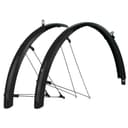
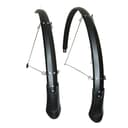
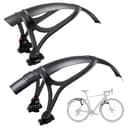
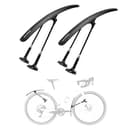
How we picked
Fenders are a fitment product before they are anything else, so the criteria are unusually concrete. Four things decided this list, in this order.
1. Does it fit a real commuter bike, and does the seller say so? A fender that doesn’t clear your tire is scrap. Every pick here publishes the wheel size and the tire width it is built for, and we quote that range rather than smoothing it into “fits most bikes.” Where a listing declines to publish a clearance figure — the budget RockBros pair does exactly that — we say so in its cons instead of inventing one.
2. How does it mount? This is the fork in the road. Bolt-on sets need fender eyelets at the dropouts plus somewhere to anchor the front fender at the fork crown and the rear at the seatstay bridge. Strap and clamp sets need none of that. A bolt-on set is more rigid, quieter and better covered; a strap-on set is the difference between having fenders and not having them, on a frame that was never drilled.
3. How much of the wheel does it actually cover? Coverage is the whole product. A full-length blade that wraps from the fork crown down past the axle stops spray at every angle it leaves the tire. A short clip-on stub catches the middle of the arc and lets the rest through, which is why cheap fenders disappoint people who expected dry feet.
4. Is there a mudflap, and does it come in the box? The last few inches of a front fender are what keep road water off your shoes and out of your bottom bracket, and the last few inches of a rear fender are what stop you spraying the person riding behind you. Only one set here ships with real mudflaps, and that is the reason it ranks where it does.
Start here: does your bike have fender mounts?
Turn the bike over and look at the dropouts — the slots where the axles sit. If you see small threaded holes near them, and another threaded hole behind the fork crown and under the seatstay bridge, your frame was designed for fenders and you should buy a bolt-on set. That means the SKS Bluemels if you want the standard answer, or the Planet Bike Cascadia if the mudflaps matter more to you than the price.
If the frame has no eyelets, you have not been locked out. The Zefal Shield G50straps to the frame and fork and still gives full-length blades, which is a genuinely different thing from a token clip-on. It costs nearly as much as a bolt-on set and it will never be as rigid, but it works on a bike that no bolt-on set can touch. If you’re still shopping for the bike itself, this is worth knowing before you buy: our guide to choosing a commuter bike treats rack and fender eyelets as a near-requirement for exactly this reason.
Getting the size right
This is the one place people waste money. A fender is described by two numbers: the wheel size it is built around (700c, 650b, 26-inch, 27.5-inch, 29-inch) and the width of the blade in millimeters. The blade has to be wider than your tire — roughly 8 to 10mm wider is the conventional rule — so that mud and grit can pass through the gap instead of packing solid and rubbing.
So: read your tire sidewall first. A tire marked 700x35cis a 700c wheel with a 35mm tire, and that rider wants a 45mm-class blade — which is exactly what the Bluemels B45 is, and exactly why its published range is 700x29-38. A rider on 40 or 45mm tires needs a wider size in the same family, not this one. The Planet Bike set here is narrower still: Planet Bike recommends the 43mm size for tires up to 700c x 35mm. Buying a fender one size too narrow is the most common fender mistake there is, and no amount of bending fixes it.
If you have no idea what your tires measure, the number is printed on the sidewall in small type, usually as something like “700x38c” or “26 x 1.95”. Check it before you order, not after.
Full-length beats clip-on, and mudflaps beat full-length
Coverage works in tiers. A short clip-on catches the spray leaving the top of the tire and misses the rest, which is why the budget option here is honestly filed as a way to test the idea rather than a way to stay dry. A full-length blade — the Bluemels, the Cascadia, the Zefal — wraps far enough forward and far enough back that the tire has nowhere to throw water except into the fender.
Then there’s the last tier, which almost nobody thinks about until they have ridden a winter without it. A mudflapis the flexible extension that hangs off the bottom of the blade. On the front fender it is the only thing standing between road water and your shoes, and it is the reason fender-equipped riders with wet feet usually don’t have one. Planet Bike publishes 100mm mudflaps front and rear on the Cascadia, which is generous, and it is the single reason that set earns “best coverage” despite being the priciest thing here. On the rear, a mudflap is also basic courtesy: without one you are power-washing anyone riding behind you.
Disc brakes, racks and e-bikes: the fitment traps
Three things on a modern commuter can turn a straightforward fender install into an afternoon. Disc brakesput a caliper exactly where a fender stay wants to run, so the stays have to route around it — Planet Bike states its stainless V-stays are disc-brake compatible, which is worth having in writing rather than guessing. A rear rackcompetes for the same eyelets as the rear fender; most racks and fenders are designed to share a bolt, but you may need a longer bolt and some patience. If you’re fitting both at once, our guide to mounting a rear rack covers the same hardware from the other side.
E-bikesare the awkward case. Hub motors, torque arms, wide swingarms and fat tires all fight a fender that was designed for a 1990s hybrid, and many budget commuter e-bikes roll on 4-inch tires that no 700c set will ever clear. That is the only reason the fat-tire set is on this list: it is not a better-made product than the SKS, it is simply the one that fits. If your e-bike is a 20-inch folder rather than a 26-inch fat bike, buy the 20 x 4.0 version of the same idea, not this one. There’s more on riding a powered bike in bad weather in can you ride an e-bike in the rain.
Living with fenders
Two small habits keep a fender set quiet and useful. First, check the stay bolts after the first couple of rides and then every few months — the buzzing rattle people blame on cheap fenders is almost always a bolt that has walked loose, and it takes ten seconds with a 4mm key to fix. Second, look at the clearance after any hard knock; a blade pushed into the tire will wear a groove in itself and eventually rub through.
The safety features are worth understanding rather than ignoring. SKS publishes an ASR system on the Bluemels that lets the front stays uncouple if something is dragged into the spokes, and Planet Bike publishes release tabs on the front of the Cascadia doing the same job. Both exist because a front fender that jams a spinning wheel is genuinely dangerous, and it is the one failure mode worth paying attention to when you fit the front blade close to the tire.
What fenders do not fix
Fenders solve road spray. They do not keep rain off your head, they do not waterproof your bag, and they do not shorten your braking distance on a wet descent. A realistic wet-weather setup is fenders plus a packable shell plus a genuinely waterproof way to carry your laptop and work clothes — see the best waterproof panniers for the carrying half of that, and bike commuting in the rain for the technique that ties it all together. Wet roads also make you harder to see, which makes a decent front and rear light set part of the same kit rather than a separate purchase.
One last honest note on money. Fenders are the rare commuting upgrade where the budget option is not a trap so much as a different product: the cheap detachable pair genuinely will make a light shower less unpleasant. It just won’t do what a full-coverage set two or three times its price does, and if you ride through a real winter you will end up buying the full set anyway. Fenders also keep grit off the chain and out of the brakes, so the more expensive set is doing quiet maintenance work the cheap one isn’t. If wet-weather riding is going to be a regular part of your commute rather than an occasional accident, skip the experiment and buy the bolt-on set that fits your bike.
And if the bike is an e-bike, the clearance arithmetic changes completely: the sets above stop between 35 and 48mm of tire, while plenty of commuter e-bikes roll on four inches. Best e-bike fenders sorts the same category by what each set will actually clear.