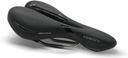
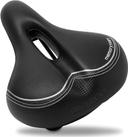
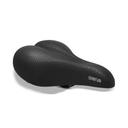
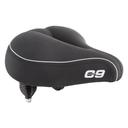
What the B17 gives you that these do not
Four things, stated plainly so you can decide whether you are giving up something you wanted.
A top that adapts to you. Tensioned leather gradually takes an impression of your sit bones, which is a different mechanism from foam compressing. Foam also takes an impression, but it does it by packing down and losing support, which is why a memory-foam saddle is softest in year one and worst in year four. The leather is the opposite shape of that curve.
Serviceability. The B17 ships with its own spanner because the tension bolt is a user-adjustable part. There is no equivalent adjustment on any saddle below: when the cover splits or the foam packs out, the saddle is finished.
A published width.The retailer table gives 175 mm, which is a number a bike fitter can work with. Of the four alternatives here, only the Cloud-9 publishes a footprint; the two Selle Royals and the Bikeroo publish no width in millimeters at all. That is a genuine information gap, it is the industry’s fault rather than ours, and this page is not going to invent the numbers.
Resale and repair culture. Not a specification, but real: leather Brooks saddles get re-tensioned, re-dressed and passed between bikes. Nothing here has an afterlife.
What these give you that the B17 does not
Comfort on day one. This is the honest headline. Every saddle below is designed to be comfortable immediately, and for a commute of twenty or thirty minutes each way that may matter more than how good a saddle eventually becomes.
A relief channel or cutout.The B17 is a solid leather top. Three of the four picks here publish some form of pressure relief: the Respiro lists a ventilation channel and pressure relief, the Cloud-9 lists a vented anatomic relief channel, and the Bikeroo lists a center cutout. If your complaint is soft-tissue numbness rather than bruised sit bones, that is not a nice-to-have — it is the feature you are shopping for, and the original does not have it.
Posture-matched shapes. Selle Royal sells the Respiro and the Avenue in riding-angle versions, and publishes the logic: an athletic position puts the trunk at roughly 45 degrees to the ground, a moderate one at about 60 degrees, a relaxed one fully upright at 90. It also publishes the rule that follows from that, which is the single most useful sentence in saddle shopping: the greater the inclination of your torso, the smaller the gap between your sit bones, so an upright position needs a wider surface. Both picks here are the Moderateversion, matched to a roughly 60-degree torso — which is what most hybrid and city-bike commuters actually have. Buy the wrong angle and the shape works against you.
Weather indifference. A vinyl or synthetic cover does not care that you locked up in a downpour. If your bike lives at a rack outside an office, this is worth more than it sounds. Our guide to commuting in the rain covers the rest of that problem.
How to choose between the four
Work from your posture first and your symptom second. Those two answers pick the saddle between them, and neither of them is about price.
If you sit at roughly 60 degrees— a hybrid, a flat-bar commuter, most city bikes, bars somewhere near saddle height — you are in the Moderate band, and the choice is between the two Selle Royals. Take the Respiro Moderate if you want the ventilation channel and pressure relief, which is the specification difference between them, and if your commute is long enough that firmness beats softness. Take the Avenue Moderateif your ride is measured in minutes, you want the same fit logic for roughly two-thirds of the money, and you would rather have extra cushioning than a relief channel. The Avenue’s listing publishes no channel and no cutout; we are not going to pretend otherwise.
If you sit fully upright— a cruiser, a step-through, a fat-tire e-bike with swept-back bars — your sit bones are further apart and you need platform rather than nose. The Cloud-9 Cruiser Select is the pick, and it is also the cheapest thing here, which is a happy coincidence rather than a compromise. It publishes a 10.5 x 10.75 in footprint and coil springs, and both of those are correct for an upright rider on a rigid frame. The same width makes it the wrong saddle for anyone leaning forward, where it will chafe your thighs. It is also one of three saddles we rank inside a hard price line in best bike seat under $50, if the B17’s price is the reason you are on this page at all.
If your complaint is numbness, not soreness, posture matters less than the cutout. The Bikeroo Extra Wide publishes a center cutout plus two separate damping paths, a steel spring and an elastomer, and it fits indoor trainers on the same rails if your bike spends winter in the living room. Its honest limits: no published width, memory foam that packs down, and a wide platform that suits upright bars only.
What to do before you buy any saddle
Two things, and they are both free. First, check your saddle height and fore-aft position, because a lot of what gets blamed on a saddle is a seatpost two centimeters too low, which rolls your weight forward onto soft tissue. Second, change one thing at a time. If you swap the saddle, the height and the angle in one evening, you will not know which change helped.
It is also worth knowing that padded shorts do a share of the work people expect a saddle to do, and that a commuter who will not wear them has a narrower set of good options — which is one more argument for a relief channel over raw softness. If you are putting a saddle on a bike you are still setting up, our commuter saddle roundup is the broader page this one is a brand-specific slice of, and how to choose a commuter bike covers the fit decisions that sit upstream of the saddle.
Last practical note: a saddle is one of the easiest components to steal, and a quick-release seatpost clamp makes it trivial. If the bike parks in public, swap the quick release for a bolt — which takes a multi-tooland about a minute — or run a cable through the rails. We cover both in how to lock your wheels and saddle.