How we picked
Four criteria, in the order they decide whether a saddle works for you. What is deliberately absent is a comfort ranking. Comfort is the interaction between a saddle’s width and your pelvis, so a page that ordered three saddles from least to most comfortable would be making a claim about your body that it cannot see.
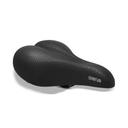
1. Does the saddle match your riding angle? First filter, because it governs everything else. Selle Royal publishes the system plainly on its own site: Athletic is the most forward-leaning position, with the trunk flexed to roughly 45 degrees to the ground; Moderate is a trunk partially flexed toward the handlebars at about 60 degrees; and Relaxedis a fully erect back at a right angle. The same page states the rule that follows from it - “the greater the inclination of the torso, the smaller the space between the ischial bones”, and “an upright riding position requires a wider surface”. All three picks here are for the Moderate-to-Relaxed half of that range. None is for the Athletic half.
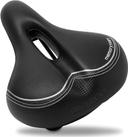
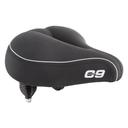
2. Does the listing publish its actual footprint? Most comfort saddles do not, which makes the ones that do unusually useful. The Cloud-9 Cruiser Select publishes 10.5 x 10.75 in- wider than it is long, which tells you immediately that it is built for a fully upright rider and will chafe the thighs of anyone leaning forward. The Bikeroo publishes “extra wide” with no number. The Selle Royal Avenue publishes no width either. Where there is no number, we say so rather than estimating one.
3. What does it do about soft-tissue pressure? The two complaints people bring to a saddle are completely different problems. A bruised, aching sit bone is an impact and width problem, answered by a wider platform and suspension. Numbness or soft-tissue pressure is a blood-flow problem, answered by a cutout or a relief channel that removes material from the middle. Two picks here publish a relief feature: the Bikeroo publishes a center cutout, and the Cloud-9 publishes a vented anatomic channel. Match the feature to your actual symptom, because the two fixes are not interchangeable.
4. What is the suspension, and is there any? On a rigid commuter frame this matters more than padding depth, because the energy you are trying to absorb arrives as a sharp hit from a pothole rather than a steady load. The Cloud-9 publishes coil springs. The Bikeroo publishes steel springs plus an elastomer, which is two different damping paths rather than one. The Selle Royal Avenue publishes extra cushioning and no spring - which is why it is the pick for a rider at 60 degrees, where some weight is on the bars, rather than for an upright rider taking the full hit through the saddle.
What $50 buys, and what it does not
It buys a genuinely comfortable saddle for an upright or semi-upright commuter, with real engineering in it: published footprints, coil springs, elastomers, cutouts and vented channels. There is no asterisk here. For the way most people ride to work, this price band is sufficient, and a rider who spends $150 on a saddle for a hybrid with swept-back bars has usually bought a shape that fits them worse.
What it does not buy is a sized range. The expensive saddle brands sell the same model in two or three widths so you can match your own sit-bone spacing; nothing here is sized, so you are buying a single fixed platform and hoping your pelvis suits it. That is the real limitation of the band, and it is why the honest advice at this price is to buy from a retailer whose returns you trust and to be willing to send one back.
It also does not buy published numbers. One of three listings publishes a footprint. None publishes a weight. None publishes a rail spec. None publishes a width in millimeters. If you have measured your sit bones and want to buy to a number, this band cannot serve you and the full field in best bike seats for commuting is where to look.
And it does not buy longevity in weather. These are foam and gel saddles with vinyl or synthetic covers, parked outdoors, rained on and baked in the sun. Foam packs down, covers craze and split, and there is no re-tensioning a foam saddle the way you can re-tension a leather one. Treat a sub-$50 saddle as a three-to-five-year part rather than a lifetime one, which at this price is a running cost of roughly ten dollars a year.
The rider this price band does not serve
If you ride with your bars at or below saddle height - a road bike, a flat-bar fitness bike set up low, a gravel bike pressed into commuting - everything on this page is too wide for you, and buying it will make things worse rather than better. The mechanism is in the Selle Royal rule quoted above: lean forward and your sit bones rotate inward and come closer together, so the contact patch you need is narrower, and a wide platform under a forward-leaning rider puts pressure on the soft tissue between the sit bones and chafes the inner thighs on every pedal stroke.
There are two honest routes for that rider, and neither of them is on this page. The first is to raise the bars rather than change the saddle, which is free if you have spacers to move or a stem you can flip, and which moves you into the position these saddles are designed for. The second is to spend above this band on a narrower performance saddle in a sized range - the territory where tensioned leather saddles live, which we cover in Brooks B17 alternatives.
There is also a third case worth naming, because it gets mistaken for a saddle problem constantly: if the pain started when you got a new bike and nothing about your position has changed, check the saddle height and the fore-aft tilt before you buy anything. A nose tilted up by a few degrees concentrates pressure exactly where nobody wants it, and a saddle two centimeters too high makes you rock side to side and rub. Both are free to fix with the multi-tool you should already be carrying - the ones worth owning are here.
Fitting it: the three adjustments that matter
A new saddle is not an upgrade until it is in the right place, and most of the complaints that follow a saddle swap are position complaints rather than product complaints.
Level first, then tilt by one degree at a time. Start with the saddle dead level - a phone with a spirit-level app across the top is accurate enough. From there, nose-down by a degree or two relieves soft-tissue pressure but slides you forward onto your hands; nose-up does the opposite and is usually the cause of the worst pain. Change one thing per ride.
Reset the height after you change saddles. Padding depth and shell thickness are not the same between two saddles, so a swap changes your effective leg extension even with the post untouched. Mark the old post height with tape before you pull it, then set the new saddle so your knee is slightly bent at the bottom of the stroke rather than locked straight.
Give it a fortnight, and ride it on your actual commute. Sit bones adapt, and a saddle that feels wrong in the first mile often feels right in the second week. The test that matters is your real route in your real clothes - not a lap of the parking lot. If it is still wrong after two weeks of riding, it is wrong, and that is what the return window is for.
Where the rest of a small budget should go
If $50 is your whole comfort budget rather than just your saddle budget, buy the saddle and then stop - but know the order of what comes next, because the next two purchases do more for comfort than a nicer saddle would.
Tires, then fenders. A wider tire at a lower pressure is the single biggest comfort change available to a commuter, and it costs about what a saddle does. It smooths the small, constant vibration that a spring cannot reach, and it does it without changing your position at all. The commuter options are in best commuter bike tires. Fenders come next because arriving dry is a comfort feature - best bike fenders.
Then gloves, and only then a bar change. If the thing that hurts after a ride is your hands rather than your seat, the saddle was never the problem: you are carrying too much weight on the bars, usually because the saddle is nose-down or the bars are too low. Padded gloves mask it and raising the bars fixes it. The glove field is in best bike gloves. And if any part of your commute happens after dark, the cheapest upgrade of all is not a comfort part at all — a reflective vest starts under ten dollars and covers the angle your lights cannot.
And if the honest answer is that you are putting money into a bike you have outgrown, the sub-$50 saddle is still the right call, because it is the cheapest way to make the current bike bearable while you decide. What a real commuter bike budget looks like at three levels is in the commuter starter kit by budget.