How we picked
Five criteria, in the order they decide the purchase. Deliberately absent: a durability ranking and any claim about how the bits feel in use. We have held none of these tools, several of these listings publish no material at all, and a steel-quality verdict we cannot support would be the least useful sentence on the page.
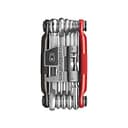
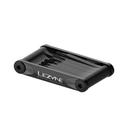
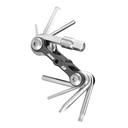
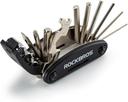
1. Does the published hex range cover your bike?The first filter, because hex bolts are what actually come loose. On a commuter you want 2 mm at the small end for cable clamps and accessory mounts and either 6 or 8 mm at the top for the seatpost and crank bolts. Three tools here publish the full span: the Crankbrothers M17 at 2, 2.5, 3, 4, 5, 6 and 8 mm, the Lezyne V Pro 11 at 2 through 8 mm, and the Topeak Mini 9, whose listing states Allen 2–8 mm and says in so many words that it “covers most bolts.” The ROCKBROS publishes that it has Allen wrenches but not which sizes, which is a real gap and the main thing you are accepting at its price.
2. Does it include Torx, and do you need it? Increasingly yes. Disc-brake rotor bolts are commonly T25, and some stems, racks and accessory mounts use Torx too. The Crankbrothers and the Topeak Mini 9 both publish T-25, which covers the rotor case. The Lezyne V Pro 11 publishes T10, T25 and T30— three sizes, and the widest Torx coverage on this page. If you have ever opened a bike bag and found the one Torx bolt your tool did not match, that is what the Lezyne is for. Check your own rotor bolts before deciding this does not apply to you; almost every commuter and hybrid sold recently has disc brakes.
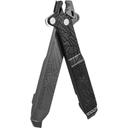
3. Does it do a job a hex key cannot? This is where the page splits. The Crankbrothers M17publishes a chain tool rated for 8- to 12-speed chains plus spoke wrenches #0–3, which means a broken chain and a loose spoke both become fixable rather than fatal. The Topeak Power Lever X attacks the other end of the problem: two tire levers that snap together into master link pliers, with a chain hook and a Presta valve core remover published on the same listing. Neither the Lezyne nor the Topeak Mini 9 publishes a chain tool, and both are honest about being hex tools. The ROCKBROS publishes tire levers but no chain tool.
4. Will you carry it?The best tool is the one in the bag, and weight is how that gets decided — which is awkward, because only two listings publish one. Crankbrothers publishes 168 g and a footprint of 89 x 43 x 19 mm for the M17. Topeak publishes 3.24 oz for the Mini 9, which is a little over 90 grams, roughly half the Crankbrothers and the lightest published figure here. The Lezyne, the Power Lever X and the ROCKBROS publish no weight at all, so this page does not rank them on it.
5. Leverage, with an honest caveat.Every tool here has short handles, because that is what folding into a pocket costs. A multi-tool is for getting home, not for a proper service: it will snug a bolt that rattled loose and it will struggle with a bolt that was overtightened by someone else. None of these is a torque wrench, and that matters specifically if you have a carbon seatpost or stem with a printed torque figure — guessing by feel on carbon is how components crack. For those, a multi-tool gets you home and a torque tool does the real adjustment at home.
What a multi-tool does not do
Worth being blunt, because the function count on the box invites the wrong assumption. It does not inflate a tire.Not one of these moves air. A flat needs levers, a tube or a patch, and a pump or a CO2 cartridge, and the complete roadside set is a tool plus a pump plus a spare — our pumps under $50 page covers the carry-it-with-you half of that.
It does not true a wheel.The M17 publishes spoke wrenches #0–3, which is enough to back off a dangerously loose spoke so the wheel will roll home. It is not enough to true a wheel at the roadside, and trying usually makes things worse.
It does not fix a chain without a master link, unless it has a chain tool.This is the distinction that catches people out. Master link pliers — what the Power Lever X publishes — open and close a quick link. If your chain has no quick link, you need a chain tool to push a pin, which on this page means the Crankbrothers. Look at your own chain before you choose: if there is a visibly different link with a clip, the pliers are the lighter answer.
It does not replace a brake pad or a cable. Those are planned maintenance, not roadside fixes, and they belong at home or at a shop. If your commuting plan relies on your bike being reliable, the useful move is not a bigger tool but a calendar: the basics are in our e-bike maintenance guide, and most of it applies to any commuter.
Which one belongs in your bag
If you are buying one tool and never thinking about it again, take the Crankbrothers M17. It is the only pick that covers all three failure types on its own published specification, its 168 g disappears in a pannier, and the chain tool is the insurance you will use once in five years and be enormously glad of. Its honest costs: it is the second most expensive here, it has no tire levers, and the steel body makes it heavier than an aluminum mini tool.
If your bike has disc brakes and odd bolts, take the Lezyne V Pro 11 for the T10/T25/T30 coverage and accept that you are buying a bolt tool rather than a chain tool. Pair it with the Power Lever X and you have both ends of the problem covered for roughly the price of one premium tool — which is, genuinely, the setup we would build if we were assembling a commuter kit from this page rather than picking a single winner.
If weight is the reason you keep leaving the tool at home, take the Topeak Mini 9. At a published 3.24 oz in a neoprene sleeve it goes in a jacket pocket, and its Allen 2–8 mm plus T25 still reaches most of what rattles loose. You are giving up the chain tool and the spoke wrenches, and Topeak does not pretend otherwise — nine functions is nine functions.
If flats are your actual problem, take the Power Lever X first and a hex tool second. Steel-reinforced levers are a real upgrade over the plastic ones that come free with a patch kit, especially on the stiff puncture-resistant tires most commuters should be running — see best commuter bike tires for why those are worth the fitting hassle. The hidden spares compartment is where a quick link lives so it is there when you need it.
If you currently carry nothing, buy the ROCKBROS 16-in-1 today and stop reading. Under ten dollars with tire levers included, it is not the tool we would choose on specification — it publishes no bit sizes, no weight and no material — but a cheap tool in the bag beats a better tool you have not bought yet. Buy a second one and leave it permanently in whichever bag you use least. The rest of the starter-kit order is in the commuter starter kit by budget.
Where to keep it, and the one habit that matters more
Keep it on the bike, not in the bag you sometimes carry. A tool in the pannier you take to the office is a tool you have on Tuesday and not on Saturday; a tool in a small saddle bag or taped into the rack is always there. If you ride with panniers anyway, the lid pocket is the obvious home — our guide to packing panniers puts tools at the bottom and heavy items low and forward.
And the habit that prevents more roadside stops than any tool fixes: check the bolts you can reach once a month, at the same time you check your tire pressure. Saddle clamp, seatpost collar, stem, rack bolts, mirror, bottle cage, light mounts. It takes two minutes with the tool you just bought, and almost every rattle a commuter notices is one of those eight things. Pressure is the other half of that routine, and Schwalbe’s published advice is to check it at least once a month with a gauge rather than a thumb — the reasoning is in our pump roundup.