Chain & Charge

Best Bike Seats for Commuting

The saddle that came with your bike was chosen by an accountant. Here is how to replace it with one chosen by how you actually sit.

By Stephen V.Last updated How we pick

Almost every commuter who gives up on cycling because “the seat hurts” is riding a saddle that was never matched to their riding position. Stock saddles exist to make a bike look finished at a price, and the one on a $600 hybrid or a $900 e-bike is usually a narrow sport shape with a thin pad — the wrong width for someone sitting upright, in the wrong place for someone whose weight is on their sit bones rather than their hands. The fix is rarely more padding. It is a different shape.

That is why this page is organized around how you sit rather than around price. Selle Royal, which has been selling saddles by riding angle for years, puts numbers on it: an Athletic position is a torso at about 45 degrees to the ground, Moderate is about 60 degrees, and Relaxedis a fully erect back at 90 degrees. The maker also states the part that most buyers get backwards — the more you lean forward, the narrower the gap between your sit bones becomes, so an upright riding position needs a wider saddle, not a softer one. Get the angle right and a firm saddle feels fine. Get it wrong and no amount of gel helps.

Three complaints cover nearly every commuter saddle problem, and they point at different shapes. Bruised, aching sit bones after a few miles usually means the saddle is too narrow for how upright you are. Numbness or soft-tissue pressure points at a saddle with no relief channel or cutout. Jarring on bad pavement on a rigid frame is an impact problem, which springs or an elastomer solve and foam does not. Each pick below is here because it answers one of those three specifically.

We have sat on none of these saddles. Every figure on this page is read from a published listing or a retailer specification table on a dated visit, every comfort claim we repeat is attributed to the maker who made it, and where a listing publishes no width — which is depressingly common in this category — we say so instead of estimating one. Here is exactly what we do instead of testing.

How this is funded:we earn a commission if you buy through our links, at no extra cost to you. It never changes which product we recommend, and we’ll tell you when we’d skip one. Full disclosure.

Quick picks

Ranked on published specs, real security and safety standards, and buyer fit. Select a row to jump to the full write-up.We have not tested these products — here is exactly what we do instead.

#ProductBest forPrice
1
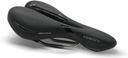
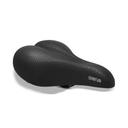
Selle Royal Respiro Stracciatella Moderate Saddle

Selle Royal Respiro Stracciatella Moderate Saddle

The commuter saddle to try first if your bars sit roughly level with your seat: Selle Royal builds the Respiro in three riding angles and the Moderate is the one matched to a 60-degree torso, which is what most hybrid and city-bike riders actually have.

Best overall
$69.95 · View on Amazon

Price as of November 23, 2026. #ad How we’re funded

2
Selle Royal Avenue Moderate City Saddle

Selle Royal Avenue Moderate City Saddle

The same riding-angle logic as the Respiro at roughly two-thirds the money, in a saddle the listing describes specifically as a city-bike seat with extra cushioning. The value pick for a commute measured in minutes rather than hours.

Best value
$45.00 · View on Amazon

Price as of November 23, 2026. #ad How we’re funded

3
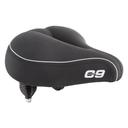
Cloud-9 Cruiser Select Saddle

Cloud-9 Cruiser Select Saddle

The budget pick, and the right shape for a genuinely upright bike: a wide 10.5 x 10.75 in platform on coil springs with a vented relief channel, for less than the price of a tank of gas.

Best budget
$39.99 · View on Amazon

Price as of November 23, 2026. #ad How we’re funded

4
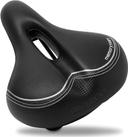
Bikeroo Extra Wide Replacement Saddle

Bikeroo Extra Wide Replacement Saddle

A wide memory-foam saddle that pairs a center cutout with both steel springs and an elastomer, which is the combination to reach for if the problem you are solving is soft-tissue pressure rather than a bruised sit bone.

Best for pressure and numbness
$44.99 · View on Amazon

Price as of November 23, 2026. #ad How we’re funded

5
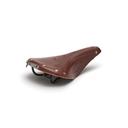
Brooks England B17 Standard Leather Saddle

Brooks England B17 Standard Leather Saddle

The long-game saddle: a tensioned leather top on steel rails that starts firm, takes the shape of your sit bones over a few hundred miles, and outlives several foam saddles. Buy it if you ride most days for years, not if you need comfort this week.

Best for the long haul
$131.19 · View on Amazon

$160.0018% off

Price as of November 23, 2026. #ad How we’re funded

The picks in full

#1Best overall

Selle Royal Respiro Stracciatella Moderate Saddle

The commuter saddle to try first if your bars sit roughly level with your seat: Selle Royal builds the Respiro in three riding angles and the Moderate is the one matched to a 60-degree torso, which is what most hybrid and city-bike riders actually have.

Strengths

  • Sold in riding-angle versions, so you can match the saddle to your posture
  • Listing publishes a ventilation channel and pressure relief, not just padding
  • Royalgel cushioning rather than foam alone

Trade-offs

  • Buy the wrong angle version and the shape works against you
  • The listing publishes no width in millimeters, which is the number fitters use
  • Costs more than twice what the sprung comfort saddles below do
Riding angleModerate (60-degree torso)
CushioningRoyalgel
ReliefVentilation channel, pressure relief
SizesOne size

Specs read from the product listing, on November 7, 2026. We have not physically tested this product.

#2Best value

Selle Royal Avenue Moderate City Saddle

The same riding-angle logic as the Respiro at roughly two-thirds the money, in a saddle the listing describes specifically as a city-bike seat with extra cushioning. The value pick for a commute measured in minutes rather than hours.

Strengths

  • Matched to the same Moderate riding angle as the Respiro
  • Described by the maker as a city-bike seat with extra cushioning
  • Noticeably cheaper than the Respiro for a similar fit intent

Trade-offs

  • No ventilation channel or relief cut-out published on this listing
  • Extra cushioning helps on short rides and hurts on long ones
  • One size only, with no published width
Riding angleModerate (60-degree torso)
Intended useCity bike
CushioningExtra cushioning (the maker's wording)
SizesOne size

Specs read from the product listing, on November 7, 2026. We have not physically tested this product.

#3Best budget

Cloud-9 Cruiser Select Saddle

The budget pick, and the right shape for a genuinely upright bike: a wide 10.5 x 10.75 in platform on coil springs with a vented relief channel, for less than the price of a tank of gas.

Strengths

  • Publishes its actual footprint - 10.5 x 10.75 in - which most comfort saddles do not
  • Coil springs take the edge off bad pavement on a rigid frame
  • Vented anatomic relief channel rather than a solid pad
  • The cheapest saddle on this page by a clear margin

Trade-offs

  • Far too wide for anyone leaning forward - it will chafe your thighs
  • Soft-touch vinyl cover, not leather; it is a wear item
  • Springs add weight and a little bounce when you pedal hard
Footprint10.5 x 10.75 in
SuspensionCoil spring
ReliefVented anatomic channel
CoverSoft-touch vinyl

Specs read from the product listing, on November 7, 2026. We have not physically tested this product.

#4Best for pressure and numbness

Bikeroo Extra Wide Replacement Saddle

A wide memory-foam saddle that pairs a center cutout with both steel springs and an elastomer, which is the combination to reach for if the problem you are solving is soft-tissue pressure rather than a bruised sit bone.

Strengths

  • Center cutout is published on the listing, not implied
  • Steel spring plus elastomer suspension, so two different damping paths
  • Memory foam over a wide platform for an upright position
  • Fits outdoor bikes and indoor trainers on the same rails

Trade-offs

  • No width published in millimeters or inches on this listing
  • Memory foam packs down over time and is not re-tensionable
  • Wide platform suits upright bars only
ShapeExtra wide with center cutout
PaddingMemory foam
SuspensionSteel spring + elastomer
FitsIndoor and outdoor bicycles

Specs read from the product listing, on November 7, 2026. We have not physically tested this product.

#5Best for the long haul

Brooks England B17 Standard Leather Saddle

The long-game saddle: a tensioned leather top on steel rails that starts firm, takes the shape of your sit bones over a few hundred miles, and outlives several foam saddles. Buy it if you ride most days for years, not if you need comfort this week.

Strengths

  • Vegetable-tanned leather top on steel rails - repairable and re-tensionable
  • Retailer spec table publishes real numbers: 275 mm long, 175 mm wide
  • Listed for city and touring use, which is exactly the commuting case
  • Ships with the Brooks spanner for the tension bolt

Trade-offs

  • Needs a break-in period before it is comfortable - there is no way around it
  • Three to four times the price of every other saddle here
  • Leather needs dressing and does not love being left out in the rain
  • Heavier than the foam saddles it replaces - leather and steel, not foam and plastic
TopLeather
RailsSteel, 7 x 7 mm
Dimensions275 mm long x 175 mm wide
ColorBrown (one size)

Specs read from the product listing, on November 7, 2026. We have not physically tested this product.

How we picked

Five criteria, in the order they decide whether a commuter saddle works. What is not here: a comfort score. Comfort is the interaction between one saddle and one pelvis, we own none of these units, and a number we did not measure is a number we would be inventing.

1. Does it match a riding angle?The first filter, and the one that eliminates most “comfort” saddles on sight. A saddle sold without reference to riding position is a shape hoping to meet a rider. Two picks here — the Respiro and the Avenue — are sold explicitly in Selle Royal’s Moderate version, which the company matches to a torso at about 60 degrees. That is the posture of a flat-bar commuter, a hybrid or a step-through e-bike with the bars above the saddle. If your bars are lower than your saddle and your back is closer to 45 degrees, buy the Athletic version of the same saddle instead, not a wider one.

2. Is there a real relief feature, or just padding? A ventilation channel, a vented anatomic relief groove or a center cutout changes where your weight sits. Soft foam only delays the problem: it compresses until you are resting on the shell, and on a longer ride it can press intothe soft tissue it was supposed to protect. Four of the five picks here publish a channel, a cutout or a vented relief area on their own listing. The one that does not — the Avenue — is on this page as the short-commute value option, and we say so in its write-up rather than pretending it has a feature it does not claim.

3. Does the listing publish real dimensions? Width is the single most useful number in a saddle purchase and the one most often missing. The Brooks B17 is the clearest here: a retailer specification table publishes 275 mm long, 175 mm wide and 520 g for the black version. The Cloud-9 publishes its footprint as 10.5 x 10.75 in. The two Selle Royals and the Bikeroo publish no width at all, which is a genuine mark against them and the reason we lean on riding angle and shape instead of pretending to a millimeter figure.

4. Does it do anything about impact? A commuter on a rigid frame with no suspension takes every expansion joint through the saddle. Coil springs (the Cloud-9) and a spring-plus-elastomer arrangement (the Bikeroo) are the honest answers to that, and they are cheap. A tensioned leather top (the Brooks) is a third answer: the hammock effect gives a small amount of natural flex that foam does not. If your route is smooth asphalt, skip all of this and buy shape instead.

5. Will it still be good in two years? Memory foam packs down. Vinyl covers crack. Leather, dressed occasionally and re-tensioned with the spanner that comes in the box, goes the other way. That is the entire argument for spending Brooks money, and it only pays off if you actually ride most days.

Match the saddle to your riding angle first

Before you compare any two saddles, work out which of three positions you ride in. Sit on your bike with your hands where you normally hold the bars and have someone look at you from the side.

Upright, back near vertical (about 90 degrees).Dutch-style bikes, cruisers, step-through e-bikes, anything with swept-back bars above the saddle. Your weight is almost entirely on your sit bones, which are at their widest spacing, so you need the widest platform here — the Cloud-9 Cruiser Select at 10.5 x 10.75 in is built for exactly this and would be absurd on a road bike. Springs help, because an upright rider cannot unweight the saddle over a pothole.

Partly leaned, about 60 degrees. The majority of commuters: flat-bar hybrids, most commuter e-bikes, gravel bikes with the stem slammed up. Your weight splits between hands and sit bones and the sit bones have come slightly closer together. This is the Moderate band, and it is where the Respiro and the Avenue sit.

Low and forward, about 45 degrees. Drop bars, a long low stem, a sporty commute. Your sit bones are at their narrowest spacing and more of your weight is forward, so a wide soft saddle becomes a thigh-chafing liability. None of the picks on this page is for you: buy the Athletic version of the Respiro, or a narrow performance saddle, and read how to choose a commuter bike if you are not sure which category your bike is in.

Three complaints, three different saddles

“My sit bones ache after two miles.”That is usually too narrow a saddle for your posture, and the answer is width rather than softness. Go wider in the same riding-angle family — a Moderate saddle if you are on a hybrid, the full cruiser platform if you are upright. Lower your saddle height by a few millimeters at the same time: a saddle set too high rocks your pelvis side to side and grinds the sit bones with every pedal stroke.

“I go numb.”Numbness is a pressure signal and it is the one complaint you should not ride through. It points at a saddle with no relief feature, or at a nose tilted up. Buy a cutout or a vented channel — the Bikeroo publishes a center cutout, the Respiro a ventilation channel with pressure relief — and set the saddle level before you blame the shape. The same pressure logic applies at the other end of the bike, which is why padded gloves for numb hands exist.

“Every crack in the road goes through me.”That is impact, not pressure, and padding is the wrong tool — springs or an elastomer are the right one. Both budget picks here have them. The cheaper fix that most commuters skip is tire pressure: running wide tires at the lower end of their printed range transforms a harsh ride, and it costs nothing. We go through that in best commuter bike tires.

What a new saddle cannot fix

Saddle height and tilt do more than the saddle itself. A level saddle at the right height is the baseline every one of these picks assumes. If your knee is still bent hard at the bottom of the stroke, or the nose points up, you will be uncomfortable on a $140 saddle in exactly the way you were on the stock one. Set height so your leg is nearly straight with your heel on the pedal at the bottom, then set the saddle level with a phone app, then ride a week before changing anything else.

Bibs and shorts are doing more work than you think.A commuter riding in jeans on a 45-minute commute is fighting seams, not saddle shape. You do not need race kit — liner shorts under normal clothes are enough, and they are cheaper than a saddle. If you are changing at the office anyway, see what to wear bike commuting.

Leather needs a break-in, and nobody can shortcut it. The Brooks B17 starts firm and takes a few hundred miles to take the shape of your sit bones. That is the deal, and it is the one thing on this page we would not recommend to someone who rides twice a month. If you want comfort on day one, buy one of the other four.

A note on seat covers and “noseless” seats

Gel seat covers are a reasonable $15 experiment on a saddle that is nearly right and a waste of money on one that is the wrong width — they add padding, which is the variable that matters least. Noseless designs genuinely solve soft-tissue pressure for some riders, but they change how you steer and brace out of the saddle, and none of the ones we could verify publishes dimensions we would be willing to quote, so we have not featured one. If your numbness persists on a cutout saddle at a level angle, that is a bike-fit conversation, not a shopping one.

One last structural point about spending. A saddle is the cheapest contact-point upgrade on a commuter bike and the one most likely to decide whether the bike gets ridden. If you are kitting out a commute from scratch, it belongs in the same conversation as a lock and lights under $50 rather than as an afterthought. If $50 is the whole saddle budget, the three picks here that fit inside it are collected in best bike seat under $50, with the live prices checked against the line — and see the commuter accessories that actually get used and bike commuting essentials.
Frequently asked questions

What is the best bike seat for commuting?

For most commuters, the Selle Royal Respiro Stracciatella Moderate. The reason is fit rather than padding: Selle Royal sells the Respiro in three versions matched to three riding angles, and the Moderate version is built for a torso at roughly 60 degrees to the ground - the posture you have on a flat-bar hybrid, a commuter bike or most step-through e-bikes. Its listing publishes a ventilation channel and pressure relief rather than just a thicker pad. If your bike is fully upright with swept-back bars, the wider Cloud-9 Cruiser Select is the better shape and costs less; if you ride most days and plan to keep the bike for years, the Brooks B17 is the saddle that improves with use.

Does a wider bike seat mean a more comfortable one?

Only if your riding position is upright. Selle Royal states the relationship plainly: the more your torso leans forward, the narrower the space between your sit bones becomes, and an upright position requires a wider surface. So width is matched to posture, not to comfort in the abstract. On a fully upright cruiser or step-through, a wide sprung platform is right. On a bike where you lean forward at around 45 degrees, that same saddle will chafe your inner thighs and put pressure where you do not want it. Work out your angle first, then pick the width that goes with it.

Is a softer saddle better for a sore backside?

Usually not, and this is the most expensive mistake in the category. Soft foam compresses until you are effectively sitting on the shell, and on a longer ride it can press up into soft tissue rather than supporting your sit bones. If your sit bones ache, the likely problem is a saddle that is too narrow for your posture or set too high, so you are rocking side to side as you pedal. If you are going numb, the likely problem is the absence of a relief channel or cutout. Both are shape problems. Extra padding helps most on short, bumpy errand rides and least on a daily commute of any length.

How long does a Brooks B17 take to break in?

A few hundred miles, and there is no honest way to shorten it. A tensioned leather top starts firm and gradually takes the shape of your sit bones, which is exactly why riders who keep one say it becomes the most comfortable saddle they own. The retailer specification table for the B17 Standard publishes 275 mm long, 175 mm wide and 520 g for the black version, and the box includes the Brooks spanner for the tension bolt. Brooks' own guidance is that Proofide is the only dressing that should be used on the leather. If you need the saddle to be comfortable this week rather than this season, buy one of the foam or gel picks instead.

What saddle width do I need for commuting?

Width follows posture, and most listings in this category refuse to publish a number - which is a real complaint and the reason this page leans on riding angle instead. As a practical route: if you sit bolt upright, you want a genuinely wide platform, and the Cloud-9 publishes its footprint as 10.5 x 10.75 in so you can at least compare it to what is on your bike. If you lean forward moderately, a Moderate-angle saddle like the Respiro or Avenue is the band to shop in. The one measurement worth taking yourself is the distance between your sit bones - a local bike shop with a measuring pad can do it in two minutes, and it converts straight into a width recommendation.

Do I need a cutout or relief channel in a commuter saddle?

If you have ever gone numb on a ride, yes - treat it as the deciding feature rather than a nice extra. A cutout or vented channel moves load off the perineal area and onto the sit bones where it belongs. Four of the five picks here publish a channel, cutout or vented relief area on their own listing: the Respiro a ventilation channel with pressure relief, the Bikeroo a center cutout, the Cloud-9 a vented anatomic relief groove, and the Brooks a tensioned leather top that flexes rather than pressing. If you have never had a pressure problem, a relief feature is optional and width plus riding angle matter more.

Is it worth replacing the saddle that came with my bike?

On a commuter bike, it is often the single best-value change you can make. Stock saddles are chosen to hit a price point on a complete bike, not to match the rider who ends up on it, and on hybrids and budget e-bikes that usually means a narrow sport shape with a thin pad - the wrong width for an upright position. A saddle costs less than a decent lock, takes one 5 mm bolt to swap, and decides whether the bike gets ridden. Change the saddle height and tilt first, since those are free; if the discomfort survives that, the shape is wrong and a replacement is money well spent.

Sources

  • Selle Royal — How to choose the right bike saddle (riding positions) — Selle Royal's own explanation of the riding-angle system its saddles are sold in, which is the fit logic our saddle page is built on. Athletic is described as the "most forward-leaning position, with considerable trunk flexion to form a 45° angle in relation to the ground"; Moderate as the trunk "partially flexed towards the handlebars to form a 60°angle in relation to the ground"; Relaxed as the back "fully erect to form a right, 90°angle in relation to the ground". On width, the page states that "the greater the inclination of the torso, the smaller the space between the ischial bones" and that "an upright riding position requires a wider surface", and notes the distance between the ischial bones "can vary between individuals, regardless of gender". The page gives NO sit-bone measurement method and no millimeter figures, so our page gives none either (accessed November 7, 2026)
  • bike-components — Brooks B17 Standard Saddle (spec table) — The retailer specification table for the Brooks B17 Standard, item 8378 — the only published figures we could verify for it, since brooksengland.com returned no specification page to our fetch on the day. Published: width "175 mm", length "275 mm" (all three colors), weight "520 g" for the black version only (no weight given for brown or honey), top material "Leather", rail material "Steel", rails "7 x 7 mm (Standard)", application "City & Touring, City". The description reads "Ideal for long tours with a sporty bent or for city & touring." Contents include "1 x Brooks spanner". The table publishes NO height, no rivet detail, no break-in instructions and no manufacturer warranty — the "100 Day Return Policy" on the page is the retailer's, not Brooks', and our page does not present it as one (accessed November 7, 2026)
  • Amazon — Selle Royal Respiro Stracciatella Moderate saddle listing (ASIN B0GN3FVZNL) — The listing our top saddle pick's price and buy link point at, confirmed "In Stock" via Creators getitems on 2026-11-07. The full title reads "Selle Royal Respiro Stracciatella Moderate Bike Saddle | Royalgel Cushioning, Ventilation Channel, Pressure Relief, Ergonomic Design" — which is where the Royalgel cushioning, the ventilation channel, the pressure relief and the "Moderate" riding angle come from. It publishes NO width in millimeters, no weight and no rail spec, so our page quotes none of those for it (accessed November 7, 2026)

Keep reading