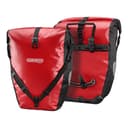
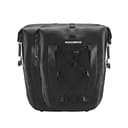
The three differences that decide this
1. Welded seams versus stitched ones
This is the big one and it is a construction difference, not a marketing one. Ortlieb builds the Back-Roller as a fully welded body — the panels are fused rather than sewn, so there are no needle holes anywhere in the bag. A roll-top closure on top of a welded body is a genuinely sealed system, which is why it is the pannier people put a laptop in without thinking about it.
The RockBros pair uses roll-top waterproof construction too, and it sheds rain well, but seams are where a bag of this type gives up first in a sustained downpour. That distinction is easy to over- or under-state, so be precise about what it means: in normal rain, on a normal commute, you probably will not notice. In an hour of hard rain, or on a bag that has been flexing on a rack for two years, the seams are the part that decides whether your bag is water-resistant or water-proof.
2. The mounting hardware
The under-discussed difference. Ortlieb’s QL2.1 system uses engineered hooks with a handle-triggered release that clamps to the rack rail and comes off in about a second. The RockBros hardware is simpler and less refined. Since you will mount and unmount these bags twice a day, every working day, the difference compounds in a way a spec sheet can’t show — and it also determines how confidently the bag stays put over a pothole.
Both need to actually fit your rack, which is not automatic. Rail diameter and the gap between the rail and the rack’s side struts decide whether hooks seat properly, and heel clearance decides whether your foot hits the bag on every pedal stroke. Check rack and pannier compatibility before you buy either pair — it is the single most common reason a perfectly good pannier gets returned.
3. Capacity and carrying options
Ortlieb lists the Back-Roller pair at 40 liters total; RockBros lists its pair at up to 30. Ten liters is a real difference — roughly the margin between “a laptop, lunch and a change of clothes” and “all of that plus a full grocery shop.” The Ortlieb is a single large compartment per bag, which is excellent for bulk and poor for organization until you add pouches. The RockBros pair converts to a shoulder bag, which is genuinely handy if you carry the bag onward after you park.
So which should you buy?
Buy the Ortlieb if you carry electronics, if you ride in genuinely wet weather most of the year, or if you intend to own one set of panniers for a decade. The welded body is the reason it is the default recommendation for all-weather commuting, and the mounting system is the reason people who own them stop thinking about panniers entirely. It is the top pick in our best waterproof panniers roundup for exactly these reasons.
Buy the RockBros if you are new to panniers, if your climate is mostly dry, if what you carry is clothes and groceries rather than a work laptop, or if the price gap is the difference between fitting panniers this month and putting it off. Two-thirds of the waterproofing benefit for a small share of the money is a very defensible trade, and a pannier you actually own beats a better one you are still saving for. It leads our best budget panniers list.
A middle path worth considering
You do not have to buy one pair for every job. A common and sensible setup is a budget pair for daily errands and groceries, plus a single premium pannier on the other side for the days you carry a laptop. You get real waterproofing exactly where it matters and you spend a fraction of what a premium pair costs. It is also how a lot of commuters discover which capacity they actually need before committing.
Whichever you choose, two things matter more than the badge. First, how you load them — heavy items low and forward, weight balanced side to side, which is the whole subject of how to pack panniers. Second, the rack underneath, since a pannier can only be as solid as what it is hanging from and both of these bags are perfectly capable of out-classing a wobbly rack. Start with best rear racks if you are building from scratch, and if you are moving away from carrying everything on your back, our comparison of panniers versus a backpack explains why almost everyone who switches stays switched.