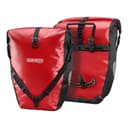
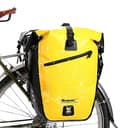
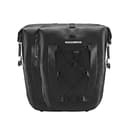
The published specifications
Every row below is from the retailer spec table fetched on 2026-10-17, except the capacity and finish, which the Amazon listing also publishes. Nothing here is estimated.
| Specification | Published figure |
|---|
| Capacity | 2 × 20 liters (40 L the pair) |
| Weight | 1,900 g the pair (asphalt-black) |
| Dimensions | 42 cm high × 23 cm (lower) / 32 cm (upper) × 17 cm deep |
| Max load | 9 kg per bag (about 20 lb) |
| Material | Polyester fabric, PVC coated (PD620 and PS490) |
| Protection class | IP64 — dust-tight, protected against splashing water from all directions, with the closure rolled 3–4 times |
| Mount | Quick-Lock2.1, racks up to 16 mm tube (8 / 10 / 12 mm reducers included) |
| In the box | Pair of panniers, 2 × 75 cm shoulder straps, 4 each of the three reducer sizes |
What IP64 actually promises — and what it does not
IP codes are worth understanding because they are the rare case where a bag maker commits to a test standard instead of an adjective. In the IEC 60529 scheme an accredited test house publishes, the first digit is solids and the second is water. A 6 in the first position is “totally protected against dust.” A 4 in the second is “protected against splashing water from all directions.”
So IP64 is a promise about rain and road spray from any angle, which is exactly the load case of a bike commute. It is not a promise about immersion— that would be a 7 in the second position — so the honest reading is: ride through a storm all week, fine; drop the bag in a canal, do not assume. For a commuter that distinction almost never matters, and it is the reason this rating is enough rather than a compromise. The same digit scale is why we are skeptical of unrated “waterproof” claims on cheaper bags, and it is the same standard we use when sorting waterproof bike lights.
The condition attached to the rating deserves repeating because it is the one thing a new owner gets wrong. Three to four rolls, folded downward, then clipped. Two rolls is not the rated product.
The QL2.1 mount, which is half of what you are buying
Pannier hooks are where cheap bags actually fail, not at the seams. The Back-Roller uses Ortlieb’s QL2.1 system: a pair of sprung hooks over the rack tube with a lower locating hook, released by lifting the carry handle. The consequence is a bag you can take off one-handed in about a second, which sounds like a luxury until you consider that a commuter does it twice a day, every day, often in the rain with the other hand holding the bike.
Two practical notes from the published spec. First, fit is conditional on your rack tube: up to 16 mm, with reducers supplied for 8, 10 and 12 mm tubes. Check your rack before ordering, because a rack outside that window makes the mount worse, not just different. Our rack and pannier compatibility guide walks through measuring it, and if you do not have a rack yet, start with the rack roundup.
Second, the hooks are not a security feature. A bag that comes off in a second for you comes off in a second for anyone else, which is why we treat pannier theft as its own problem in how to lock panniers. Ortlieb’s answer is that you take the bag with you; the shoulder straps in the box exist for exactly that walk.
What it is genuinely bad at
A review that only lists strengths is a brochure. Four real costs:
1. There is nothing inside.The Classic is one tall welded tube per side. No laptop sleeve, no pockets, no dividers, nothing to stop a water bottle lying on your shirt. Welding a bag shut is what makes it waterproof, and internal structure is the thing you give up. In practice you buy a packing cube or a padded sleeve and accept that the organization is yours to solve — and if you carry a laptop daily, a padded sleeve inside this bag is not optional, because a 42 cm deep tube will let a laptop land on the rack bolts. The laptop pannier page covers the bags that solve it structurally instead.
2. The load limit is lower than the volume suggests.9 kg per bag is generous for clothes and a laptop and genuinely restrictive for a grocery run: 20 liters of canned goods and liquids passes 9 kg easily. The volume is not the constraint, the rack and the bag’s own limit are, which is the same arithmetic we run in how much a rack can hold.
3. Roll-top access is slower than a zip. Every stop costs you unclip, unroll, rummage, re-roll. For a two-stop commute that is nothing. For a delivery-style day with twenty stops it is a genuine annoyance, and a trunk bag or a zipped pannier wins.
4. The price is the price.This pair costs several times what a competent water-resistant pair costs, and the gap does not buy you more capacity, a lighter bag or more features. It buys a rated seal, the mount, and a product line that has been serviceable with spare parts for a long time. If you commute twice a week in a dry climate, that is a bad trade and we would rather tell you so — the alternatives are compared head to head in Ortlieb vs RockBros and Ortlieb vs Rhinowalk.
Who should buy it
Buy it if: you ride year-round, you carry a laptop or clothes you need dry, your route includes road spray, and you take the bag indoors with you. That is a very common commuter profile and it is the one this bag was designed around.
Do not buy it if:you mostly carry gym kit and groceries, you live somewhere dry, or you want pockets. Spend a third of the money, accept “water resistant,” and put the difference into a better lock— which protects something more expensive than the bag. The same “how much is enough” logic applies there, and we work it through in Kryptonite Evolution vs New York.
Buy one, not two, if your load is a laptop and a change of clothes. A single 20 L bag covers it, the asymmetry is unnoticeable at commuting speed, and you can add the second later because they are sold individually too. We make that case properly in one pannier or two.
The e-bike note
On an e-bike the fit question gets sharper, not softer. Many commuter e-bikes use fatter rack tubing, run a rack that is integrated with the frame, and carry a rear light or a battery mount exactly where a pannier’s lower hook wants to sit. The 16 mm ceiling on the QL2.1 is the number to check against your own rack before you order. Heel clearance is the other one: e-bikes often have shorter chainstays loaded with a motor, and a 42 cm tall bag mounted too far forward will meet your heel. The e-bike pannier page goes through both.