Will a Rear Rack Fit a Disc-Brake Bike?
Almost certainly yes — but only after three checks, and only one rack in our picks actually publishes disc-brake compatibility in writing. Here is what to measure before you order.
How this is funded:we earn a commission if you buy through our links, at no extra cost to you. It never changes which product we recommend, and we’ll tell you when we’d skip one. Full disclosure.
Yes, in almost every case — but “disc brakes” is the wrong thing to be worried about.The thing that actually stops a rear rack fitting is missing frame eyelets, and the thing disc brakes specifically do is put a caliper on the inside of your left rear dropout, exactly where one of the rack’s lower legs wants to sit. Modern racks are designed around that caliper. The one in our picks that says so in writing is the Ibera PakRak Touring Carrier Plus+, which publishes frame-mounted, disc-brake-compatible fitment and adjusts to fit 26 to 29 inch frames.
Three checks settle it before you spend anything. One:does your frame have rear rack eyelets — small threaded holes at the dropout and up on the seatstay? Two:does the rack’s lower leg clear the caliper, with the gap still there when the rack is loaded? Three: does the rack suit your wheel size and tire width, and does it leave your heel somewhere to go?
If you have eyelets, buy a rack that publishes disc compatibility and stop thinking about it. If you do not, you are shopping for a universal clamp-on rack and should expect to spend time dialing the fit in. The three racks below cover both cases — and only one of them actually publishes a disc-brake claim, which is a finding rather than an oversight. The checks, the measurements and the post-fit inspection follow underneath.
Quick picks
Ranked on published specs, real security and safety standards, and buyer fit.We have not tested these products — here is exactly what we do instead.
| # | Product | Best for | Price |
|---|---|---|---|
| 1 | 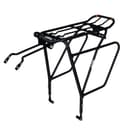 Ibera PakRak Touring Carrier Plus+ The commuter rack we'd fit first: frame-mounted for heavier top and side loads, height-adjustable to fit 26-29in bikes, and made for disc-brake frames. Solid, affordable, and pannier-ready. | Best disc-brake rack | $49.99 · View on Amazon Price as of October 21, 2026. #ad How we’re funded |
| 2 | 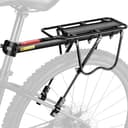 West Biking Universal Adjustable Rear Rack The budget universal rack: adjustable to fit most frames, a high stated load capacity, and reflective detailing — the cheap, cheerful way to add carrying capacity to a bike without eyelets fuss. | Best for an awkward frame | |
| 3 | 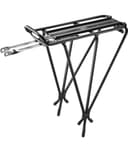 Topeak Explorer Rear Rack A durable alloy rack whose party trick is the MTX QuickTrack rail on top — click on a Topeak MTX trunk bag without straps. The pick if you like Topeak's snap-on bag ecosystem. | Best for snap-on bags | $59.95 · View on Amazon Price as of October 21, 2026. #ad How we’re funded |
Check 1: do you have rear rack eyelets?
Look at the rear dropouts, where the wheel axle sits, and at the seatstays just below the seat cluster. You are looking for small threaded holes — usually two per side, one low and one high. That is the standard frame-mounted rack interface, and if you have all four, the rest of this is easy.
Commuter and hybrid bikes almost always have them. Road bikes, carbon frames and some gravel bikes often do not, and if yours does not, you are shopping in a different category — a universal clamp-on rack or a seatpost rack. The West Biking universal adjustable rack exists for exactly that case, and its listing is honest that universal fit takes patience to dial in.
Check 2: does the lower leg clear the caliper?
This is the actual disc-brake problem. A rear disc caliper sits on the inside of the left dropout, in the same few centimeters of space a rack’s lower leg wants. Three outcomes:
- The rack leg sits outboard of the caliper.This is what “disc-brake compatible” usually means and what the Ibera PakRak Touring Carrier Plus+ publishes. No fuss.
- The leg lands on the caliper.Sometimes solved with the spacers that ship with many racks, sometimes solved by mounting the lower leg to a higher eyelet, and sometimes not solvable — in which case return the rack rather than forcing it.
- The leg clears, but only just. The one to watch. A gap that looks fine unloaded can close when 30 pounds of groceries flexes the rack. Check it loaded.
Check 3: height, width and the wheel
Rack fit is also about the wheel it straddles. The Ibera rack publishes height-adjustable fitment for 26 to 29 inch frames, which covers almost every commuter and hybrid bike sold. Fat-tire bikes and some e-bikes are the exception: a 4-inch tire needs more width between the rack legs than a standard rack provides, and that is a genuine incompatibility rather than a tight fit.
Two more things to look at while you are down there. Fender interference— a rack and a full fender both want the same bolt on the seatstay bridge, and you may need a longer bolt or a different mounting order; our fender guide covers the combination. And heel clearance— a rack set too far forward puts your pannier where your heel goes, which is the most common complaint about an otherwise correctly fitted rack.
What each of the three racks is actually for
Ibera PakRak Touring Carrier Plus+is the default. It publishes the two things that matter here in writing — frame-mounted, disc-brake compatible, and height-adjustable for 26 to 29 inch frames — and it is pannier-ready on standard side rails. The honest limitation from its own listing: it needs frame eyelets or an adapter.
West Biking universal adjustable rack is the answer when the frame fights you: adjustable to a wide range of frames, a high 110 pound stated capacity, reflective accents, and a low price. Its listing concedes that the hardware is not premium and that universal fit takes patience. For a frame with no eyelets, patience is the price of entry.
Topeak Exploreris the one to buy for a reason unrelated to disc brakes: the MTX QuickTrack rail on top, which lets a Topeak MTX trunk bag click on and off without straps. Its listing also notes that the frame-mount fit needs eyelets. Buy it if you want the snap-on bag system — we compare it directly with the Ibera on Ibera vs Topeak racks.
Worth stating plainly: only the Ibera publishes disc-brake compatibility. The other two very likely fit most disc bikes, and we are not going to tell you they are rated for it when their listings do not say so. That is the whole reason this page exists.
After it is fitted: the five-minute check
Fit the rack, then do this before the first loaded ride. Squeeze the rear brake hard and look at the caliper — nothing should be touching. Spin the wheel and listen for a rub. Load the rack with roughly what you intend to carry and look at the caliper gap again, because that is the measurement that matters. Then check every bolt is tight, and check them again after a week; new racks settle, and a loose rack bolt is the noise everybody mistakes for a creaking bottom bracket. Our rack mounting guide has the full sequence, and how much a rack can hold covers reading the load rating honestly.
Once the rack is on, the bag question opens up — and rack rail diameter and hook spacing decide which panniers fit, which is a separate check we work through in rack and pannier compatibility. If the bike is an e-bike, go to rear racks for e-bikes instead; the load and speed change the answer.
Frequently asked questions
Will a rear bike rack fit a disc-brake bike?
In most cases yes, but it is a fit question rather than a yes-or-no one. Disc brakes put a caliper on the inside of the left rear dropout, exactly where one of a rack's lower legs wants to sit, so the rack must either clear the caliper or mount above it. Three things decide it: whether your frame has rear rack eyelets, whether the lower mounting point clears the caliper, and whether the rack's legs can be set wide or high enough. Racks that publish disc-brake compatibility — the Ibera PakRak Touring Carrier Plus+ is the one in our picks that does — have already designed around that caliper.
What is a disc-brake-compatible rack?
A rack whose lower legs and mounting hardware are shaped to clear a rear disc caliper, usually by sitting the leg outboard of the caliper or by using a longer, offset lower stay. Some racks add spacers for the same purpose. The useful distinction is whether the maker says so: the Ibera PakRak Touring Carrier Plus+ publishes frame-mounted, disc-brake-compatible fitment and a 26 to 29 inch adjustable height. Plenty of racks fit disc bikes fine without claiming it, but if you want the question answered before you pay, buy the one that answers it.
Can I fit a rack if my bike has no eyelets?
Yes, with a universal clamp-on rack or a seatpost rack, and with real caveats. A universal adjustable rack like the West Biking clamps to the frame rather than bolting to eyelets, which is what makes it the option for a frame with nothing to screw into — its own listing concedes that universal fit takes patience to dial in. The trade is load: a frame-mounted rack on proper eyelets carries heavier top and side loads more confidently than anything clamped on. If the plan is two loaded panniers of groceries, eyelets are worth seeking out.
Does a rear rack interfere with disc brakes?
It should not, and if it does, something is wrong with the fit rather than with the idea. The failure modes to check after fitting are a rack leg touching the caliper body, a mounting bolt fouling the caliper's adjustment, and a leg sitting close enough to the rotor that heat or flex brings them into contact. Spin the wheel and squeeze the brake hard before the first ride, look at the gap with the bike loaded, and re-check after a week of riding. A rack that clears unloaded can close that gap when 30 pounds sits on it.
How much weight can a rear rack hold?
It depends on the rack and the mounting, and the published figure is the ceiling rather than the plan. The West Biking universal rack publishes a 110 pound stated capacity, which is high for the category and worth reading as a maximum under ideal conditions. What actually limits you is usually the mounting: a clamp-on rack on a frame with no eyelets is not carrying its headline figure comfortably, and the frame itself may have a lower rated limit than the rack. Check both, and read our guide to how much a rack can hold.
Do I need a disc-specific rack for an e-bike?
You need a rack rated for the load and the speed, and nearly every commuter e-bike has disc brakes, so in practice yes — look for published disc compatibility. Two extra things matter on an e-bike. First, many e-bikes ship with a rack already fitted and rated by the maker, and that rack is almost always the right answer. Second, e-bike speeds and weight put more into the rack and its bolts than a regular bike does, so a frame-mounted rack on real eyelets beats a clamp-on one. Our rear racks for e-bikes page covers the specifics.
Sources
- Topeak — MTX TrunkBag DXP (MTX 2.0) — Topeak's published specs for the MTX TrunkBag DXP 2.0: 19.4 L capacity with an expandable top section, 1,185 g, 36 x 25 x 21.5-29 cm, 600 denier polyester over rigid EVA foam, MTX QuickTrack 2.0 mounting, side panels that expand to full panniers, and the note that MTX Dual Side Frames are required when using the panniers on MTX BeamRacks (accessed September 15, 2026)
Keep reading
Best Rear Bike Racks
The racks worth fitting, compared on mounting, published load and what bags they take.
See the picksHow to Mount a Rear Rack
The order to tighten things in, the spacers nobody explains, and the post-fit checks.
Read the guideRack and Pannier Compatibility
Rail diameter, hook spacing and heel clearance — the three measurements that decide fit.
Read the guideRear Racks for E-Bikes
Why e-bike speeds and weight change which rack you should buy, and which mountings hold up.
Read the guide