How we picked
Four criteria, in the order they decide the purchase. What is absent, and absent on purpose, is a brightness ranking. We own none of these vests, we run no retroreflectivity test, and not one listing publishes a figure in the units that standard actually uses. A page that ordered five vests by how bright they look would be dressing up a guess.
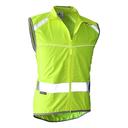
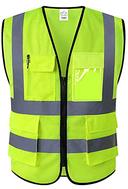
1. Does the listing name the reflective material?This is the first filter because it is the only hard evidence on offer. Retroreflective performance comes from the material - glass-bead or microprismatic film - not from how much of the garment is a different color. Exactly one vest here names it: the Salzmann says 3M Scotchlite. The others say “reflective”, “360-degree reflective” or “reflective strips”, which tells you a reflective element exists and nothing about what it is. That is not proof the others are worse. It is the difference between a claim you can check and a claim you cannot, and on a safety purchase we weight that heavily.
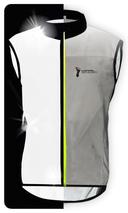
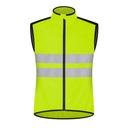
2. How much of you does it cover, and from which angles? A fully reflective shell has no dark side to accidentally turn toward a driver; a vest with taped strips has gaps, and the gaps move as you do. The ReflecToes Deluxe is a fully reflective fabric rather than a mesh frame with tape on it, which is why it takes the coverage award. The Graunton publishes 360-degree reflective detailing, which is a real claim about angles even though the material is unnamed. The two mesh vests - Salzmann and XIAKE - work on bands rather than full coverage.
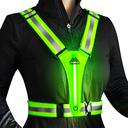
3. Does it do a second job? In practice this decides whether you keep wearing it in January. A mesh vest adds nothing but visibility, which is perfect over a coat and useless as a layer. The ReflecToes is wind resistant with back vents, so it functions as a gilet. The Graunton is a full-zip windbreaker vest with a rear pocket you can actually put a phone in. The Topward does the most unusual second job of all: it makes its own light.
4. Will you wear it? Last on the list and first in importance, which is the same paradox as helmets. The best reflective vest is the one on your body, and a work-site yellow mesh vest has a real social cost that a cycling-cut black-and-silver gilet does not. We have put a cheap mesh vest at the top of the page anyway, because the evidence favors it - but if the honest reason you would not wear it is that it looks like roadworks, buy the Graunton and wear it.
The thing a vest cannot do
Retroreflective material needs a light source pointed at it from roughly the direction of the viewer. That is the physics, and it produces three specific failures a vest cannot cover - all three of which an active light does cover.
The unlit approach.On a dark lane, a driver’s headlights sweep across you at a distance that depends on the bend of the road. Before that, you are returning nothing, because nothing is being aimed at you. A rear light is visible the whole time.
The bright background. In a city, a reflective panel competes with shopfronts, streetlights and headlights pointed everywhere. Reflection is a fraction of incident light; a light makes its own. This is why daytime running lights exist, and why we rate them so highly in best daytime running lights for bikes.
The badly aimed headlight. A car with dipped or misaligned beams lights the road ten meters ahead and not your torso. You have no control over this and no way to know it is happening.
None of that makes a vest a bad purchase; it makes it an addition. The argument in full, including where the law lands on reflectors versus lamps, is in reflectors vs lights and be seen vs see. The short version: in most US states an active front and rear lamp is the legal requirement and reflective material is additional, never a substitute. The California rules, which are the most specific we have written up, are in California bike light laws.
Where reflective material does the most good
Position matters more than quantity, and there is a reason the best cycling kit puts reflective material low and on the limbs rather than in one large panel on the chest.
Your ankles and knees are the most recognizable thing about you. They move in a circle, and nothing else on a road at night does that. A driver reading a pedaling motion identifies a cyclist faster and more reliably than one reading a static bright patch, because the motion is unambiguous. This is why reflective ankle bands are worth owning alongside a vest, and why a vest alone leaves the single most legible signal unused.
Your back is the biggest available surface and the easiest to block. A commuter backpack covers most of it. If you carry one, the vest needs to go over the pack, not under it - which sounds obvious and is routinely done the other way round. We cover the packs themselves, and the way a full one hides your tail light, in best bike commuter backpacks.
Your sides are what a junction sees. A bike is nearly invisible in profile: two thin wheels and a frame, with the lights pointing away from the threat. Reflective sidewall tires and spoke reflectors help here and so does any vest that wraps rather than bibs.
Vest, jacket or lights: where the next $20 should go
Spend in this order, and the order is not the one the marketing suggests.
First, a working front and rear light. Not negotiable, not replaceable by reflective material, and legally required in most places after dark. A complete set costs less than one premium vest - best bike lights under $50 has the whole field, and best budget bike lights has the cheapest legal route.
Second, a vest. This page. It covers the angle your lights cannot and it costs almost nothing. If you commute after dark even twice a week, buy one this month.
Third, daytime lighting. Counterintuitive, and the one place this page would spend money before buying more reflective fabric: a reflective vest does nothing in daylight, because there is no beam to return. A bright flashing front light does. If you ride in daylight as well as after dark - and most commuters do - that is the next gap.
Fourth, and only then, a reflective jacket. A full REFLECT360-style jacket costs five to ten times what these vests do. It is a good product and it is the wrong first purchase, because it buys more of what you already have rather than the thing you are missing. Buy it as a jacket - for the waterproofing and the warmth - and treat the reflectivity as a bonus. Our wet-weather and winter kit lists are in commuter rain gear and winter commuting gear.
Sizing, washing and the lifespan nobody mentions
Three practical notes that apply across every pick here.
Buy it to go over your bulkiest layer. A vest sized to your shirt is a vest you cannot wear in February over a winter coat, which is exactly when you need it most. The adjustable mesh vests here (Salzmann, Topward, XIAKE) handle this with straps; the fitted shells (ReflecToes, Graunton) are sold per size, so size up if it will live over a jacket.
Reflective material wears out, and washing is how. Retroreflective film degrades with abrasion, heat and detergent - a vest that has been through a hot wash fifty times does not reflect like a new one, and there is no indicator to tell you. Wash cool, do not tumble dry, and replace a vest that has gone gray and stiff rather than trusting it. At these prices that is a running cost of a few dollars a year.
Keep it where you cannot forget it. The failure mode for a vest is not that it fails, it is that it is at home. Leave it in the pannier, the trunk bag or the bottom of the backpack permanently, which is a decent argument for the cheap mesh vests: at under ten dollars you can own two and stop making the decision. Where the rest of the always-in-the-bag kit lives is in commuter bike accessories.