What $200 buys that $100 does not
Three things, and the first is the only one that is really about security.
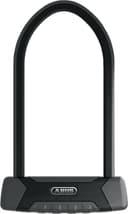
1. Shackle and link diameter at the top of the scale. Under $100 the serious U-locks run 13 to 14 mm; in this band you get 16 mm on the New York Standard and 18 mm on the Fahgettaboudit Mini, and chain links of 14 to 15 mm hardened steel. Diameter is the figure that matters against the tools thieves actually carry, because a bolt cropper has to physically close around the steel and a cordless grinder has to cut through more of it. Which tools get used, and against what, is in how thieves break bike locks.
2. The maker’s own top grade. Kryptonite publishes a 1-to-10 security scale and reserves 10 for the Fahgettaboudit line; the New York series sits at the top of it. ABUS does the same on its own scale, and independent Sold Secure grades exist for some models. What those ratings do and do not tell you is in bike lock security ratings explained.
3. Reach, which is a security feature in disguise. The most common real-world failure is not a cut lock, it is a lock that would not fit around the frame AND a solid object, so the bike got secured by the wheel or by nothing. A 1515 chain reaches around a lamp post with the frame inside it; a mini U-lock may not reach around a fat rack. See how to lock your bike and how to lock a bike without a rack.
What $200 does not buy is grinder immunity. A cordless angle grinder gets through every lock on this page given uninterrupted time; what a top-tier lock buys is more of that time and more noise, which in a public place is the whole game. The honest version of that argument is in are angle-grinder-proof locks real.
Which shape, for which parking
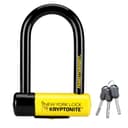
Mini U-lock, for a bike parked outdoors in a high-theft city. The Fahgettaboudit Mini is the pick. The small body is the security feature: it denies a thief the gap needed to insert a bottle jack or a pry bar, which is how cheaper U-locks actually fail. The cost is reach - you lock the rear wheel and frame to a slim stand, and you plan your parking around the lock rather than the other way round.
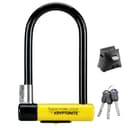
Full-size U-lock, for city parking where you want options.The New York Standard keeps a 16 mm shackle in a body with a usable opening, so you can get frame plus a wheel around a fat rack. That flexibility is why it is the most practical of the three U-locks here for most people, and the ABUS Granit XPlus 540 is the same idea with ABUS’s fit and feel.
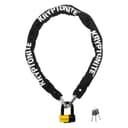
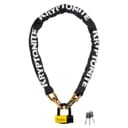
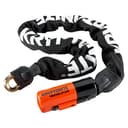
Chain, for overnight and for awkward anchors. If the bike lives outside overnight or on the street at work, a chain is the right answer: the New York Legend 1515 and the Fahgettaboudit 1415 reach around things a U-lock cannot, and they are the heaviest objects on this page by a wide margin. You do not commute with one of these in a bag - you leave it at the place you park.
And if you want a chain you can carry, the Evolution 1090 is the budget pick for exactly that reason: the cheapest lock here that still belongs to this tier, and manageable in a pannier. The wearable option, the Hiplok Gold, and the folding locks sit in the next band down - best bike locks under $100 has them, and the shape arguments are in U-lock vs chain lock and folding lock vs U-lock.
Spending $200 well: two locks, or one?
The best use of a $200 budget is usually not one $200 lock. It is a top-tier U-lock plus a second, different lock. Two reasons. First, two locks of different types force a thief to carry and use two different tools, and the marginal thief carries one. Second, the second lock secures what the first cannot reach - the front wheel, the saddle, the bits that walk away on their own. We make that case in full in do you need two bike locks and how to lock your wheels and saddle.
Three more things worth your money before a third lock. Registration and a recorded serial number, which is what actually recovers a bike - see what to do if your bike is stolen. A tracker, which does nothing to prevent theft but changes what happens afterwards - AirTag alternatives for a bike. And better parking habits, which cost nothing at all: how to prevent bike theft.
A note on how much to spend relative to the bike. The usual rule of thumb is around 10 percent of the bike’s value, which lands a $200 lock on a $2,000 bike - and on an e-bike, where the bike is heavy, valuable and the most targeted thing on a street, that rule points firmly at this band. Our e-bike-specific ranking is in best e-bike locks, the battery is a separate problem in how to secure an e-bike battery, and the full spending argument is in how much to spend on a bike lock.