How we picked
Five criteria, in the order they decide the purchase. What is not here: a weight ranking and a time-to-cut figure. Several of these listings publish no weight at all, we have attacked none of these locks, and a cut time we did not measure is a number we would be inventing.
1. Is there an independent grade?The first filter and the one that separates this page from most “best under $100” lists. Sold Secure puts a lock in front of a defined tool set for a defined time and issues Bronze, Silver, Gold or Diamond, so a Gold is comparable across brands. Four picks here publish a Sold Secure grade on their listing and we have said which one each holds. One of them — the KryptoLok Standard — is described as Silver on its US listing and Gold on UK retailer listings, and rather than pick the flattering one we are telling you the grade differs between markets.
2. How thick is the metal, and is it solid or linked?Shackle diameter is the figure that correlates most directly with how long a bolt cutter or pry bar takes, and the U-locks here publish 12 mm to 13 mm of hardened steel in one solid loop. A folding lock’s plates are far thinner — the Bordo publishes 5 mm — and its defense comes from hardening and rivets rather than bulk. Those are different failure modes, not better and worse ones, and we compare them directly in folding lock vs U-lock.
3. What can you lock it to?Where buyers get caught out. A mini U-lock will take a frame and a wheel to a slim bike hoop and will not reach around a fat street sign, a square railing or a scaffold pole. A folding lock at 85–90 cm reaches almost anything in a city. If your parking is improvised rather than a purpose-built rack, buy reach over thickness — the test case is locking a bike where there is no rack.
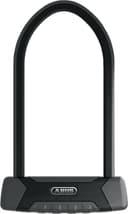
4. Is there a way to carry it? A lock with a bracket or a holster travels on the bike, so it is with you whether or not you remembered it. Most picks here ship with one. The notable exception is the ABUS Granit XPlus 540, whose retailer spec table states explicitly that the mount is not included— it is the best-protected lock on this page and the one you have to solve the carrying problem for yourself. Options are in how to carry a bike lock.
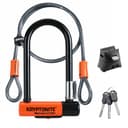
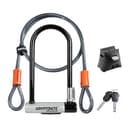
5. What is in the box?At this price the extras change the real value. Two of the U-locks include a 4 ft flex cable, which is the cheap answer to the front wheel and the saddle — not a lock in its own right, but a useful second thing for a thief to deal with. Several include a frame bracket, a second key and a code card for replacements. One includes an LED key, which sounds trivial until you are finding a keyhole in a dark bike room.
Which shape should you buy?
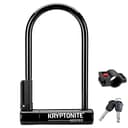
Buy a U-lockif you use real bike racks. This is the default and the right default for most commuters: all the mass goes into a short, thick shackle, the tight body gives a thief nothing to lever against, and the versions with a cable in the box cover your wheels. If you want the most protection you can get under the line regardless of carry, the ABUS Granit XPlus 540 is it — its retailer table publishes a 13 mm parabolic hardened shackle and ABUS’s own maximum level 15 of 15, with the maker’s guidance that levels 10 to 15 are the right choice for high-quality bikes in large cities.
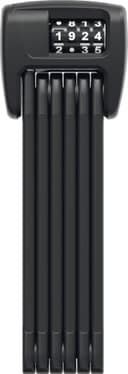
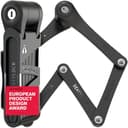
Buy a folding lockif your parking is unpredictable, your frame is small, or you regularly lock two bikes together. Nearly a meter of reach that folds into a block is a genuinely different capability, and on a folder or a compact frame it is often the only shape with somewhere to mount. You are accepting a linked construction in exchange, and the Bordo publishes ABUS level 10 of 15 against the 540’s 15 — the same maker saying, on its own scale, that one is more protected than the other.
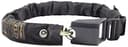
Buy a wearable chain if the thing stopping you carrying a serious lock is where it goes rather than what it weighs. A Sold Secure Gold chain worn at the waist is the only option here that gives chain-grade security with no bag involved. It is also the option riders either adopt permanently or abandon after a fortnight, so be honest with yourself.
What $100 does not buy
Nothing on this page stops an angle grinder, and nothing here claims to. A cordless grinder goes through 13 mm of hardened steel in well under a minute and through a folding lock’s plates faster. The only independent grade involving a grinder test is Sold Secure Diamond, and no lock in this budget holds one; grinder-resistant locks are a separate, heavier and considerably more expensive category, which we cover in are angle-grinder-proof locks worth it.
What a lock in this band does buy is time against the tools thieves carry most of the time — bolt cutters, a short pry bar, a hammer, a bottle jack — and the deterrent of being visibly harder than the bike next to yours. That is the realistic goal, and it is why where and how you lock matters as much as what you spend: how to lock your bike properly and how thieves actually break locks are worth ten minutes before you spend anything.
One structural point about the budget. If you have $100 to spend on security and an expensive bike, two $50 locks of different types often beat one $100 lock, because a thief then needs two kinds of tool and twice the time at the rack. If the bike is modest and comes indoors overnight, one good lock in this band is the better answer. That trade-off is argued out in do you need two bike locks and how much to spend on a bike lock.
And if the bike is an e-bike, treat this page as a floor rather than an answer. An e-bike is heavier, more valuable and a much more attractive target, and the battery is a separate theft problem with its own solution — see best bike locks for e-bikes and how to secure an e-bike battery.
And if the bike is worth more than this cap implies, the band above is where the thickest hardened shackles and the top of each maker’s own scale live: best bike locks under $200.