Chain & Charge

Kryptonite KryptoLok vs Evolution

Nearly the same shackle, a full Sold Secure grade apart, and roughly $45 between them. The deciding question is not which lock is stronger - it is where your bike sleeps.

By Stephen V.Last updated How we pick

On paper these two locks are 0.3mm apart and a full security grade apart, and the grade is the part that matters. The KryptoLok Standard publishes a 12.7mm hardened shackle and, on its US listing, Sold Secure Silver. The Evolution Mini-7 publishes a 13mm hardened shackle and Sold Secure Gold. Three tenths of a millimeter of steel does not explain a grade jump, which tells you the difference is in the things the shackle diameter does not capture: the body shape, the deadbolt arrangement, the cylinder, and the heat treatment Kryptonite calls its hardened kryptonium steel.

That is the whole decision, and it is not a decision about strength in the abstract. Both locks are real hardened U-locks and both are vastly better than the cable lock most people replace. The question is whether your bike is ever left somewhere you cannot see it for more than a few minutes, because a Silver-grade lock and a Gold-grade lock fail to different attackers. Opportunists with hand tools are stopped by both. Semi-organized thieves working a known rack with a long bolt cutter are a different proposition, and the grade is the only independent statement you have about where each lock sits.

The second difference is the one people discover after buying, and it has nothing to do with security. The KryptoLok here is a Standard body; the Evolution here is a Mini-7, listed at 8 x 17.8cm. The small opening is a security feature — less room for a jack or a crowbar — and a daily inconvenience, because it will not reach a fat signpost plus a wheel. If your only available parking is a thick post or a chunky rack, that constraint can override the grade argument entirely.

We own neither lock and run no test lab, so nothing below is a test result. Every figure comes from the live listing or a dated retailer spec table, and this page also carries the one conflict we could not resolve: the US and UK listings do not agree on the KryptoLok’s Sold Secure grade. Here is exactly what we do instead of testing.

How this is funded:we earn a commission if you buy through our links, at no extra cost to you. It never changes which product we recommend, and we’ll tell you when we’d skip one. Full disclosure.

Quick picks

Ranked on published specs, real security and safety standards, and buyer fit. Select a row to jump to the full write-up.We have not tested these products — here is exactly what we do instead.

#ProductBest forPrice
1
Kryptonite Evolution Mini-7 U-Lock

Kryptonite Evolution Mini-7 U-Lock

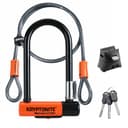
The lock most commuters should actually own: a 13mm shackle that carries an independent Sold Secure Gold grade in a mini body, at roughly half the weight and half the money of the New York line — and it ships with the cable that solves the front wheel.

Best for outdoor parking
$109.94 · View on Amazon

Price as of October 24, 2026. #ad How we’re funded

2
Kryptonite KryptoLok Standard U-Lock with Cable

Kryptonite KryptoLok Standard U-Lock with Cable

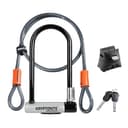
The best-value 'real' lock for everyday commuting: a 12.7mm shackle the US listing rates Sold Secure Silver, bundled with a cable to loop a front wheel. Enough deterrent for most parking without the top-tier price or weight.

Best for reach and value
$65.79 · View on Amazon

$79.9518% off

Price as of October 24, 2026. #ad How we’re funded

3
Kryptonite Keeper 12 Standard U-Lock

Kryptonite Keeper 12 Standard U-Lock

The honest budget U-lock: a 12mm shackle rated Sold Secure Silver. It won't stop a determined grinder, but it's a real hardened lock at a cable-lock price — the floor we'd recommend, not a $15 cable.

The budget floor
$46.95 · View on Amazon

$50.958% off

Price as of October 24, 2026. #ad How we’re funded

The picks in full

#1Best for outdoor parking

Kryptonite Evolution Mini-7 U-Lock

The lock most commuters should actually own: a 13mm shackle that carries an independent Sold Secure Gold grade in a mini body, at roughly half the weight and half the money of the New York line — and it ships with the cable that solves the front wheel.

Strengths

  • Independently graded Sold Secure Gold, not just a maker's in-house number
  • 13mm hardened shackle and a double-deadbolt design, both on the listing
  • Mini body gives a crowbar or jack almost no room to work
  • 4 ft KryptoFlex cable and a FlexFrame-U bracket are in the box

Trade-offs

  • 13mm is a shorter grinder job than the 16-18mm locks — this is not an overnight-outdoors lock
  • The mini opening is genuinely restrictive; it will not reach a fat post plus a wheel
  • The bundled cable is convenience security only and cuts in seconds
  • Listing publishes no weight, so plan the carry by its class rather than a figure
Shackle13mm hardened steel
Security ratingSold Secure Gold certified (listed)
MechanismDouble deadbolt (listed)
Extras4 ft cable + FlexFrame-U bracket
Published detailListing gives no weight or internal dimensions

Specs read from the product listing, on October 17, 2026. We have not physically tested this product.

#2Best for reach and value

Kryptonite KryptoLok Standard U-Lock with Cable

The best-value 'real' lock for everyday commuting: a 12.7mm shackle the US listing rates Sold Secure Silver, bundled with a cable to loop a front wheel. Enough deterrent for most parking without the top-tier price or weight.

Strengths

  • 12.7mm hardened shackle in a full-size Standard body that reaches most racks
  • Includes a flex cable for the second wheel
  • Comes with a frame mount and costs well under the New York line

Trade-offs

  • US listing rates it Sold Secure Silver — a grade below the Evolution line
  • Not in the grinder-resistant class of the 16-18mm locks
  • The bundled cable is convenience security, not primary security
Shackle12.7mm hardened steel (listing)
Security ratingSold Secure Silver certified (US listing)
Extras4ft flex cable + bracket, 2 keys, disc-style cylinder
Best useDaily commuting

Specs read from the product listing, on July 23, 2026. We have not physically tested this product.

#3The budget floor

Kryptonite Keeper 12 Standard U-Lock

The honest budget U-lock: a 12mm shackle rated Sold Secure Silver. It won't stop a determined grinder, but it's a real hardened lock at a cable-lock price — the floor we'd recommend, not a $15 cable.

Strengths

  • 12mm hardened shackle — a genuine U-lock, not theater
  • Sold Secure Silver rating and a mounting bracket included
  • Among the cheapest locks we'd actually trust

Trade-offs

  • Silver rating is a step below Gold — not for high-theft areas
  • Thin enough that a large bolt cutter is a threat
Shackle12mm hardened steel
Security ratingSold Secure Silver
MountIncluded bracket
Best useLow-risk parking, backup lock

Specs read from the product listing, on July 23, 2026. We have not physically tested this product.

The two locks, side by side

Every cell below is a figure the listing or the retailer spec table publishes. The blanks are real — neither listing publishes a weight, which is genuinely annoying for a product you have to carry, and we are not going to estimate one.

 KryptoLok StandardEvolution Mini-7
Shackle12.7mm hardened steel13mm hardened kryptonium steel
Sold Secure gradeSilver (US listing) — see the conflict belowGold (US listing)
Kryptonite in-house scoreNot published on the listing7 out of 10 (bike-components spec table)
BodyStandard (full size)Mini-7, 8 x 17.8cm
LockingDisc-style cylinderDouble deadbolt + reinforced high-security disc cylinder
Cable4ft KryptoFlex120cm, 10mm thick
In the boxMounting bracket, 2 keysFlexFrame-U bracket, 3 keys (one with a lamp)
WeightNot publishedNot published (spec table cell is a unit error)

The grade conflict, stated plainly

We will not pretend this is tidy. The US Amazon listingfor the KryptoLok Standard U-lock reads “Sold Secure Silver Certified” in its own title. Several UK retailer listingsfor a KryptoLok Standard U-lock describe the same model name as Sold Secure Gold. Kryptonite’s own product pages return 404 at the URLs search engines hold for these locks — the same wall we hit writing the Fahgettaboudit Mini review — so we could not go to the maker to settle it.

There are two innocent explanations and we cannot distinguish between them from published sources. Sold Secure grades are awarded to a specific submitted product, and “KryptoLok Standard” has covered several generations and regional variants over the years; a grade earned by one revision does not automatically carry to the next. It is also possible the UK listings are simply out of date. What we can say is what each listing we can actually read publishes today, which is what the table above does.

The practical takeaway is not “ignore the grade.” It is the opposite: buy the lock whose grade is printed on the listing you are buying from, today. If you are buying in the US and you want Gold, the Evolution says Gold on its own title and the KryptoLok says Silver on its own title. That is the version of the fact that applies to your purchase. If this matters to you — and for insurance purposes it sometimes does literally matter — screenshot the listing at the time you buy.

Where each one actually wins

Buy the Evolution Mini-7 if your bike is ever out of sight outdoors.Station parking, a street rack outside a store, an apartment courtyard, anywhere the bike sits for hours while you are somewhere else. Three things stack in its favor: an independent Gold grade on the listing, a double deadbolt (both legs of the shackle are held, so cutting one does not open the lock), and the mini body that gives a crowbar or a bottle jack almost nowhere to sit. It is also the cheapest lock in Kryptonite’s range that gets you a Gold grade, which is the real reason to pick it over the KryptoLok rather than the 0.3mm.

Buy the KryptoLok Standard if the parking is low-risk or the reach is the problem.Two genuine cases. First, a bike that comes indoors every night and is only ever locked for twenty minutes in daylight — a Silver lock is proportionate there, and the money saved is better spent on a second lock for the wheel than on upgrading the first. Second, and this is the one people underestimate: the Standard body opens enough to go around things the Mini-7 cannot. If the only thing to lock to on your route is a thick signpost or a large-diameter rack, a more secure lock that does not fit is worse than a slightly less secure lock that goes through the frame and the rack properly.

Neither, if your bike sleeps outdoors in a city.This is worth saying bluntly because both of these locks get bought for that job and neither is built for it. A 12.7mm or 13mm shackle is a short job for an angle grinder, and a lock left on a street overnight is exactly the situation where a grinder gets used. That is a 16–18mm problem, and it is covered on the angle-grinder-resistant locks page and the Evolution versus New York comparison, which picks up exactly where this page stops.

What the Keeper is doing on this page

We included the Keeper 12 as a third row for one reason: a lot of people searching “KryptoLok vs Evolution” are really asking “how little can I spend on a lock that is not a joke.” The Keeper is that answer — a 12mm hardened shackle rated Sold Secure Silver, at a price closer to a cable lock than to either lock above. It is the floor we would recommend, and it is a real U-lock rather than security theater.

It is not, however, a cheaper KryptoLok. It has a thinner shackle, no bundled cable for the front wheel, and no claim on the Gold tier. If your bike is worth more than a few hundred dollars, the step from Keeper to Evolution is the single best money-to-security move in this whole lineup, and the step from KryptoLok to Evolution is the second best. We argue the actual spend tiers out in how much to spend on a bike lock.

The cable is not the second lock

Both of the main locks here ship with a flex cable — 4ft on the KryptoLok, 120cm at 10mm thick on the Evolution — and both cables exist to loop a front wheel so it is not trivially removable. That is a worthwhile job and it is genuinely convenient to have it in the box.

It is also convenience security and nothing more. A 10mm braided cable is cut by a decent pair of hand cutters in seconds; it deters a passer-by who wanted a free wheel, and it stops nobody who came equipped. Treat the cable as what it is: the thing that makes your wheel a less attractive target than the unsecured wheel next to it. If you want the wheels and saddle actually secured, that is a different technique and some different hardware, and it is covered in locking your wheels and saddle.

A note on the in-house 1-10 number

Kryptonite publishes its own security score for each lock on a 1–10 scale, and the retailer spec table we could read gives the Evolution Mini-7 a 7 out of 10. It is useful for ranking locks withinKryptonite’s own range — a 7 really does sit below the 10 the company gives its Fahgettaboudit line — and it is worth precisely nothing for comparing across brands, because every maker grades its own homework on its own scale.

That is the entire argument for caring about Sold Secure instead. It is an independent test house, the grade is awarded to a specific submitted product, and Bronze, Silver, Gold and Diamond mean defined things about how long a lock resisted defined attacks. We walk through what each grade actually involves in bike lock security ratings explained. When a maker’s own number and an independent grade disagree about which of two locks is better, believe the independent one.
Frequently asked questions

Is the Kryptonite Evolution better than the KryptoLok?

On the figures the US listings publish, yes - and by more than the shackle diameter suggests. The Evolution Mini-7's listing states Sold Secure Gold and a double deadbolt; the KryptoLok Standard's listing states Sold Secure Silver. That is a full independent grade apart even though the shackles are only 0.3mm apart, which tells you the difference lives in the body shape, the deadbolt arrangement, the cylinder and the heat treatment rather than in raw thickness. The KryptoLok still wins on two practical points: it costs noticeably less, and its full-size Standard body reaches around posts and racks the mini body cannot.

What is the difference between KryptoLok and Evolution?

Four published differences. Shackle: 12.7mm on the KryptoLok Standard, 13mm on the Evolution Mini-7, described as hardened kryptonium steel. Grade: the US listings say Silver and Gold respectively. Locking: the Evolution lists a double deadbolt and a reinforced high-security disc cylinder, the KryptoLok a disc-style cylinder. Body: the KryptoLok here is a full-size Standard, the Evolution a Mini-7 listed at 8 x 17.8cm. Price sits roughly $45 apart at the time of writing, which is the real question - whether a grade jump is worth that to you depends entirely on where the bike is parked.

Is the KryptoLok Sold Secure Gold or Silver?

It depends which listing you read, and we could not resolve it from the maker. The US Amazon listing for the KryptoLok Standard U-lock says 'Sold Secure Silver Certified' in its own title. Several UK retailer listings for a KryptoLok Standard describe it as Sold Secure Gold. Kryptonite's own product pages return 404 at the URLs search engines hold for this lock, so there is no maker page to settle it. Two innocent explanations exist: Sold Secure grades are awarded to a specific submitted product and the KryptoLok name has spanned several generations, or the UK listings are simply stale. Our advice is to buy on the grade printed on the listing you are actually buying from, and screenshot it if the grade matters for insurance.

Is a 13mm shackle enough for an e-bike?

For daytime errands where the bike is in sight, usually. For an e-bike left locked outdoors where you cannot see it, no - and we would not recommend either lock on this page for that. An e-bike is heavy, expensive and desirable, which pushes it up the target list, and a 13mm shackle is a short job for an angle grinder. The honest answer for e-bike parking is a 16-18mm lock, a second lock so one tool does not open everything, and a tracker so theft is recoverable. Our e-bike lock picks and the battery-specific problem are both covered separately.

Does the Evolution Mini-7 fit most bike racks?

It fits most purpose-built bike racks and struggles with improvised ones. The listed 8 x 17.8cm opening is enough for a frame tube plus a standard rack hoop, which is the normal case. It is not enough for a frame plus a wheel plus a thick signpost, or for large-diameter street furniture. Before buying a mini U-lock, look at where you actually park: if it is a proper rack, the mini body is a security advantage because it leaves no room for a crowbar or a jack. If your only option is a fat post, buy the full-size Standard body instead and accept the lower grade, because a lock that does not go around the thing secures nothing.

Is the included cable any use?

It is useful and it is not security. Both locks ship with a flex cable - 4ft on the KryptoLok, 120cm at 10mm thickness on the Evolution - and its job is to loop your front wheel so it is not a free part sitting next to a locked frame. That is worth having. But a 10mm braided cable goes through in seconds with ordinary hand cutters, so it deters opportunism and nothing else. Never run the cable as your primary lock, and never assume the cable makes a wheel secure - it makes it less attractive than the unsecured wheel next to it.

Which Kryptonite lock should I buy for a college campus?

The Evolution Mini-7, in most cases. Campus parking is the worst combination for a lock: high bike density, predictable long stays, racks that thieves can case at leisure, and a lot of bikes whose owners are away for hours. That argues for the Gold grade rather than the Silver one, and the mini body is an asset at a crowded rack where a thief needs leverage room. The one exception is a campus where the only racks are oversized - then the reach of the Standard body matters more. We go through the campus case specifically, including the second-lock question, on our campus lock page.

Sources

  • Amazon — Kryptonite KryptoLok Standard Bike U-Lock listing (ASIN B06XCLTVPQ) — The listing this page's price and buy link point at, re-confirmed purchasable on 2026-10-24. Its title publishes "12.7mm Shackle, 4ft Cable", a "Mounting Bracket, 2 Keys & Disc-Style Cylinder", and — the figure that matters here — "Sold Secure Silver Certified". UK retailer listings for a KryptoLok Standard U-lock describe it as Sold Secure Gold, so the grade differs between the market listings and our page says so rather than picking one. The listing publishes no weight and no internal dimensions (accessed October 24, 2026)
  • Amazon — Kryptonite Evolution Mini-7 Bike U-Lock listing (ASIN B06XZT8KZ1) — The listing this page's price and buy link point at, re-confirmed purchasable on 2026-10-24. Its title publishes "13mm Steel Shackle, 4 ft Cable", "Sold Secure Gold Certified 13mm Hardened Steel Shackle", a "Double Deadbolt", a "FlexFrame-U Mounting Bracket" and "3 Keys". No weight and no internal dimensions are published (accessed October 24, 2026)
  • bike-components — Kryptonite Evolution Mini 7 U-Lock with Kryptoflex Cable (spec table) — The retailer's published specification table for the Evolution Mini-7: design "U-lock with cable"; U-lock material "hardened kryptonium™ special steel"; dimensions "8 cm x 17.8 cm"; shackle thickness "13 mm"; cable length "120 cm"; cable thickness "10 mm"; security rating "7 (out of 10)" on Kryptonite's own in-house scale; features "shackle with double deadbolt design for additional security" and a "reinforced high security disc cylinder lock for security against drilling and picking"; contents "1 x Kryptonite Evolution™ Mini 7 U-lock", "1 x Kryptonite Kryptoflex cable®", "1 x mount", "1 x key with integrated lamp", "2 x keys". The weight cell reads "1.61 g", a unit error on the page, so no weight is stated as fact on our page (accessed October 24, 2026)
  • Sold Secure — Ratings explained — The Bronze / Silver / Gold / Diamond lock ratings and what each attack test involves, including the Diamond angle-grinder test (accessed July 23, 2026)

Keep reading