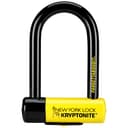
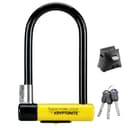
The published specifications
The Amazon listing this page links to publishes the shackle diameter and essentially nothing else — no weight, no internal dimensions, no cylinder type. The figures below come from a retailer specification table fetched on 2026-10-10, because Kryptonite’s own product page for this model could not be reached: the URLs on kryptonitelock.com returned 404 and the model is not indexed there. That is a real limitation and we would rather state it than imply we read the maker’s sheet.
| Specification | Published figure | Source |
|---|
| Shackle thickness | 1.8 cm (18 mm), steel | Retailer spec table; also in the Amazon title |
| Overall dimensions | 15.3 × 8.3 × 1.8 cm | Retailer spec table |
| Crossbar | “Two-wall crossbar, extremely tough” | Retailer spec table |
| Cylinder | Reinforced high-security disc cylinder, stated as drill- and pick-resistant | Retailer spec table |
| Keys | 3, one with an integrated key lamp | Retailer spec table |
| Security rating | 10 out of 10 — Kryptonite’s own scale | Retailer spec table |
| Weight | Not stated here.The spec table prints “2.06 g”, which is a unit error — grams cannot be right for an 18 mm steel U-lock | Unverifiable from the sources we could reach |
| Independent (Sold Secure) grade | Not stated here. We could not retrieve a Sold Secure listing for this model on 2026-10-10 | Unverified |
Two of those rows are blanks on purpose, and they are the two rows a less careful review would fill in. The weight figure on the spec table is plainly a unit error, so rather than convert a wrong number we say we do not have a verified one. And we could not pull a Sold Secure record for the Mini, so we do not claim a Gold or a Diamond. If that grade matters to you — and for an insurance policy it may well be the only thing that matters — check Sold Secure’s own approved-product search before you buy, and read what the grades actually test first.
What the 18 mm shackle actually buys you
Thickness matters against two different attacks, and it matters very differently for each.
Against bolt croppers and leverage, it is close to decisive. Cropping force scales steeply with diameter, and at 18 mm you are beyond what hand-carried croppers do to a shackle. Combine that with the small body and you have removed the two quietest, most common street attacks: there is nothing to crop through easily and nowhere to insert a jack.
Against an angle grinder, it buys you time and nothing else. This is the part the marketing language around every premium lock blurs. A cordless grinder goes through hardened steel; the only question is how many cuts and how long each takes. A thicker shackle means more seconds per cut, and a U-lock needs two cuts to release the bike rather than one, which doubles the exposure. That is a real deterrent in a busy street and not a wall. We go through the attack classes properly in how thieves break bike locks and the grinder question specifically in angle-grinder-proof locks.
The honest summary: the Fahgettaboudit Mini moves you from “a thief with a $40 tool takes this bike quietly” to “a thief needs a loud power tool, two cuts and somewhere to do it unobserved.” That is a large change in your actual risk and it is not the same as immunity.
The two real costs
1. Weight, which you carry every single day.We will not print a figure we could not verify, but the shape of the problem is not in doubt: an 18 mm hardened shackle in a steel body is among the heaviest things you will put in a bag, and it is heavier than the lock most people are upgrading from. Locks get left at home when they are annoying, and a lock at home protects nothing. If you have not solved the carry problem, solve it before you buy — how to carry a bike lock covers the four methods that work, and note that this lock does not ship with a frame bracket in the way some U-locks do.
2. Reach, which is the one that catches people out.A 15.3 by 8.3 cm body is small. That is the point — it is what denies leverage — but it also means the lock has to go around a thin-ish object and your frame and ideally your rear wheel, all at once, with almost no slack. In practice that means: a slim stand or a proper bike-rack bar, yes; a fat street pole, a square sign post or a thick railing, often no. Before you buy, look at where you actually lock up. If the only thing available is a wide post, a chain is the honest answer and we cover the trade in U-lock vs chain lock.
There is a third, smaller cost worth naming: the mini body makes good locking techniqueharder, because you have less room to get the frame and the rear wheel inside the shackle together. Most riders solve it the way we recommend anyway — lock the rear wheel and the frame inside the rear triangle, and secure the front wheel separately. See locking your wheels and saddle.
A note on the name
Worth knowing before you shop, because it looks like a counterfeit signal and is not. Kryptonite’s branding and every retailer spec sheet read Fahgettaboudit. The Amazon listing title for the ASIN this page links to reads “Fahgettaboutit”— with a T. Both spellings refer to the same product and the listing is the one we re-confirmed as purchasable on 2026-10-10. It is a transcription slip in a marketplace title, not a different lock.
How it compares to the two locks either side of it
Against the New York Standard— the same top-tier Kryptonite family with a full-size body. You get the same class of shackle with far more usable reach, so it locks to things the Mini cannot, at the cost of more weight and a body with more room inside it for a lever. If your parking spot is a fat post, the Standard is simply the correct choice; if it is a slim rack and you want minimum leverage, the Mini is.
Against the KryptoLok— the step down, and the lock most commuters should actually own. It is lighter, cheaper, easier to live with, and it is enough for the great majority of parking: a daytime stop at an office, a shop, a station in a low-theft town. Choosing between tiers is a question about your parking and your bike’s value rather than about the locks, and how much to spend on a bike lock is the argument in full.
If your bike is an e-bike, the calculation shifts toward this lock rather than away from it: higher value, heavier to bring indoors, and a bigger resale market. That case is in best e-bike locks, where this lock leads, and the storage half of it is in how to store an e-bike.
Who should buy it
- Yes: you park a valuable bike or an e-bike outdoors in a city with a known theft problem, and you lock to a slim rack or stand.
- Yes: your bike has already been targeted once, or you have lost one from the same spot.
- Probably: you park overnight on the street and have accepted that you will carry a heavy lock to do it.
- No: your bike lives indoors and gets locked for twenty minutes outside a coffee shop. Buy the step-down and spend the difference on lights.
- No: the only thing you can lock to is a wide post or a railing. Measure first; a chain will serve you better.
And whichever tier you land on, a lock is one layer. The tracker-and-alarm layer that answers “where did it go” is a different purchase with different strengths — see AirTag vs GPS tracker— and the full stacked plan is in how to prevent bike theft.