Which complaint are you actually making?
Match your reason to the pick, because choosing the wrong alternative means trading away protection you wanted to keep.
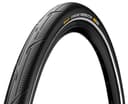
“It feels dead and it is heavy.”Buy the Continental Contact Urban. This is the central trade on the page: Continental’s SafetyPro breaker is a nylon textile layer rather than a rubber slab, and Continental’s own words for it are maximum puncture protection with minimal added weight. You give up some absolute protection and you get a tire that accelerates and rolls like a bike tire rather than a tractor part. For most urban commutes that is the right trade.
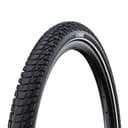
“It is terrifying on wet paint and cold tarmac.”Buy the Schwalbe Marathon 365. The Marathon Plus is built for mileage and protection, not for grip in the cold, and a hard-wearing compound at 4 degrees on a painted junction is a genuine weakness. The 365 uses a siped tread on the ADDIX 4Season compound, which is a compound designed for exactly those conditions, with GreenGuard protection underneath instead of SmartGuard - Schwalbe publishes that as a 3 mm insert. Less puncture protection, markedly more confidence in November.
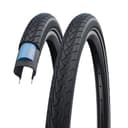
“It does not come in the size my bike takes.” Two answers. For a 700c bike that wants more air than the common 35 mm Marathon Plus, the Marathon Plus Tour E50 keeps SmartGuard in a 700x38 and adds the E-50 marking for fast e-bikes. For a folding bike or a small-wheel commuter, the Marathon 20 x 1.75 exists because almost nothing in 20 in is sold with a real protection belt - and small wheels pick up more punctures per mile, so protection pays off faster there.
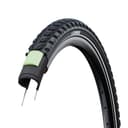
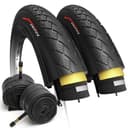
“It costs too much.”Buy the Fincci pair, with honesty about what it is: a published 1 mm anti-puncture layer is a fraction of SmartGuard’s 5 mm, and the tire is a fraction of the price. It ships two folding tires AND two Schrader tubes in one box, which is the whole replacement job rather than half of it. It is the right purchase if you are currently riding bald stock rubber, and the wrong one if you ride through glass every day.
“I cannot get it onto the rim.” This one does not have a product answer so much as a warning: a Marathon Plus is a stiff wire-bead tire and fitting it is a two-lever, strong-thumbs job. Every alternative here is easier, and the Fincci and the 365 are folding-bead, which means one can live in a pannier as a spare. Fit new tires at home, not at the roadside - and carry what you need for a tube swap: best bike multi-tool.
What the Marathon Plus is genuinely best at
Three things, and if any of them is your situation, the alternatives are the wrong move.
Glass-strewn city streets where a flat costs you the day. A 5 mm rubber barrier is simply more barrier than a nylon breaker. If your commute crosses broken glass, hedge trimmings or an industrial estate, the weight is the price of not standing on a verge at 8am.
Mileage. The Marathon Plus runs a wire bead and a 67 TPI Endurance casing - built to last rather than to feel quick - and riders routinely report several thousand miles on a rear. Cheap tires are cheap per tire, not always cheap per mile.
Side-on visibility, which is an underrated feature. The Marathon Plus has a Reflex sidewall: a reflective ring on the tire itself. A reflective circle on a turning wheel is the most legible signal a cyclist can give a driver from the side, which is where junction collisions happen - the Contact Urban also publishes a reflective sidewall, and it is a real reason to prefer those two. The argument in full is in reflectors vs lights and best reflective vests.
Before you change tires at all
Check your pressure first, because it is free and it fixes most flats. A large share of commuter punctures are pinch flats from an underinflated tire hitting a pothole edge, not thorns through the tread - and no amount of puncture belt fixes a tire run 20 psi low. Weekly checks with a gauge do more for your flat rate than a tire upgrade: best bike pump for commuting.
Then check your rim tape and your tube. A recurring flat in the same spot is usually a rim tape failure or a spoke end, and new tires will not touch it.
Then check fitment, before ordering. Read the number on your current sidewall - something like 700x35C or 47-406 - and check both that it fits the rim and that a wider tire will clear your frame and fenders. Going two sizes wider on an e-bike is usually a good idea because the motor pays for the width, but only if the clearance is there. Our e-bike-specific ranking is in best tires for e-bikes, and the full commuter field, including the studded winter option none of these replaces, is in best commuter bike tires. If your real problem is riding through a freeze rather than through glass, read bike commuting in winter first.