Chain & Charge

Best Tires for E-Bikes

There is one fact that sorts this entire category: some commuter tires carry a published E-rating certifying them for fast e-bikes, and most do not. Everything else - puncture belt, width, compound - comes after that.

By Stephen V.Last updated How we pick

An e-bike asks more of a tire than any other bicycle, and it asks for it every single day. The bike weighs 50 to 70 lb before you sit on it. It holds 20 mph on the flat where a pedal bike would be coasting at 12. The motor delivers torque through the rear contact patch from a standstill at every light. Together those three things wear the rear tire out faster, heat it harder, and make every piece of glass on the road a worse bet than it was before.

Which is why this page leads with a specification almost nobody checks. Two of the six tires below publish an E-rating: the Schwalbe Marathon Plus Tour E50 is E-50 marked, and the Continental Contact Urban is E50 rated and ECE-R75 marked. That is a certification for use on fast e-bikes, not a marketing phrase - and in Europe it is a legal requirement on speed pedelecs. The other four are good commuter tires that do not carry it, and we say which is which rather than blurring it.

Before anything else, go and read the number on your current tire’s sidewall. Fitment decides this purchase, not preference: a tire that does not fit your rim and clear your frame is not a slow tire, it is an unusable one. Most commuter e-bikes are 700c or 27.5 in; folding and small-wheel e-bikes are 20 in; fat-tire models take 4 in rubber that none of these replaces. Every spec below is read from the maker’s own listing or site - we own none of these tires and run no rolling-resistance tests. That is how we pick, in full.

How this is funded:we earn a commission if you buy through our links, at no extra cost to you. It never changes which product we recommend, and we’ll tell you when we’d skip one. Full disclosure.

Quick picks

Ranked on published specs, real security and safety standards, and buyer fit. Select a row to jump to the full write-up.We have not tested these products — here is exactly what we do instead.

#ProductBest forPrice
1
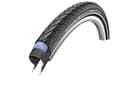
Schwalbe Marathon Plus Tour E50 700x38

Schwalbe Marathon Plus Tour E50 700x38

The same SmartGuard idea in the wider 700x38 size most commuter and e-bike wheels actually take, with the E-50 marking that means the tire was certified for fast e-bikes rather than merely sold near them. The pick if your bike has a motor and a curb weight to match.

Best overall for e-bikes
$59.84 · View on Amazon

$63.906% off

Price as of November 23, 2026. #ad How we’re funded

2
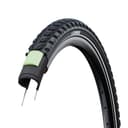
Continental Contact Urban 700x40

Continental Contact Urban 700x40

The compromise pick, and for most commutes the right one: a nylon SafetyPro breaker instead of a thick rubber slab, so you get real puncture protection without the dead, slow feel of a Marathon Plus. Continental's own words for it are maximum puncture protection with minimal added weight.

Best balance of grip and protection
$58.80 · View on Amazon

Price as of November 23, 2026. #ad How we’re funded

3
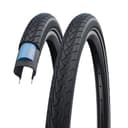
Schwalbe Marathon Plus 700x35C

Schwalbe Marathon Plus 700x35C

The tire you buy to stop thinking about flats. Schwalbe puts a 5 mm SmartGuard rubber insert under the tread and rates it protection level 7 of 7 — the only level the company lets its tires call unflattable. You pay for that in weight, in price, and in a tire that fights you on installation.

Most puncture protection
$63.59 · View on Amazon

$69.008% off

Price as of November 23, 2026. #ad How we’re funded

4
Schwalbe Marathon 365 All-Season Tire

Schwalbe Marathon 365 All-Season Tire

The one tire for a rider who refuses to own two sets. A siped all-weather tread on the ADDIX 4Season compound with GreenGuard underneath — less puncture protection than a Marathon Plus, markedly better grip on wet paint, cold tarmac and wet leaves.

Best all-season
$51.15 · View on Amazon

$54.276% off

Price as of November 23, 2026. #ad How we’re funded

5
Schwalbe Marathon 20 x 1.75 (47-406)

Schwalbe Marathon 20 x 1.75 (47-406)

The reason this pick exists is fitment, not performance: folding commuters and small-wheel e-bikes take 20 in tires, and almost no puncture-protected tire is sold in that size. This is the one that is, from the brand that owns the category.

Best for 20 in folding e-bikes
$45.15 · View on Amazon

$50.8411% off

Price as of November 23, 2026. #ad How we’re funded

6
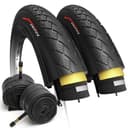
Fincci 700x38c Tire Pair with Tubes

Fincci 700x38c Tire Pair with Tubes

The honest budget route into puncture protection: two folding tires AND two Schrader inner tubes in one box, with a published 1 mm anti-puncture layer. It is a fraction of the protection a Marathon Plus gives you, for roughly a third of the money, and it ships the tubes you were going to have to buy anyway.

Best budget
$58.99 · View on Amazon

Price as of November 23, 2026. #ad How we’re funded

The picks in full

#1Best overall for e-bikes

Schwalbe Marathon Plus Tour E50 700x38

The same SmartGuard idea in the wider 700x38 size most commuter and e-bike wheels actually take, with the E-50 marking that means the tire was certified for fast e-bikes rather than merely sold near them. The pick if your bike has a motor and a curb weight to match.

Strengths

  • E-50 marked (listing) — certified for e-bikes to 50 km/h, not just e-bike friendly
  • SmartGuard protection in a 38 mm width, which rides far better than a 35 on bad pavement
  • Addix Green compound on the Performance line casing (listing)
  • HS619 tread — the touring pattern, not a knobby that buzzes on tarmac

Trade-offs

  • Heavy, like every Marathon Plus; on an e-bike you notice it less, which is the point
  • E-50 is a European moped-class certification — nothing in the US requires it
  • Priced at the top of the category, and you will want two
  • One size only on this listing: 700x38. A 27.5 or 20 in wheel needs a different tire
Size (this listing)700x38
E-bike ratingE-50 (listing) — certified to 50 km/h
ProtectionSmartGuard (Schwalbe level 7 of 7, 5 mm insert)
Tread / compoundHS619, Addix Green (listing)
LinePerformance (listing)

Specs read from the product listing, on October 31, 2026. We have not physically tested this product.

#2Best balance of grip and protection

Continental Contact Urban 700x40

The compromise pick, and for most commutes the right one: a nylon SafetyPro breaker instead of a thick rubber slab, so you get real puncture protection without the dead, slow feel of a Marathon Plus. Continental's own words for it are maximum puncture protection with minimal added weight.

Strengths

  • SafetyPro Breaker — Continental publishes it as nylon textile, chosen for low weight
  • E50 rated (listing) and ECE-R75 marked, so it is legal on fast e-bikes in Europe
  • Reflective sidewall (listing) for side-on visibility in traffic
  • 40 mm width is the sweet spot for potholes, tram lines and gravel shortcuts

Trade-offs

  • A woven breaker is a different kind of protection than a 5 mm rubber insert — good against glass and thorns, less of a fortress against a nail
  • Continental's Safety-Level 6 is its OWN in-house scale and is not comparable to Schwalbe's level 7
  • Wire bead, so it will not fold into a pannier as a spare
  • This listing is 700x40 only
Size (this listing)700x40
ProtectionSafetyPro Breaker, nylon textile (Continental)
Maker's levelSafety-Level 6 on Continental's own scale
E-bike ratingE50 / ECE-R75 (listing + Continental)
SidewallReflective (listing)

Specs read from the product listing, on October 31, 2026. We have not physically tested this product.

#3Most puncture protection

Schwalbe Marathon Plus 700x35C

The tire you buy to stop thinking about flats. Schwalbe puts a 5 mm SmartGuard rubber insert under the tread and rates it protection level 7 of 7 — the only level the company lets its tires call unflattable. You pay for that in weight, in price, and in a tire that fights you on installation.

Strengths

  • Schwalbe's top protection level (7 of 7) via a published 5 mm SmartGuard insert
  • Reflex sidewall — a reflective strip on the tire itself, visible side-on at night
  • Wire bead, 67 TPI Endurance casing (listing): built for mileage, not racing
  • The maker publishes the protection figure, so the central claim is checkable

Trade-offs

  • Heavy and stiff — a noticeably slower, more wooden ride than a lighter city tire
  • Famously hard to mount by hand; budget for strong thumbs or good levers
  • Schwalbe states plainly that you can never completely rule out a puncture
  • This listing is ONE size, 700x35C. Read your sidewall before you buy
Size (this listing)700x35C
ProtectionSmartGuard, 5 mm insert — level 7 of 7 (Schwalbe)
Casing67 TPI, wire bead, Endurance (listing)
SidewallReflex reflective strip (listing)
Pressure checkSchwalbe: thumb test not sufficient on Marathon Plus — use a gauge

Specs read from the product listing, on October 31, 2026. We have not physically tested this product.

#4Best all-season

Schwalbe Marathon 365 All-Season Tire

The one tire for a rider who refuses to own two sets. A siped all-weather tread on the ADDIX 4Season compound with GreenGuard underneath — less puncture protection than a Marathon Plus, markedly better grip on wet paint, cold tarmac and wet leaves.

Strengths

  • Siped tread plus ADDIX 4Season compound (listing) — built for cold, wet grip
  • GreenGuard protection: Schwalbe publishes a 3 mm insert made with recycled material
  • Listing states e-bike and city-bike suitability and a 20 to 28 inch size range
  • One tire covers autumn rain, winter damp and summer commuting

Trade-offs

  • GreenGuard is protection level 5 on Schwalbe's scale, not the Plus's level 7 — this is a grip tire first
  • Siped all-season rubber wears faster than a hard-compound touring tire
  • No substitute for studs on actual ice
  • The 20-28 inch range is the MODEL's range; this ASIN is one size inside it, so check the size shown at checkout
Model size range20 to 28 inch (listing) — this ASIN is one size within it
ProtectionGreenGuard, 3 mm recycled insert — level 5 (Schwalbe)
CompoundADDIX 4Season (listing)
TreadSiped, for all weather conditions (listing)
UseE-bikes and city bikes (listing)

Specs read from the product listing, on October 31, 2026. We have not physically tested this product.

#5Best for 20 in folding e-bikes

Schwalbe Marathon 20 x 1.75 (47-406)

The reason this pick exists is fitment, not performance: folding commuters and small-wheel e-bikes take 20 in tires, and almost no puncture-protected tire is sold in that size. This is the one that is, from the brand that owns the category.

Strengths

  • A 20 x 1.75 / 47-406 size, which is genuinely hard to find with real protection
  • Schwalbe Marathon casing — the touring tire that made the brand's name
  • Small wheels pick up more punctures per mile, so protection pays off faster here
  • Fits the fold-and-carry commuters this site covers

Trade-offs

  • LISTING AMBIGUITY, stated plainly: the title names the tire Marathon but advertises SmartGuard, which is the Marathon PLUS belt. We cannot resolve which belt ships, so treat the protection level as unconfirmed
  • Heavy for a 20 in tire, and small wheels feel added weight more
  • One size only — a 20 x 1.95 or a 406 fat tire needs something else
  • No reflective sidewall published on this listing
Size (this listing)20 x 1.75 / 47-406
ProtectionListing says SmartGuard on a tire named Marathon — unresolved, see cons
TypeClincher, flat-less touring tire (listing)
FitFolding and 20 in small-wheel bikes

Specs read from the product listing, on October 31, 2026. We have not physically tested this product.

#6Best budget

Fincci 700x38c Tire Pair with Tubes

The honest budget route into puncture protection: two folding tires AND two Schrader inner tubes in one box, with a published 1 mm anti-puncture layer. It is a fraction of the protection a Marathon Plus gives you, for roughly a third of the money, and it ships the tubes you were going to have to buy anyway.

Strengths

  • Two tires plus two 48 mm Schrader-valve tubes in one purchase (listing)
  • Publishes an actual protection figure — a 1 mm anti-puncture layer — not just the words
  • Folding bead, so one can live in a pannier as a spare
  • The cheapest way on this page to stop riding on bald stock rubber

Trade-offs

  • 1 mm of protection is not in the same class as a 3 mm or 5 mm insert, and we will not pretend otherwise
  • Schrader valves only — if your rims are drilled for Presta, these tubes will not fit
  • No brand record for casing longevity to lean on; expect to replace sooner
  • One size: 700x38c / 40-622
Size (this listing)700x38c / 40-622
In the box2 tires + 2 inner tubes (listing)
Protection1 mm anti-puncture layer (listing)
Valve (tubes)48 mm Schrader (listing)
BeadFoldable (listing)

Specs read from the product listing, on October 31, 2026. We have not physically tested this product.

What an E-rating actually means

ECE-R75 is the European regulation that certifies a bicycle tire for use at e-bike speeds, and the E-number is the speed it was certified to. An E-25 marking means up to 25 km/h, which covers most Class 1 and 2 e-bikes. An E-50 marking means up to 50 km/h, which covers speed pedelecs and anything you are likely to do on a Class 3 with a tailwind. The test is about the tire and rim staying together under sustained load and heat, which is exactly the thing a heavy bike at speed threatens.

In the US nothing requires an E-rating, and that is why so few listings mention it - which cuts both ways. It does not mean an unrated tire will fail on your Class 2 commuter; plenty of good commuter tires are perfectly happy under an e-bike at 20 mph. It does mean that the two rated tires here have passed a test the others have not, and if you ride a fast e-bike, loaded, in the heat, that is the cheapest insurance on this page.

A note on honesty: the Schwalbe Marathon 365 listing states e-bike and city-bike suitability across a 20 to 28 inch size range, which is a manufacturer suitability claim rather than an ECE-R75 marking. We are quoting it as the listing phrases it, and we are not upgrading it into a certification it does not claim.

How we picked

Four criteria, in the order they decide the purchase for a motor-assisted bike.

1. Does it fit, in the size your bike takes? First, because everything else is irrelevant otherwise. The Marathon 20 x 1.75 is on this page for exactly one reason: folding and small-wheel e-bikes take 20 in tires and almost nothing with a real puncture belt is sold in that size. If you ride a fold, that pick is the page.

2. The published protection figure, not the word.Schwalbe publishes a 5 mm SmartGuard insert on the Marathon Plus and calls it protection level 7 of 7 - the only level the company lets a tire call unflattable. Continental publishes a nylon SafetyPro breaker chosen for low weight. Fincci publishes a 1 mm anti-puncture layer. Numbers you can compare, from the makers themselves, rather than “puncture resistant” in a bullet. An e-bike earns that protection back faster than a pedal bike does, because a flat on a 65 lb bike is a much worse afternoon.

3. Width, because the motor pays for it. On a pedal bike a wider tire is a tax you pay in effort. On an e-bike the motor absorbs it, which makes 38 to 40 mm close to free - and that extra air is what takes the edge off potholes, tram lines and the broken edges of a bike lane. It also runs at lower pressure, which on a heavy bike is the single biggest ride-quality improvement available. If you are on 32s now and your frame has room, go wider.

4. Grip when it is cold and wet. A motor delivers torque from a standstill through the rear wheel, and the surfaces that catch a commuter - wet paint, steel plates, wet leaves - do not care how many watts you have. The Marathon 365 is the pick here on a siped tread and the ADDIX 4Season compound, and the Marathon Winter Plus in our wider tire ranking is the only answer to actual ice.

Rear tire first, and the other e-bike-specific habits

Replace the rear before the front, and expect to do it more often. On any bike the rear carries more weight; on an e-bike it also takes all the motor torque if the bike is a rear hub drive, which most budget commuters are. It is normal to wear two rear tires for every front. If you are buying one tire, buy it for the back.

Pressure matters more than it did. A heavier bike with a rider and a loaded pannier needs more pressure than the same tire on a road bike, and an underinflated tire on an e-bike is both slow and much more likely to pinch flat on a pothole. Check it weekly rather than monthly - a floor pump with a gauge is the tool for the job, and our ranking is in best bike pump for commuting.

Reflective sidewalls are quietly one of the best visibility buys. The Marathon Plus has a Reflex sidewall and the Contact Urban publishes a reflective sidewall too. A reflective ring on a moving wheel is the most legible thing you can show a driver from the side, which is where junction collisions happen - the same argument we make in best reflective vests and reflectors vs lights.

Budget for the fitting, honestly. A Marathon Plus is a famously hard tire to get onto a rim, and doing it at the roadside on a heavy e-bike with a motor in the hub is genuinely unpleasant. Fit new tires at home, with levers and time, and carry what you need for a tube swap - best bike multi-tool and e-bike maintenance cover the rest of it. The full commuter tire ranking, including the studded winter option, is in best commuter bike tires.
Frequently asked questions

What are the best tires for an e-bike?

For a 700c commuter e-bike, the Schwalbe Marathon Plus Tour E50. It is E-50 marked, meaning certified for e-bikes up to 50 km/h rather than simply sold as e-bike friendly, and it carries the same SmartGuard puncture belt as the standard Marathon Plus in the wider 700x38 size that most e-bike wheels take. The Continental Contact Urban 700x40 is the other rated option and rides livelier, because its SafetyPro breaker is a light nylon textile rather than a thick rubber slab. If your e-bike is a 20 in folder, the Schwalbe Marathon 20 x 1.75 is the pick by fitment.

Do e-bikes need special tires?

They need tires that can take the weight, the torque and the sustained speed, which is not the same as needing a tire sold under an e-bike label. The specification that means something is ECE-R75 certification, shown as an E-number on the sidewall: E-25 for up to 25 km/h, E-50 for up to 50 km/h. Nothing in the US requires it, and plenty of good commuter tires without it are fine under a Class 1 or 2 bike at 20 mph. If you ride a Class 3, carry loads, or ride in heat, a rated tire is cheap insurance for exactly the failure mode the test covers.

Why do e-bike tires wear out so fast?

Three reasons stacked on top of each other. The bike is heavy - often 50 to 70 lb before you sit on it - so there is more load on the contact patch than a pedal bike ever puts there. It travels faster for longer, and wear rises steeply with speed. And if it is a rear hub drive, which most budget commuters are, every watt of motor torque is delivered through the rear tire from a standstill at every traffic light. Expect to replace roughly two rear tires for every front one, and buy for the back first.

What tire width is best for an e-bike?

Wider than you would pick on a pedal bike - 38 to 40 mm is the sweet spot for a 700c commuter e-bike, if the frame and fenders have the clearance. The reason is that the usual penalty for width, extra effort, is paid by the motor rather than by you, while the benefits are all yours: more air volume to absorb potholes and tram lines, lower pressure for a calmer ride under a heavy bike, and a bigger contact patch for wet grip. Check your frame clearance and any fender bridge before you jump two sizes.

Can you put puncture-proof tires on an e-bike?

Yes, and an e-bike is the best possible home for them. Puncture belts like Schwalbe's 5 mm SmartGuard insert cost you weight and rolling resistance, which is the usual argument against them - and on a motor-assisted bike you barely notice either, while the benefit is unchanged. A flat on a 65 lb e-bike with a hub motor is a much harder roadside job than a flat on a road bike, so the protection pays off twice. The one real warning is installation: a Marathon Plus is a famously stiff fit, so do it at home with levers rather than on a kerb.

What pressure should e-bike tires run?

Toward the upper half of the range printed on the sidewall, because the bike plus rider plus cargo is heavier than the same tire would see on a pedal bike, and an underinflated tire on an e-bike is both slow and much more likely to pinch flat over a pothole. Start in the middle of the stated range, then add pressure if the tire feels squirmy in corners or if you are carrying panniers. Check weekly rather than monthly - a tire loses pressure on its own, and the heavier the bike, the sooner you feel it.

Sources

  • Schwalbe — Technology FAQ: puncture protection — Schwalbe's own protection-level table, 7 (highest) down to 1: level 7 is "SmartGuard / smartdualguard", level 6+ "Super Defense", level 6 "Double Defense", level 5 "V-Guard / GreenGuard / RaceGuard", level 4 "RaceGuard", level 3 "K-Guard", level 2 "67 EPI Carcass", level 1 "50 EPI Carcass". The published insert thicknesses: SmartGuard "5 mm puncture protection insert" of "highly elastic special rubber", described as "The safest puncture protection available for bicycle tires"; smartdualguard "4 mm puncture protection insert plus two layers of nylon fabric (RaceGuard)", "The safest puncture protection, especially for e-bike tires"; GreenGuard "3 mm puncture protection insert with recycled material", a "Recycled puncture protection insert made from natural rubber". Level 7 is introduced with: "Only Schwalbe has the touring and city tires that can call themselves 'unflattable' (Flat-less) (Protection Level 7)." On the Marathon Plus specifically, Schwalbe publishes that it "offers the best possible protection against typical punctures" AND, in the same place, "You can never completely rule out a puncture." It also instructs: "Always use a pressure gauge to set the air pressure on all Marathon Plus tires" because "Due to the special construction, checking the pressure with your thumb is not sufficient." No thickness or protection level is published for V-Guard, RaceGuard, K-Guard or the bare carcass options (accessed October 31, 2026)
  • Continental — Contact Urban bicycle tire (product page) — Continental's own published description of the tire's protection and e-bike rating. On the breaker: "The SafetyPro Breaker is designed from nylon textile" and "Maximum puncture protection with minimal added weight" — a woven textile belt rather than a thick rubber insert, chosen explicitly for low weight. On e-bike use the page carries an "E-Bike Ready | ECE-R75" label and a "Safety-Level" badge showing level 6 on Continental's OWN in-house scale (not Schwalbe's, and not an independent rating). It states "All of our city/trekking tires are rated to a standard speed of at least 25 km/h" and "Those tires marked e50 are also certified for S-Pedelecs". The page does NOT publish sizes, widths, weights, a reflective-sidewall claim or the PureGrip compound, so none of those is cited to it; several images on the page are labeled PremiumContact 6 rather than Contact Urban, which is why only the text above is used (accessed October 31, 2026)
  • Schwalbe — Technology FAQ: tire pressure — The tire maker's own published guidance: "You should check and correct the air pressure at least once a month"; a loss of about 1 bar per month is considered normal even for airtight tubes; "The pressure loss is significantly faster at high pressures and significantly slower at low pressures"; latex tubes should be checked and adjusted before every ride; and the thumb test is "not very reliable" because tires feel firm from roughly 2 bar regardless of actual pressure, so Schwalbe recommends a pressure gauge instead (and calls the thumb test "completely inadequate" on Marathon Plus tires). On permanently low pressure: premature wear, with sidewall cracking the typical result, and unnecessarily increased abrasion (accessed October 24, 2026)
  • PeopleForBikes — Electric bike policies and laws — The 3-class e-bike system (Class 1 pedal-assist to 20 mph, Class 2 throttle to 20 mph, Class 3 pedal-assist to 28 mph) and the 750W federal power limit (accessed July 23, 2026)

Keep reading