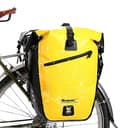
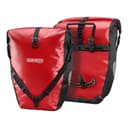
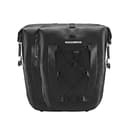
Side by side, on the specs each maker publishes
| Bag | Capacity | In the box | Waterproofing (published) | Mount |
|---|
| Rhinowalk 27L | 27 L | One bag | Waterproof body | Hooks; converts to shoulder bag |
| Ortlieb Back-Roller Classic | 40 L (pair) | Two bags | Fully waterproof, welded, roll-top | QL2.1 quick-release |
| RockBros 30L pair | Up to 30 L (pair) | Two bags | Roll-top waterproof | Hooks; converts to shoulder bag |
Two cells deserve a second look. Neither Rhinowalk nor RockBros publishes an IP rating or a hydrostatic-head figure, so “waterproof” on those listings is the maker’s own word rather than a tested number. Ortlieb publishes the construction instead — welded, roll-top — which is the more useful claim, because welded seams are a fact about the bag rather than a rating. That is the difference you are actually buying, and we would not pretend it is marketing.
The second is the laptop sleeve. The Rhinowalk publishes a padded one; the Ortlieb is deliberately one big undivided compartment and expects you to add pouches. For a commuter whose bag exists mainly to carry a computer, that is not a small detail — it is the feature.
One bag or a pair: the decision underneath this comparison
Almost everyone choosing between these two is really choosing between one bag and two, and the honest answer for office commuting is one. A single loaded pannier does create a small handling asymmetry, and it is far less noticeable than people expect — invisible after a week. A second bag is extra weight, extra width at your heels, and a second thing to unclip every time you park. We work the handling question through properly on one pannier or two.
A pair earns its place in three situations: a load genuinely over about 25 liters, a grocery shop you want split evenly low on both sides, or wet and dirty kit you want kept away from clean clothes. If you are in one of those, buy the pair and stop reading the one-bag argument. If you are not, the pair is a purchase you will spend years half-using. Our pannier sizing guide has the liter-by-liter breakdown.
What the money buys you at Ortlieb prices
Welded construction. Stitched seams are holes in fabric with thread through them, sealed with tape; welded seams are the fabric fused to itself. Tape eventually lifts. Welds do not. On a bag that spends ten winters on a rack, that is the whole ballgame.
The QL2.1 mount. The hooks lift and release with the handle, so the bag comes off in one motion with one hand, and the lower hook clamps rather than just resting. Cheaper hooks rest on the rail and rattle. If you take a bag off twice a day, every day, this is the feature you will notice most.
Resale and parts. Ortlieb sells replacement hooks, inserts and lids. A ten-year-old Back-Roller with new hooks is a working pannier; a ten-year-old budget bag with a broken hook is trash.
What the money does not buy you: organization, a laptop sleeve, a shoulder strap that makes sense for walking into a meeting, or a bag that looks like a bag rather than a dry sack. Those are exactly the things an office commuter notices, and exactly where the Rhinowalk wins.
And if you want the middle
The RockBros 30L pair is the honest compromise: a roll-top waterproof pair that converts to shoulder bags, at a price much closer to the single Rhinowalk than to the Ortlieb. Its listing concedes the trade in the right place — the hook hardware is not as refined as QL2.1, and seams are the weak point in a sustained downpour. For a commuter who wants two bags for occasional shopping and is not riding through a monsoon, that is a sensible place to land. We put it head to head with the Ortlieb on Ortlieb vs RockBros.
Whichever you choose, check the rack before you order: hook spacing, rail diameter and heel clearance decide whether a pannier fits at all, and they are the most-skipped step in this category. Start with rack and pannier compatibility, and if the rack itself is still a question, best rear racks is the place to begin.