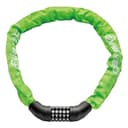
How we matched these
Four tests. A lock had to pass at least one clearly to be on this page, and we have not scored any of them against Kryptonite overall — an overall score would be us pretending to have attacked six locks with a tool set.
1. Does it hold an independent grade?The strongest match, because a Sold Secure grade means the same thing on any brand: an organisation with nothing to sell attacked that lock with a defined tool set for a defined time. The wearable chain here publishes a Sold Secure Gold, which is a like-for-like answer to the graded locks in the Kryptonite range. The folding ABUS is listed by Sold Secure in its successor form at Pedal Cycle Bronze. Everything else on this page we describe with the maker’s own figure and say so.
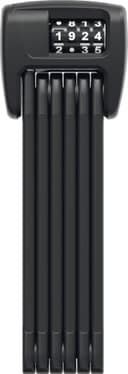
2. Does it match on published metal?Shackle diameter is the figure that correlates most directly with how long a bolt cutter or pry bar takes. The premium ABUS publishes 13 mm of parabolic hardened steel, the same order as Kryptonite’s own Evolution line, and its table states the shackle, case and locking elements are all special hardened steel. The folding locks publish thinner plates — the Bordo gives 5 mm — defended by hardening and rivets rather than by bulk, which is a different failure mode and not a worse one in every situation.
3. Does it offer a shape Kryptonite does not lead with?This is where the alternatives genuinely win rather than merely differ. A folding lock that collapses into a block and unfolds to nearly a meter reaches around a fat sign post, a square railing or two bikes at once, and mounts on frames where a U-lock bracket has nowhere to go. A chain worn at the waist puts the weight on your hips and needs no bag at all. Neither is a thing Kryptonite’s best-known locks do.
4. Is the carrying problem solved?Kryptonite’s brackets are part of why the brand is the default, and this is the one test the top pick here fails: its retailer spec table states explicitly that the mount is notincluded, alongside one key, one LED key and a code card. If you buy it, you are solving the carry yourself — a pannier, a rack strap or an aftermarket bracket. Both folding locks ship with a frame case, which is the opposite end of the same question. Options are in how to carry a bike lock.
Which alternative fits which reason
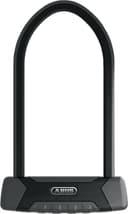
You want a premium cylinder and a different brand’s engineering.Buy the ABUS Granit XPlus 540. The XPlus cylinder is the feature ABUS markets hardest and describes in terms of resistance to manipulation such as picking, and the lock carries ABUS’s own top level of 15 of 15 with the maker’s guidance that levels 10 to 15 suit high-quality bikes in large cities. Published weights are 1450 g at the 230 mm size and 1656 g at 300 mm. Budget for how you will carry it. Our full review and Kryptonite vs ABUS go deeper.
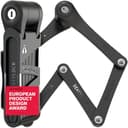
You park at whatever is there, not at bike racks.Buy a folding lock. 85–90 cm of reach that packs into a block is a capability no U-lock has, and it is the right answer for railings, posts, fences and locking two bikes together. The premium one publishes hardened 5 mm bars and includes a frame holster; the value one is lighter on hardware and lighter on price. The trade is argued in folding lock vs U-lock and the shape has its own roundup at best folding bike locks.
The problem is where the lock goes, not what it weighs. Buy the wearable Sold Secure Gold chain. It is the only option here that gives you a graded chain with no pannier, no bracket and no bag, because it rides on your waist. It is also the option riders either adopt permanently or give up on within a fortnight, so be honest with yourself about whether you will wear a chain.
You want a keyless lock for coffee stops. The budget pick here is a combination chain, and we are naming its limits in the same sentence as its price: it is a 90 cm keyless deterrent for a quick errand or a bike shed, it is cuttable with hand tools, and it should never be the only lock on an expensive bike or an e-bike. It earns a place on this page as the cheapest thing here that is useful, not as a security lock. If that is what you need, it is a good buy; if you are protecting real value, it is not the lock.
The limit that applies to every lock on this page
None of these stops an angle grinder, Kryptonite included at these price points. A cordless grinder goes through 13 mm of hardened steel in well under a minute and through a folding lock’s plates faster. The only independent grade whose test involves a grinder is Sold Secure Diamond, and nothing here holds one. What a graded lock buys is time against the tools thieves carry most of the time — bolt cutters, a short pry bar, a hammer, a bottle jack — plus the deterrent of being visibly harder work than the bike beside yours. We set out what “grinder-proof” actually means in are angle-grinder-proof locks worth it and what the grades include in bike lock security ratings explained.
Which leads to the most useful thing on this page, and it is not a product. Two different locks beat one better lock for the same money, because a thief then needs two kinds of tool and twice the time standing at the rack — and mixing brands is a legitimate reason to buy an alternative even if you like Kryptonite. A U-lock from one maker and a folding lock from another is a stronger setup than two of anything. The reasoning is in do you need two bike locks, and where to put them is in how to lock your bike properly.
If the bike is an e-bike, treat everything above as a starting point rather than an answer: it is heavier, more valuable and a more attractive target, and the battery is a separate theft problem. See best bike locks for e-bikes and how to secure an e-bike battery.