What ABUS actually publishes
The specification, from ABUS’s figures as reproduced in a retailer spec table and confirmed against the Amazon listing:
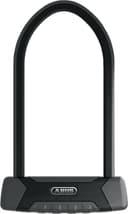
Shackle: 1.3 cm thick, hardened steel.13 mm, and the retailer table lists the shackle material as steel while ABUS’s feature text is more specific — “the shackle, the case and the supporting elements of the locking mechanism are made of special hardened steel”. Note the second half of that sentence. It is the case and the locking mechanism supports that are the usual soft target on a cheap U-lock, and ABUS is claiming hardened steel for all three.
Security rating: 15 of 15, “maximum”.This is ABUS’s own in-house scale, and the honest reading of it is comparative within ABUS’s catalog, not against anybody else’s. ABUS’s own guidance, reproduced on the same page, is the useful part: “Locks with maximum protection (levels 10-15), are the right choice for high quality bicycles and use in large cities or regions with a high risk of theft.” That is the maker telling you who the lock is for, in its own words.
Two sizes, with published weights. The arm length comes in 23 cm or 30 cm— full published dimensions “23 x 10.8 x 1.3 cm / 30 x 10.8 x 1.3 cm” — and the weights are 1450 g for the 230 mm and 1656 g for the 300 mm. The listing we price and link is the 230 mm. That 206 g difference sounds trivial and is not: it is the difference between a lock you keep carrying in April and a lock that has migrated to a drawer.
Cylinder: ABUS XPlus.Described as “ABUS X Plus cylinder for strong protection against manipulation, e.g. picking”. This is the component the 540’s reputation largely rests on, and it is worth understanding why picking resistance matters less than people think and more than it looks — more on that below.
In the box: no mount.The retailer’s contents list is the lock, one key, one LED key, and an ABUS code card — and then, explicitly, “not incl. mount”. The Amazon listing title advertises “incl. 2 keys”, consistent with the key count, and likewise says nothing about a bracket. Keep reading; this is the most practical finding in the review.
The spec row nobody fills in
Now the blank, and it is a real one. The retailer’s test-certification row reads “Ice Spray Tested, Vds, Sold Secure, OSIMZ”— four certifications named, and no Sold Secure grade given. Sold Secure grades are the whole point of Sold Secure: Bronze, Silver, Gold and Diamond are genuinely different tests with different tool sets and time limits behind them, and “Sold Secure” on its own tells you a record exists, not what it says.
We could not retrieve a grade for this lock from a primary source on the day, so this review does not state one. That is a deliberate blank, and it is the kind of row a less careful review fills in from memory or from another review that filled it in from memory. If the Sold Secure grade is the figure your decision turns on, look the model up in Sold Secure’s own approved-product search before you buy, and be aware that the grade can differ between a UK and a US listing of the same model name — we have already run into exactly that conflict on the Kryptonite KryptoLok, where the US listing says Silver and UK retailers say Gold. We explain what the grades actually test in bike lock security ratings explained.
The two certifications most people skip over are more interesting than they look. VdS is a German insurance-industry approval, which in some markets is the thing that actually determines whether a theft claim pays out. And “Ice Spray Tested” addresses a specific attack: freeze a hardened steel shackle with a compressed-gas can and it becomes brittle enough to shatter with a hammer. It is not a theoretical attack and it is not one most lock listings mention at all.
What 13 mm buys you, and what it does not
Let us be blunt about where this lock sits, because the number is smaller than the number on the heaviest U-lock on the market. 13 mm is the serious-commuter tier, not the absolute maximum, and the shackle diameter is not the whole story.
Against bolt cutters and leverage, 13 mm of hardened steel in a parabolic shackle shape is a genuinely difficult target. The parabolic profile matters: a thief’s most efficient tool is usually a length of scaffold pipe through the shackle, twisted, and a curved cross-section resists that better than a plain round bar of the same thickness. A small shackle opening helps for the same reason — there is less room to insert anything.
Against a cordless angle grinder, 13 mm is cut. So is 16 mm, and so is 18 mm. That is the honest position and the entire reason we have a separate page on what “grinder-proof” actually means. A grinder turns the question from “can this be cut” to “how long does it take, how loud is it, and how willing is the thief to stand there doing it” — which is a question about where you park more than about which lock you bought. Nothing in this review should leave you thinking the 540 is immune to a grinder.
Against picking, the XPlus cylinder is the 540’s standout claim, and here is why it is worth more than it appears. Picking is a rare attack on a parked bike precisely becausegood cylinders exist — it is slow and skilled, and brute force is neither. But a weak cylinder is not just pickable; it is drillable and it is snappable, and the cheap end of the U-lock market has lost whole model lines to a cylinder vulnerability that had nothing to do with the shackle. A strong cylinder is insurance against the lock being bypassed rather than broken, and it is the reason a 13 mm ABUS can reasonably be argued against a 16 mm budget lock.
For the full picture of which attacks actually happen and in what proportion, the page to read next is how thieves break bike locks.
The bracket problem, which is the real buying decision
This is the finding we would want a friend to know, and it is not on any spec sheet as a problem. The retailer contents list says “not incl. mount”, and the Amazon listing we link does not publish a bracket either. ABUS sells frame brackets separately — the SH B and the KLICKfix-compatible EaZy KF are the common ones, and some retail bundles include one, which is exactly why the listings disagree and why our registry entry already says “bracket sold or bundled separately depending on listing”.
Why it matters more than it sounds: a 1450 g U-lock with nowhere to live is the single most common reason an expensive lock stops being used. It is too heavy for a jacket pocket, it is a bad passenger loose in a pannier where it bangs around and wears through the fabric, and the back-pocket carry that works for a mini lock does not work at this weight. If the lock has no home on the frame, the number of days you leave it behind goes up, and a level-15 lock at home protects nothing.
So: check the specific listing for a bracket before you order, and if it has none, order one in the same basket. Our full treatment of the carrying problem — frame mounts, holster bags, the pannier-pocket approach, and why the jacket-pocket method is a bad idea at this weight — is in how to carry a bike lock.
Which size, and how much the 540 covers
A 23 cm arm length sounds generous and is the smaller of the two options, so think about geometry before you choose. A U-lock only secures what fits inside it: the standard technique is rear wheel plus seat tube plus rack, and whether that works depends on your frame, your tire width and what you are locking to. A fat-tire e-bike with a thick rack upright is exactly where 23 cm starts to feel tight, and the 30 cm is the answer at a 206 g penalty.
The flip side is the leverage logic above: a longer shackle leaves more room for a pipe, so bigger is not automatically safer. The 23 cm is the right default unless you have a specific reason — a wide tire, a thick-post bike rack, two bikes at once — to need the reach. On the two-bikes question, read how to lock two bikes together before you buy the long one for that purpose, because the answer is usually not a longer U-lock.
Whatever size you choose, the 540 secures one wheel and the frame. Your front wheel and your saddle are still attached with quick-releases, and on an e-bike your battery may be too. Those are separate problems with separate solutions, covered in locking your wheels and saddle and securing an e-bike battery.
Who should buy something else
Three honest redirects, because this lock is wrong for a lot of people who land on this page.
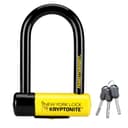
If you want the thickest shackle available and will accept the weight, the Kryptonite New York Fahgettaboudit Mini runs an 18 mm shackle that Kryptonite rates 10 out of 10 on its own scale, in a deliberately tiny body that leaves almost no room for a tool. It is heavier and the small opening restricts what you can lock to, which is the trade. We reviewed it in full.
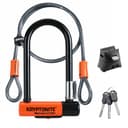
If the 540’s price is the problem, the Kryptonite Evolution Mini-7 is the sensible step down: a 13 mm Sold Secure Gold-certified shackle with a published grade, a cable included for the front wheel, and a FlexFrame-U bracket in the box — which, given everything above, is not a small detail. The tier-by-tier version of this argument is in how much to spend on a bike lock.
If a U-lock is simply awkward on your bike, the folding-lock category exists for exactly that reason and ABUS owns it — the Bordo 6000 folds flat into a frame-mounted case and reaches around things a U-lock cannot. It is a different security level and we are not going to pretend otherwise; folding lock vs U-lock is the comparison, and the Bordo 6000 review is the deep dive.
And if you are weighing the whole ABUS-versus-Kryptonite question rather than this one model, that is its own page: Kryptonite vs ABUS.