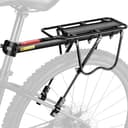
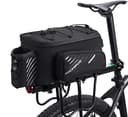
The three combos, and who each is for
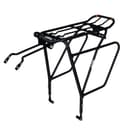
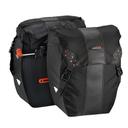
Combo 1 — the matched system.The Ibera PakRak Touring Carrier Plus+ with the Ibera PakRak clip-on panniers. This is the build to choose if you are buying both halves at once and you want the fit question to disappear: the bags clip positively onto the rack’s own rail rather than hooking over a tube, which is both faster to use and firmer under load than hooks. The rack publishes frame mounting, disc-brake compatibility and adjustability across 26-to-29-inch frames; the panniers ship as a pair with a rain cover. The honest cost of a matched system is that you are tied to that brand’s rail if you later want different bags.
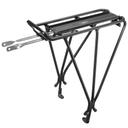
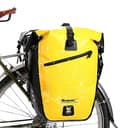
Combo 2 — the open platform.The Topeak Explorer with any hook-mounted pannier — our pick for that role is the Rhinowalk 27 L, a waterproof single bag that converts to a shoulder bag. The Explorer publishes standard pannier rails on the sides and a Topeak MTX QuickTrack rail on top, which means it takes conventional panniers from any maker and also snaps on a Topeak MTX trunk bag. Choose this build if you want to keep your options open, or if you already own bags. It is the most flexible rack here and that flexibility is the entire reason to pay a little more for it.
Combo 3 — the budget build. The West Biking universal adjustable rack with the RockBros 15 L rack-top bag and its rain cover. This is the setup for someone who needs to carry a laptop and a lunch tomorrow and does not want to spend much: the rack publishes a 110 lb stated capacity, universal adjustable fit and reflective accents, and a trunk bag sitting on top of the platform avoids the heel-clearance question entirely. It is also the right starting point if you are not yet sure panniers are the format you want, because the rack will take proper panniers later.
How we paired them
Four criteria, in the order they decide whether a combination works.
1. Does the bag’s mount match the rack’s rail? The whole point. A proprietary clip system is unambiguous: the bag fits that rack and is a guess on anything else. A hook-and-tube system is universal in principle and specific in practice, because the hooks have a diameter range. We have only paired bags and racks where the listings make the match explicit or where the bag is a conventional hook design on a rack that publishes standard pannier rails.
2. Will the rack fit the bike you own? Two common blockers, both worth checking before you order. Disc brakesput a caliper exactly where many rack stays want to go, which is why our top rack publishes disc compatibility and why we would not recommend a rack that does not mention it — the full detail is in will a rear rack fit a disc-brake bike. And eyelets: a frame-mounted rack wants threaded bosses on the seat stays and near the dropouts, and plenty of modern bikes have fewer than you expect. A universal adjustable rack with seat-post or clamp mounting is the fallback, and it carries less.
3. What is the load rating, and which part is the limit?A stated rack capacity is the number to respect, because it is almost always lower than what the bags can hold — and on a rack the rating assumes the load is spread rather than hanging off one corner. Where a bag also publishes a per-bag limit, the lower of the two numbers is your real ceiling. The arithmetic, including the bit about an e-bike’s extra forces, is in how much weight a bike rack can hold.
4. Does it suit how you load the bike? Panniers hang low and beside the wheel, which is the best place for weight and the worst place for your heels. A rack-top bag sits above the wheel, which is a slightly worse place for weight and no place at all for your heels. If you carry a small daily load, the trunk bag is genuinely the easier life; if you carry groceries or gear, the panniers win on volume and handling. We argue it out in panniers vs trunk bag.
If you are on an e-bike, change the order
An e-bike changes two things about this decision and it is worth saying before you buy a rack for one. The forces are higher— more weight at more speed over the same curb — so the rack’s rating and the quality of its mounting matter more than they do on a 25 lb hybrid. And the space is contested: a hub motor, a rear-mounted battery and a wide tire can all sit exactly where a rack wants to bolt on, and many e-bikes ship with a proprietary rack as the only thing that fits. Start at rear racks for e-bikes rather than here, then come back for the bag — and look at panniers for e-bikes, where lock-down mounts exist for exactly this reason.
What to buy alongside the combo
Three things that stop a new setup annoying you in week one. A rain coverif your bag is not sealed, because the bag is what is protecting your laptop — some of these include one. A plan for locking the bags, because a quick-release pannier is quick-release for everyone; the realistic answer is that you take them with you, and the alternatives are in how to lock panniers to a bike. And mudguards, because the moment you start using a rack year-round you discover how much water a rear wheel throws at a bag — see best bike fenders for commuting.
Fitting it is a twenty-minute job with an Allen key set, and it is worth doing carefully because a rack bolt that works loose takes the wheel with it. The step-by-step is in how to mount a rear bike rack, and once the bags are on, how to pack panniers is the five minutes that makes the bike feel normal again.