How we picked
Five criteria, in the order that decides the purchase. What is not here: a durability score and an abrasion ranking. Nobody in this category publishes a usable fabric-life figure, we have not ridden any of these bags for a year, and a number we did not measure is a number we would be inventing.
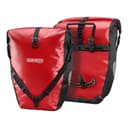
1. Is the waterproofing a rating or an adjective?This did most of the sorting. “Water resistant” on a listing means nothing in particular. A published protection class means something specific — the Back-Roller Classic’s IP64 is dust-tight and protected against splashing water from all directions, and its maker attaches a condition to it: the closure must be rolled three or four times and secured downwards. That is a checkable claim with a stated limit, which is exactly what we want to see. A roll-top with no published class still keeps rain out far better than a zip, and a rain cover is a real solution as long as you know it is a cover.
2. Does the mount publish a tube size?The hardware question. Hooks with included reducers fit the widest range of racks. A brand-specific clip-on system is faster to use and holds more firmly, and ties you to that brand’s rack. A simple hook-and-bungee is the cheapest and the one most likely to rattle loose over a curb — fine on a short errand, annoying on a long commute.
3. Is there a published load limit?Rare, and valuable where it exists. The 9 kg per bag figure for the Ortlieb is the number that tells you whether the bag or your rack is the binding constraint, because most racks are rated well above that. If the bag publishes nothing, your rack’s own rating is the number to respect — see how much weight a bike rack can hold.
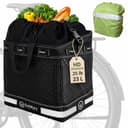
4. Does it carry the thing you are actually carrying? A 20 L roll-top is a superb laptop-and-clothes bag and a poor grocery bag, because a bag that tapers at the bottom crushes a loaf and tips a carton. A shaped grocery pannier that stands up on its own is the opposite. Two picks here are on this page purely because they hold a shopping bag upright, and we would not have included either on weatherproofing.
5. Does it come off and carry? A commuting pannier gets carried into a building twice a day. A shoulder strap, a comfortable handle or a conversion into a bag you can walk with is a genuine daily-use feature and the thing that decides whether you keep using the bag.
One pannier or two?
Start with one.For the overwhelming majority of commutes, a single 20–27 L bag on the drive side carries a laptop, a lunch, a change of clothes and a lock with room left over, and it costs half as much. The bike is noticeably lopsided only when you load it heavily, and at commuting weights the asymmetry is something you stop noticing in a week. We have made the full case in one pannier or two.
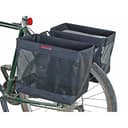
Buy the pairif you do grocery runs, carry tools or gear, or the weight you put on the bike is more than about 8 kg. Past that point the handling penalty of a single loaded bag is real — the bike wants to lean and the steering feels lazy — and splitting the load across both sides fixes it. Pairs are also better value per litre: three of the picks here ship as two bags. Loading them properly is a skill worth five minutes: how to pack panniers for a balanced ride.
Panniers vs the alternatives
The honest comparison, because panniers are not automatically right. Against a backpack, panniers win on everything except convenience: your back stays dry, your shoulders carry nothing and the weight sits low where it helps the bike, but you need a rack and you have to detach the bag at both ends. That trade is argued out in panniers vs backpack.
Against a trunk bag, which sits on top of the rack rather than beside it, panniers carry much more and keep your heels clear, while a trunk bag is easier to live with for a small daily load and never clips your foot. If you carry a laptop and nothing else, the trunk bag may genuinely be the better buy — see panniers vs trunk bag and the trunk bag roundup.
And against a front basket: a basket is unbeatable for throwing things in without thinking and useless in rain or at speed, because weight high and forward spoils the steering. Baskets and panniers are not competitors so much as different habits, which we split out in basket vs pannier.
What to buy alongside them
You need a rear rackrated for the load and compatible with your brakes — the roundup is at best rear bike racks, and e-bike owners should start at rear racks for e-bikes because the heavier bike and the hub motor change the answer. If you have disc brakes, check clearance first in will a rear rack fit a disc-brake bike.
Two smaller things that matter more than they sound. A rain cover if your bag is not sealed, because the bag is the thing protecting your laptop. And a plan for locking the bags, since a quick-release pannier is quick-release for everybody — how to lock panniers to a bike covers the options, and the short answer is that you take them with you.