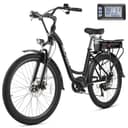
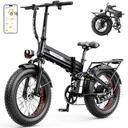
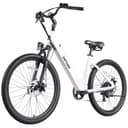
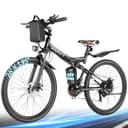
How we picked
Five criteria, in the order they decide whether a bike is good value rather than merely cheap. Notice what is absent: a range figure we endorse, a top-speed test and a reliability score. Manufacturer range claims are produced in ideal conditions by the people selling the bike, we have ridden none of these, and a durability rating we did not measure is a number we would be inventing.
1. Does the listing publish watt-hours or a voltage and amp-hour figure?The first filter, because without it you cannot compare fuel tanks. A bike that publishes “48 V, 499 Wh” is telling you something checkable. A bike that publishes only a mileage claim is telling you what it hopes. Where only a range claim exists we attribute it to the manufacturer in the card itself and treat it as a ceiling in flat, warm, pedal-assisted conditions — which is exactly what it is.
2. Does the battery come off the frame?This is the most underrated value feature in the category and it is binary. A removable battery means you charge indoors at a normal outlet, which matters for apartment dwellers, for charging safety, and for battery life — lithium cells genuinely dislike being charged below freezing, and a bike that lives on a balcony all winter with a fixed battery is a bike with a shorter life. Four of the five picks here publish a removable battery. Our charging safety guide covers the rest of the handling rules.
3. Can you store it where you live?A storage problem is the most common reason an e-bike stops being ridden, and it is worth more in the value calculation than a hundred watts. A folding bike buys you a hallway closet or a car boot and costs you ride quality through smaller wheels and a hinge. A step-through frame buys you easy mounting in work clothes. A conventional 26-inch frame rides best and needs a bike-sized space. Be honest about where the bike will actually live before you compare specs — see how to store an e-bike.
4. What will the first year cost on top? Assembly check, a serious lock, a helmet, lights, and consumables that wear faster on a 60 lb bike than on a 25 lb one. We have weighted bikes down where the sticker looks like a bargain but the spec implies early maintenance, and up where the listing publishes a conventional, serviceable setup.
5. Does it make you faster than your actual alternative? The only test of value that matters. If the bike does not beat your current commute on door-to-door time or cost, nothing else about it counts. The arithmetic is worked through properly in e-bike vs car: the real cost breakdown, and the short version is that the per-mile running cost of an e-bike is pennies of electricity against federal figures for driving that are measured in dollars per mile.
Where the value curve bends
Here is the shape of this market, stated plainly, because it explains the ranking above.
Below about $350 you are buying the fact of an e-bike rather than a good one. The motor works, the battery is small, the components are the cheapest available and the assembly quality is a lottery. This is a legitimate purchase for one specific person: someone who wants to find out whether an e-bike changes their commute before committing real money, on a short, flat route. It is a poor purchase for anyone whose commute the bike has to be reliable for.
Between roughly $400 and $600 is where the curve bends, and it is where our top pick and two others sit. This is the band where you start getting a 48 V system, a battery large enough to be measured in hundreds of watt-hours, a removable pack, and a frame built around a geometry choice (step-through, city, folding) rather than around hitting a price. Per dollar spent, this is the most capability on the page.
Above about $1,000you are no longer buying basic capability; you are buying a specific capability you have identified — serious range, fat tires for broken pavement, a fold that still rides well. That is a perfectly good reason to spend it, and our range pick is here for exactly that. It is a bad reason to spend it if you have not worked out which capability you need, which is why the band above this one is also where the most money gets wasted in this category.
The honest limits of a budget e-bike
Three things to know before you buy any of these, none of which is a reason not to.
Published range is a ceiling, not an expectation. Manufacturer figures assume moderate pedal assist, flat ground, a light rider and warm weather. Hills, throttle use, cold, headwinds and a loaded rack all take real bites out of it, and cold is the one that surprises people most. Plan around roughly half the claimed figure for a worst-case winter day and you will never be stranded. The physics is laid out in e-bike battery and range, explained.
Weight changes everything about owning the bike. These bikes are heavy. That is fine while the motor is running and a serious problem when you are carrying one up a flight of stairs, lifting it onto a rack, or pushing it home with a flat battery. A folding e-bike is compact, not light, and the distinction catches buyers out constantly.
The classes matter for where you are allowed to ride. Most states have adopted a three-class framework, and the class determines whether you can use a bike path, whether a throttle is permitted and whether there are age limits. Check it before you buy, not after: e-bike classes 1, 2 and 3 explained and do you need a license.
What to buy alongside it
The value case for an e-bike collapses if it gets stolen, so the first accessory is not optional. An e-bike is heavier, more valuable and a more attractive target than the bike next to it, and it needs a lock chosen for that — see best bike locks for e-bikes and, for the battery specifically, how to secure an e-bike battery.
After that: lights, because you will be riding at e-bike speeds in traffic (the e-bike light picks account for the higher closing speeds), a rack and bags if the point is to replace car trips (rear racks for e-bikes), and mudguards, because a heavy bike ridden year-round throws a lot of water. The whole list in order is at the e-bike starter kit.
One more sorting of the same field, if value is not the constraint: best electric bikes for adults ranks these bikes by the rider each one suits - the fold, the step-through, the hill climber - rather than by what each one costs.