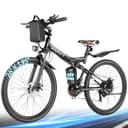
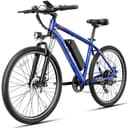
Which adult are you? Start here
The four questions below sort this field faster than any spec sheet, and they are in the order that actually decides the money.
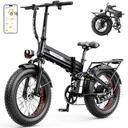
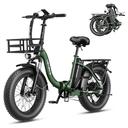
1. Where does the bike sleep? This is first because it is the one answer you cannot change later. If the bike has to come up a stairwell, go in a hallway or ride in a car trunk, you need a fold - the Mars 3.0, the Ranger 2.0 or the Vivi. If you have a garage, a shed or a ground-floor bike room, skip the fold entirely: folding hinges add weight and one more thing to maintain, and a non-folding frame at the same price is a better bike. The full argument is in how to store an e-bike.
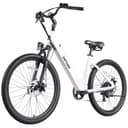
2. Does your route have a real hill? Not a rise - a hill, the kind you currently avoid. Every bike here is listed with a peak wattage figure, and peak is a marketing number rather than sustained output, so treat the ranking as relative and not absolute. On that relative scale the Ranger 2.0 is listed highest at 1400W peak, the Jasion EB5 at 1000W peak, the Vivi at 749W peak. What those numbers do and do not mean is in how many watts you need for commuting, and the hill-specific picks are in best e-bikes for hills.
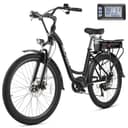
3. Can you get your leg over the frame in what you wear to work? A high top tube is a daily small annoyance in a suit, a skirt or a bad knee, and it is the most common reason a bike quietly stops getting ridden. The Gotrax Dolphin is the step-through here, and the Heybike Ranger 2.0 publishes a step-thru frame as well, which is a large part of why it earns its place.
4. What is the number you will not go over? Answer this before you look at the bikes, not after. The honest spread on this page runs from the Jasion EB5 at the bottom to the Mars 3.0 at the top, and the cheapest bike that is still a real commuter - gears, a removable battery, a motor that moves an adult up a rise - is the EB5. That is why it is named the budget pick rather than the worst bike. The price-first view of the same field is in best e-bikes for the money and best e-bikes under $1,000.
The three numbers worth reading, and the one to ignore
Watt-hours, not watts.Range comes from the battery’s energy, which is its watt-hour figure - the Mars 3.0 lists 624 Wh, the Ranger 2.0 600 Wh, the ANCHEER 499 Wh. A quoted mile range is a best case at low assist on flat ground with a light rider, and real commuting with hills, cold and a loaded rack can land well under half of it. Watt-hours at least let you compare two bikes honestly. The full breakdown is in e-bike battery and range.
Removable or not. Every bike here has a removable battery, and that is deliberate - it is the feature that decides whether an apartment commuter can own an e-bike at all, because the pack charges indoors while the bike lives in a hallway or a shed. It also means you can take the expensive part with you when you lock up outside. See best e-bikes with a removable battery.
Class, because it decides where you can legally ride. A Class 1 or 2 bike is allowed on far more paths than a Class 3, and some of these bikes ship capable of speeds that put them at the top of that scale. What the classes mean and where each is allowed is in e-bike classes explained.
And the number to ignore: peak watts. Peak is the brief burst a controller will allow, not what the motor sustains up a long climb. Two bikes with the same peak figure can climb very differently. We quote it because the listings do, and we rank on the whole package instead.
What you should budget for on top
None of these bikes arrives commute-ready, and the gap is bigger on an e-bike than on a pedal bike because the bike itself is heavier, faster and far more worth stealing.
A lock that matches the bike’s value, which is not a cable. An e-bike is the most stolen kind of bike on a street, and a $20 lock on a $900 bike is not a security decision. Our e-bike-specific picks are in best e-bike locks, and the battery needs its own thought - how to secure an e-bike battery.
Lights, because you will ride home in the dark. Factory e-bike lights are usually a marker rather than a beam, and at 20 mph a marker is not enough to see a pothole by. Start at best bike lights for e-bikes.
Carrying capacity, since the motor makes weight free. The one genuine superpower of an e-bike commute is that a full pannier costs you almost nothing in effort. A rack and a bag turn the bike into a car substitute rather than a toy - best panniers for e-bikes has the field.
Charging habits matter too, and they are the one maintenance item on an e-bike that is genuinely a safety item rather than a convenience one - e-bike charging safety.